

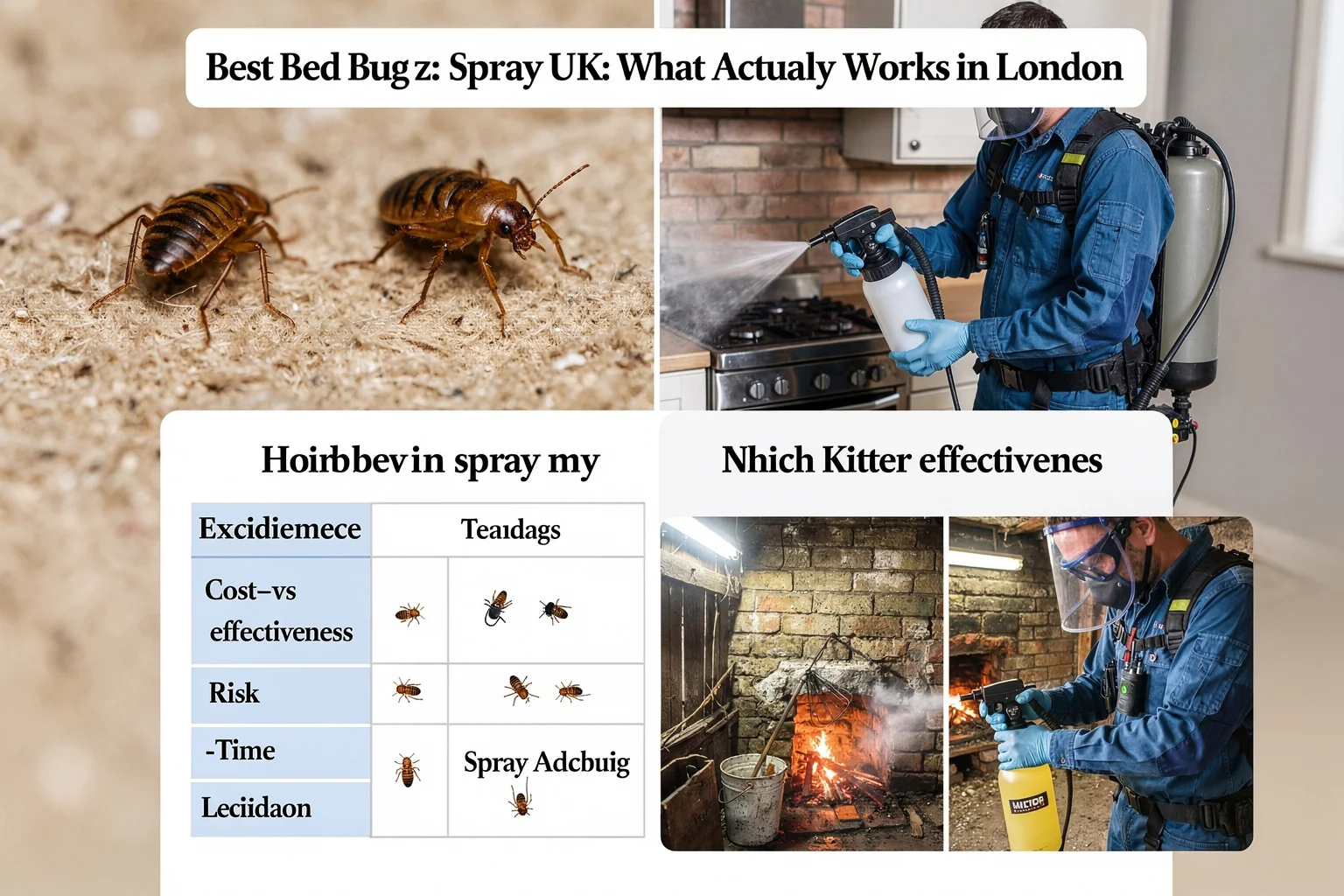
Best Bed Bug Spray UK: What Actually Works in London Flats
The search for a bed bug spray that actually works in London flats often starts at 2am, after another night of interrupted sleep and fresh bites. You want something you can buy tomorrow morning, apply yourself, and trust to solve the problem. The reality is more complicated. London's dense housing, period properties with original floorboards and plasterwork, and rising insecticide resistance have changed what "works" means.
This comparison looks at the sprays and kits actually available to UK buyers, what the active ingredients do, where they fall short in typical London conditions, and when calling a technician is the faster and cheaper route.
Why London Flats Defeat Most Sprays
Bed bugs in Victorian and Edwardian conversions face a different challenge than those in modern builds. Original skirting boards with gaps, loose plaster behind picture rails, floorboard cracks, and shared party walls create harbourage that aerosols simply cannot reach. A spray that kills on contact only handles the insects you see. The ones behind the bed frame, inside the divan base, or in the wall void behind the headboard remain untouched.
The British Pest Control Association's code of practice notes that a thorough survey of all resting areas is essential before any treatment, and that a combination of methods is usually needed for reliable control. In practice, this means most flat infestations need more than a single product from a hardware shop.
Insecticide resistance adds another layer. A 2026 report in Metro documented "mutant" bed bug populations across the UK with documented resistance to common pyrethroids. Dr Matthew Davies, advisor to the Greater London Pest Liaison Group, confirmed infestations have continued rising into 2026. When resistant populations are present, a spray that should kill within minutes may only stun or repel, driving bugs deeper into hiding.
What the Active Ingredients Actually Do
Understanding labels helps you spot marketing claims versus genuine capability. Most UK bed bug sprays fall into three chemical families:
Pyrethroids (permethrin, cypermethrin, deltamethrin) provide residual protection on treated surfaces. They kill insects that cross the barrier hours or days later. However, resistance is now widespread. A 2026 analysis from pest.co.uk noted that field resistance to pyrethroids means sprays "struggle to penetrate bed frames, skirting boards, divan bases, fabric folds and screw voids." Where resistance exists, these chemicals may knock down susceptible bugs while leaving the population largely intact.
Neonicotinoids (imidacloprid) work on the nervous system through a different pathway, making them useful where pyrethroid resistance is suspected. They tend to be slower-acting but can provide longer residual control when combined with other actives.
Insect Growth Regulators (pyriproxyfen, methoprene) do not kill adults directly. They disrupt development of eggs and nymphs, breaking the reproductive cycle. Used alone, they leave existing adults alive. In combination products, they prevent the next generation from maturing while other actives handle the current population.
Natural pyrethrum delivers fast knockdown but minimal residual effect. It is useful for flushing insects from hiding during inspection, not as a standalone treatment.
The most effective amateur products now combine multiple actives. A triple-action formula pairing a pyrethroid with an IGR and natural pyrethrum addresses adults, nymphs, and eggs through different mechanisms.
The Sprays and Kits Worth Considering
Pest Expert Formula C+ Advanced Bed Bug Killer Spray
The Pest Expert Formula C+ has become the reference point in UK amateur treatments. Its triple-action formula combines cypermethrin, pyriproxyfen IGR, and natural pyrethrum. The 5-litre container treats approximately 250 square metres with residual protection claimed up to 12 weeks.
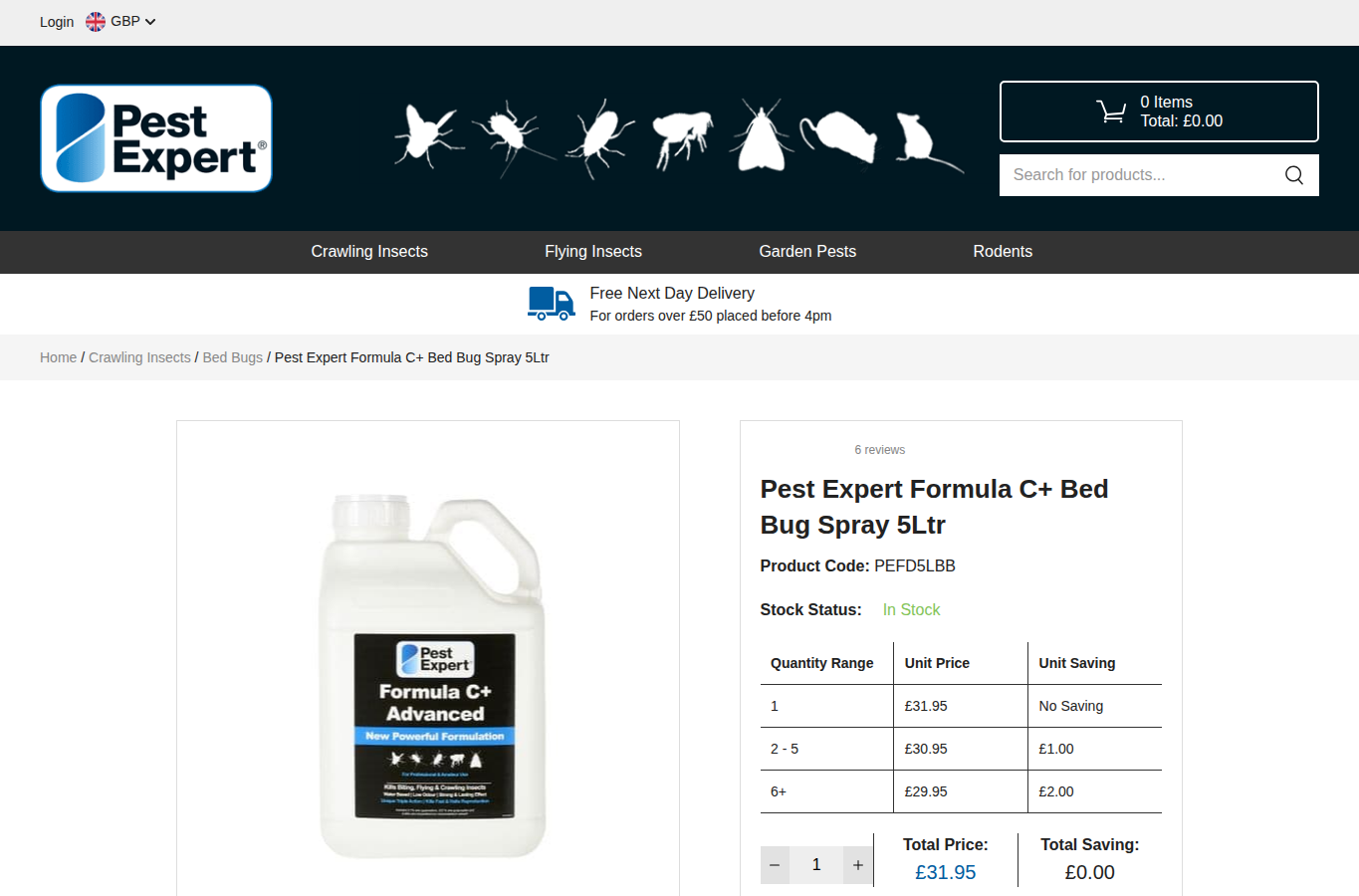
What distinguishes this product is the inclusion of pyriproxyfen. Without an IGR, any eggs that survive initial treatment hatch into a fresh population two to three weeks later. The combination approach matches what professionals use, though at lower concentration.
The manufacturer recommends pairing the spray with their Formula P powder and fogger products for complete coverage. This matters in London flats where voids and cracks exceed what surface spraying can reach. The 5-litre size suits whole-flat treatment; smaller infestations in single rooms may find the volume excessive.
NOPE! CP Bed Bug Killer
Available through Wickes, the NOPE! CP Bed Bug Killer comes as a 5-litre container with pump-action pressure sprayer. It is formulated for direct application to carpets, floors, soft furnishings, and bed frames, with explicit warning not to use on human bedding. Linens require washing at minimum 60°C instead.
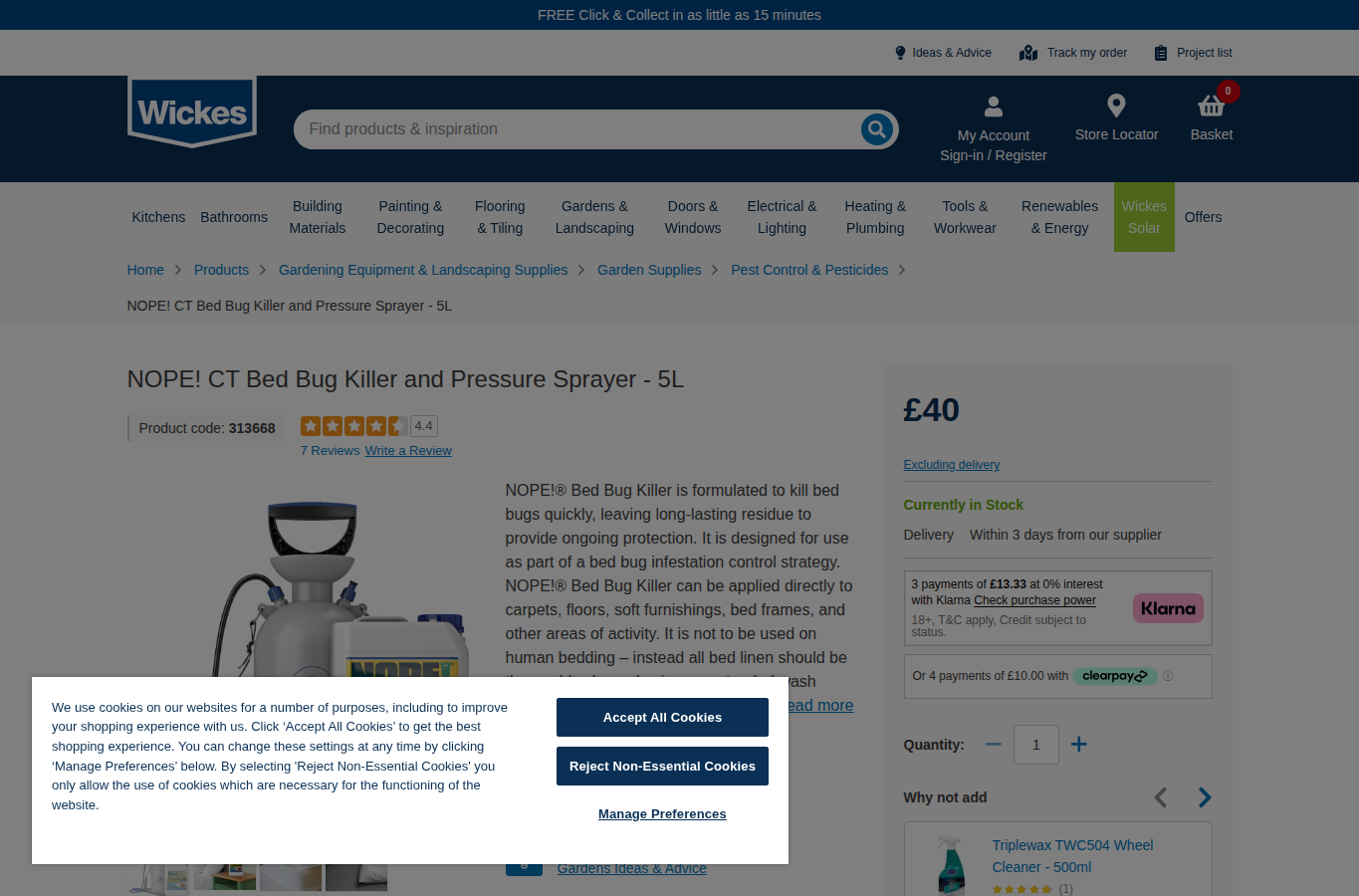
The included sprayer with 1.5m flexible hose addresses a genuine practical problem: reaching behind heavy furniture and into awkward gaps without moving everything. For flats with built-in wardrobes or beds against walls, this matters more than the chemical formulation.
The product claims fast contact kill and long-lasting residue, though specific active ingredients are less prominently detailed than in professional-grade alternatives. It sits at a mid-market price point around £40 for 5 litres, making it accessible for renters or landlords managing multiple properties.
Cimetrol Super RFU Insect Spray
Cimetrol Super RFU takes a similar triple-action approach in a smaller 300ml format. It combines cypermethrin, natural pyrethrum, and an IGR in a continuous-spray bottle designed for upside-down application. This is specifically useful for mattress seams, tufts, and underside treatment where conventional trigger sprays become awkward.
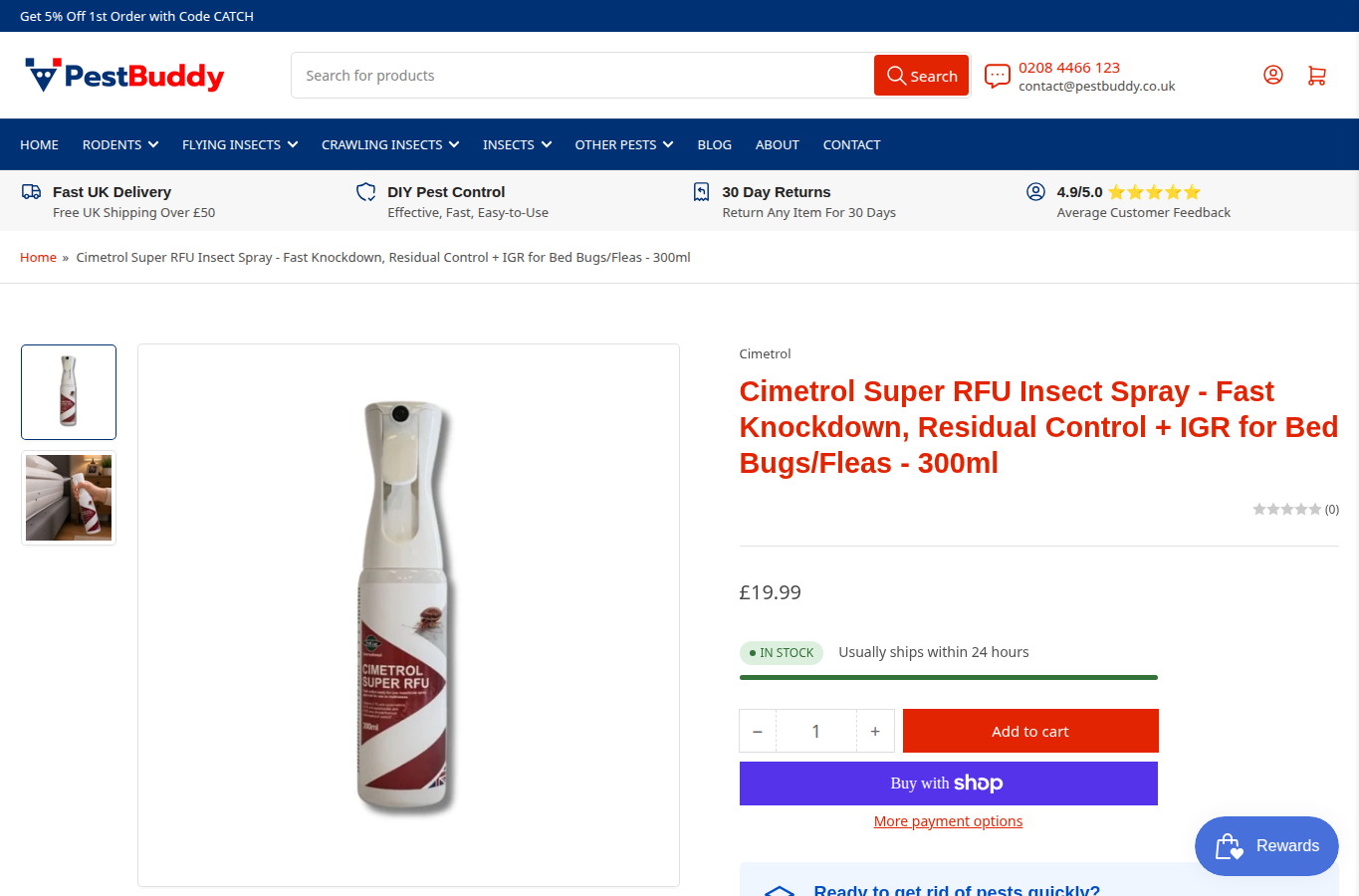
The smaller size suits targeted treatment of a single bed or sofa rather than whole-room application. For early-stage infestations caught before spreading, this may be sufficient. The manufacturer explicitly recommends combining with other products for complete control, acknowledging the limitation of any single spray.
Rentokil Insectrol
The Rentokil Insectrol aerosol contains permethrin and D-allethrin, established actives with proven knockdown against susceptible populations. It is specifically recommended for cracks, crevices, and areas where activity has been observed, with good residual activity in protected locations.
At 250ml, this is a spot-treatment product rather than a whole-room solution. The aerosol format allows precise application into voids and gaps, but coverage is limited. For flats with established infestations, multiple cans would be needed, and the pyrethroid base may face resistance issues in London populations.
The product instructions emphasise laundering bed linen rather than spraying it, and excluding animals during application. Ventilation requirements are standard but important in small London bedrooms with limited window opening.
Bedlam Plus
Reviewed as one of the stronger DIY options, Bedlam Plus combines imidacloprid with a pyrethroid for dual-action control. Contact kill occurs within 15–30 minutes when sprayed directly, with residual protection up to two weeks. This shorter residual window means reapplication is necessary, typically 2–3 times over several weeks.
The product's strength is its speed of kill and the different resistance profile of imidacloprid versus pyrethroids alone. The limitation is the treatment schedule: missing a reapplication window allows surviving eggs to hatch and re-establish. For busy Londoners or those treating a rental between tenancies, this compliance burden is significant.
Where DIY Sprays Fail in Practice
The gap between laboratory claims and flat-floor results comes down to three factors: coverage, compliance, and resistance.
Coverage is the hardest to achieve. A 2026 case study from BASF on professional use of Fendona 6SC noted that full eradication typically required two chemical applications, with some sites needing a third depending on population size and insect movement. This is with professional equipment, training, and access to wall voids. Amateur spray application rarely matches this thoroughness.
Compliance fails because bed bug treatment demands precise timing. Washing all linens at 60°C, drying on high heat, dismantling bed frames, treating every seam and screw hole, then repeating after 10–14 days—this schedule conflicts with work and family life. The Sutton case reported by Your Local Guardian in September 2026 described a family who received ten pest control treatments without resolution, with the mother noting "it just comes back, but bigger and worse than ever." Even professional intervention can fail without proper method; amateur efforts face worse odds.
Resistance means the wrong spray actively harms your position. Surviving bugs retreat deeper, spread to adjacent rooms through shared walls, and develop stronger populations. A 2026 HeatKillUK analysis observed that DIY insecticide "can often make the problem worse" by dispersing rather than eliminating populations.
When Heat Treatment Becomes the Smarter Option
Professional heat treatment has moved from alternative to preferred method for many London infestations. JG Pest Control reported in 2026 that heat treatments now account for 46% of their bed bug work, up from 41% the previous year, with heat treatment demand rising 36% year-on-year. The reason is straightforward: heat at 56–60°C penetrates all harbourage simultaneously, killing adults, nymphs, and eggs without chemical residue or resistance concerns.
For London flats specifically, heat addresses the structural problems that sprays cannot. It reaches behind original plaster, through floorboard gaps, into divan bases, and across party walls where insects may have travelled from neighbouring properties. No spray achieves this penetration.
The cost comparison is less clear-cut than it appears. Professional chemical treatment for a single room typically runs £200–400, often requiring multiple visits. Heat treatment for equivalent space runs higher per session but usually requires only one treatment. For time-pressed professionals, landlords between tenancies, or families with young children, the single-visit resolution has value beyond the headline price.
BPCA members increasingly offer heat as frontline treatment for stubborn infestations, and local councils including Westminster have advised residents that professional help is usually necessary for reliable resolution.
Making the Decision for Your Situation
The right approach depends on infestation stage, property type, and your capacity for thorough follow-through.
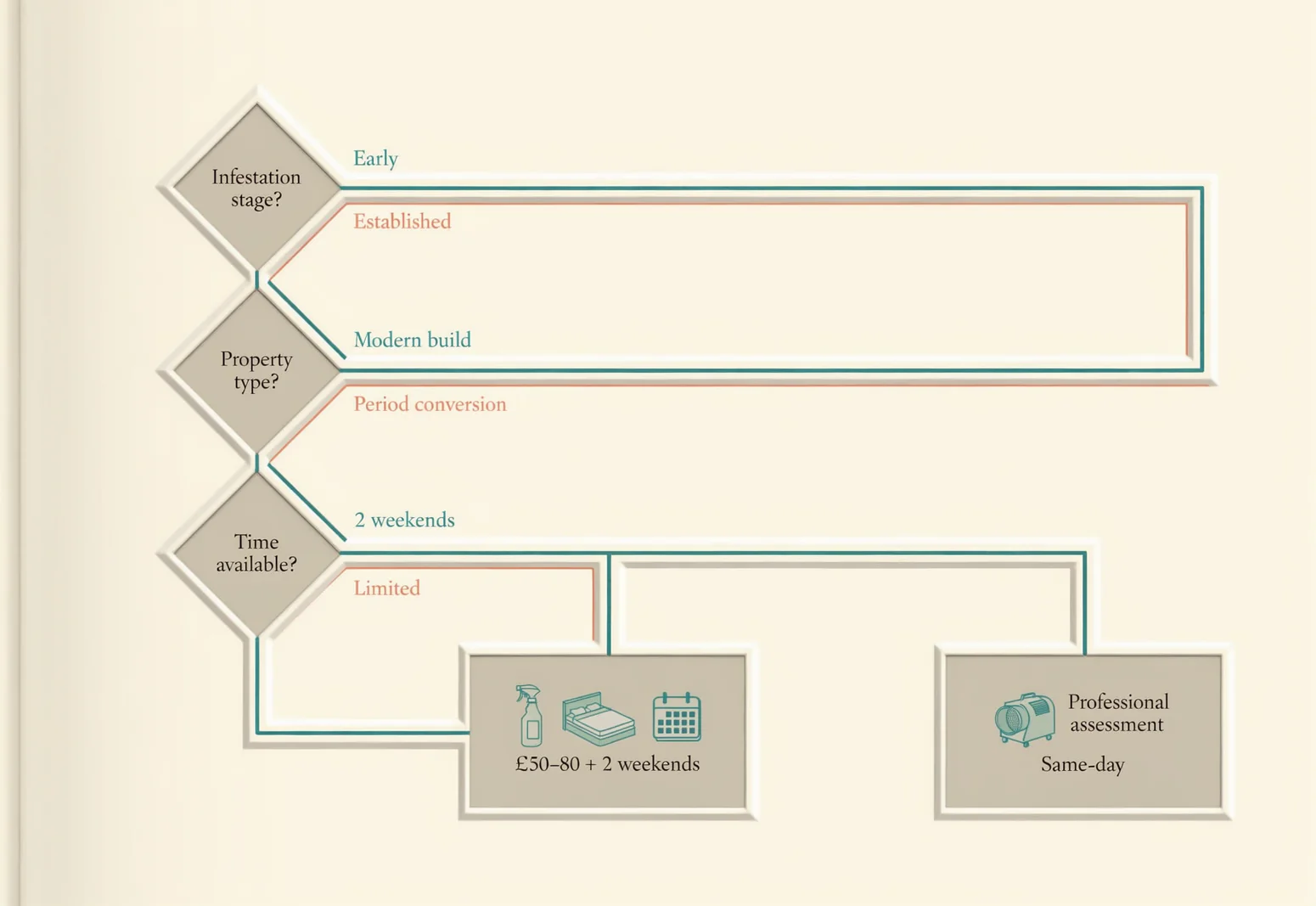
Early stage, single bed, no adjacent flats: A triple-action spray kit with IGR, combined with mattress encasement and rigorous laundry protocol, may resolve the issue. Budget £50–80 for product, £30–50 for encasement, and two full weekends for application and reapplication.
Established infestation, multiple rooms, period property: Professional assessment is warranted. The cost of multiple failed DIY attempts typically exceeds single professional treatment, and the delay allows population expansion. Professional bed bug treatment provides same-day assessment in most central London areas.
High-density building, shared walls, rental property: Even successful unit treatment may face reinfestation from adjacent properties. Coordinated building-wide approach through landlord or managing agent is usually necessary. Individual unit spraying in isolation rarely holds.
Children, elderly, or respiratory sensitivities present: Heat treatment avoids chemical residue concerns entirely. Where chemical treatment is used, BPCA guidelines require clear information to customers about products applied and re-entry timing.
For specific London neighbourhoods, local technicians understand the building stock and typical infestation pathways. Kensington bed bug control addresses period mansion blocks with original features. Westminster bed bug exterminators handle high-turnover rental stock near transport hubs. Camden bed bug specialists manage Victorian conversions with complex floor plans.
What to Ask Before Buying Any Spray
Regardless of product choice, verify three things:
- HSE approval number on the label, confirming legal sale and use in the UK
- Active ingredients listed by concentration, not just marketing descriptions
- Specific claims versus general claims: "Kills bed bugs on contact" differs from "Kills bed bugs and eggs with residual protection"
Be wary of products relying on essential oils or "natural" formulations without proven residual action. These may repel temporarily or kill on direct contact while leaving the breeding population intact.
Questions Londoners Actually Ask
Can I treat bed bugs myself or do I need a professional?
For a very early, localised problem in a single room with no complicating factors, thorough DIY treatment can work. For infestations beyond this stage, or in period properties with complex harbourage, professional intervention is usually faster and more reliable. The key variable is whether you can achieve complete coverage and maintain the treatment schedule.
Why do bed bugs keep coming back after spraying?
Surviving eggs hatch after 7–14 days. Without an IGR in your spray, or without precise reapplication timing, new adults emerge and restart the cycle. Resistance to common actives means some populations survive initial contact. In multi-unit buildings, reinfestation from untreated neighbouring properties is common.
Is heat treatment better than chemical spray?
Heat treatment kills all life stages in one session without resistance issues or chemical residue. It requires professional equipment and preparation but usually needs only one visit. Chemical treatment is lower cost per session but often requires multiple applications and struggles with deep harbourage. For established infestations in London period properties, heat has become the preferred professional method.
How much does professional bed bug treatment cost in London?
Chemical treatment typically ranges £200–400 per room, often requiring 2–3 visits. Heat treatment runs higher per session but usually single-visit. Exact costs depend on property size, infestation extent, and access requirements. Marylebone bed bug treatment and other central London services can provide specific quotes after survey.
Are bed bug sprays safe around children and pets?
All approved sprays carry specific re-entry times and ventilation requirements. Products should not be applied to bedding or surfaces with direct skin contact until fully dry. IGR-containing products require particular attention to label instructions. Heat treatment avoids these concerns entirely. Paddington bed bug solutions and similar local services can advise on child-safe approaches for your specific situation.