
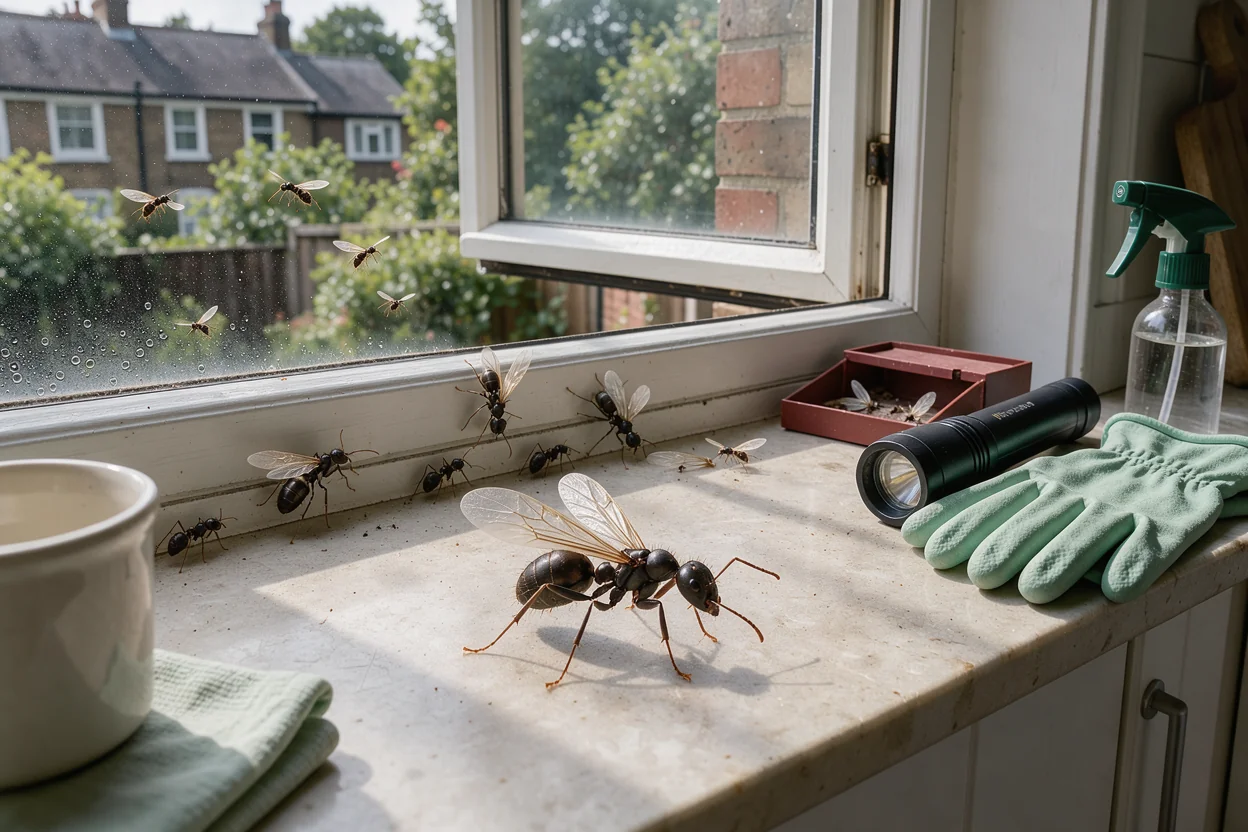
Flying Ant Day in the UK happens when ant colonies release winged males and future queens during suitable weather. Summer warmth, light winds and colonies reaching the breeding stage help explain why gardens and pavements can suddenly fill with insects. For property owners, the useful distinction is where those ants originate: an outdoor swarm and repeated emergence through an indoor floor gap need different responses.
There is no fixed national date. This October 2026 seasonal update explains the summer phenomenon; it does not report a confirmed current UK-wide peak.
The dramatic appearance can make an established colony seem like a sudden arrival. Often, the nest was already nearby. Its winged breeding generation has simply become visible.
Why several colonies take flight together
Flying-ant swarms appear coordinated because neighbouring colonies experience similar weather and may be ready to breed at similar times. A warm, sheltered street can therefore have several active nest entrances during the same spell.
The flight is part of reproduction. Winged males and young queens leave established colonies to mate, a process called a nuptial flight. Ordinary worker ants continue their activity around the nest.
This helps explain the apparent speed of an outbreak. The insects have developed within their colonies before they gather at entrances and depart. A pavement that looked quiet earlier can become busy without a new colony having arrived that day.
Nearby nests also create a confusing picture. Ants emerging beside a front step may belong to one colony, while those lifting from a lawn or neighbouring garden come from another. Similar timing does not prove that every visible insect belongs to a single nest.
For a household watching from a window, the most useful observation is the departure point. Look for ants repeatedly coming out of one opening, rather than counting insects in the air.
A photograph of that opening, taken without disturbing it, can preserve more useful evidence than a close-up of a lone ant on a windowsill. Include enough surrounding wall, paving or flooring to make the location recognisable.
Warmth, humidity and pressure do different jobs
Weather helps explain flying-ant activity, but a single forecast reading cannot reliably predict what will happen at a particular property. Colony readiness and the conditions immediately around the nest also matter.
Warm, calm conditions create a flying opportunity
Ants depend on surrounding temperatures for their activity. Warm conditions can support flight, while strong winds make take-off and movement more difficult.
A sheltered courtyard may therefore have different conditions from an exposed pavement nearby. Sunlit paving, shaded soil and the base of a wall can also warm at different rates.
These small differences help explain why one garden becomes busy while another remains quiet. A regional forecast describes a wider area; ants experience conditions at their nest entrance.
There is no useful household rule that every nest will release its winged ants at one exact temperature. Watch what is happening at the opening itself.
Muggy weather is a clue with limits
Humidity affects how quickly insects lose moisture. Moist air can favour activity, but a humid afternoon alone does not establish that a flight is imminent.
Rain adds another complication. Conditions before, during and after a shower differ, so “it happens after rain” is too simple as a prediction. Warmth, wind and the colony’s stage of development still matter.
Atmospheric pressure also appears in explanations of summer swarms. A falling barometer should not be treated as a reliable warning for an individual nest.
The practical interpretation is modest: warm, relatively still weather can make flight more likely. A forecast cannot confirm whether a colony beneath a particular patio is ready to release winged ants.
What the wings reveal about the ants
The wings identify a breeding stage, rather than a separate household pest called a flying ant. Black garden ants are a familiar example behind summer sightings in British gardens and streets.
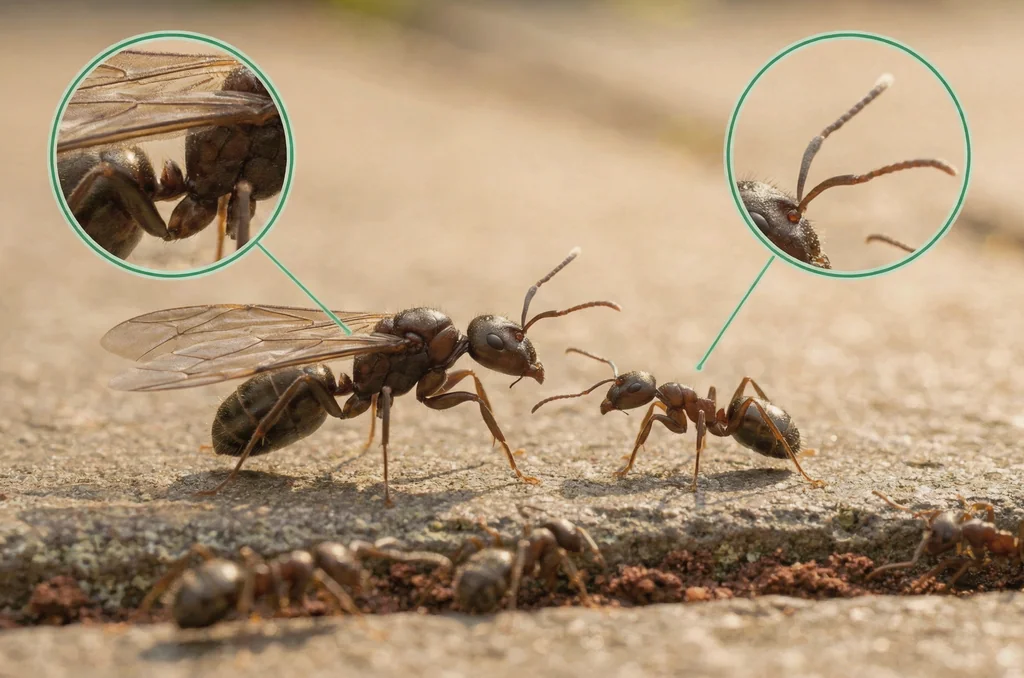
Workers do not suddenly grow wings when the weather changes. Colonies produce winged reproductive ants as part of their life cycle.
At a busy entrance, you may see smaller wingless workers alongside larger winged individuals. Size varies, so size alone is a poor identification test.
For a clearer photograph, look for:
- A distinct narrow waist between the middle and rear body sections.
- Bent antennae, when the image is sharp enough to show them.
- Two pairs of wings, although overlapping wings can be difficult to separate visually.
- Wingless ants using the same opening or nearby route.
A blurred image of wings against glass may leave these details hidden. Photograph an insect at rest if possible.
After mating, a queen may shed her wings and search for somewhere to establish a nest. A large wingless ant walking alone can therefore be part of the same seasonal event.
Loose wings on a sill provide a clue, but they cannot establish where a colony is located. Ants may have entered through an open window before shedding their wings.
Keep the insect’s appearance and its movement route together in your notes. Either detail on its own can lead to the wrong explanation.
Why one swarm can be followed by another
Flying Ant Day describes a seasonal pattern that can include several flights. Different colonies and species do not all operate to one national timetable.
A local burst may subside while activity continues elsewhere. Another suitable spell can bring fresh departures from other nests, so a second sighting does not automatically mean the first swarm has returned.
There are several useful clocks to distinguish. One is the period when insects are actively leaving a particular entrance. Another is the time during which winged ants remain visible around the property. A third is the wider summer period during which different colonies may fly.
Those periods overlap, but they answer different questions. Ants disappearing from a window does not establish that a nearby colony has gone.
Likewise, finding more insects later does not prove that an indoor treatment has failed. First establish whether the later insects are arriving from outdoors or emerging from the same internal opening.
Season also matters for identification. An autumn gathering at an upstairs window deserves a fresh look at the insects themselves. Cluster flies indoors are another possible explanation for a sudden concentration around windows.
Record each sighting separately, with its date, room and apparent direction of travel. That makes repeated emergence easier to distinguish from several unrelated arrivals.
The important evidence is where they emerge
Flying ants inside a building need closer observation because an open window and a concealed emergence point can produce similar scenes. Both may leave insects gathered against glass.
Ants arriving through windows and doors
During an outdoor flight, insects can enter through open windows, patio doors or other accessible gaps. A concentration beside an open window is consistent with accidental entry.
Check the surrounding area before deciding where they came from. Are there insects outside on the frame? Is a swarm visible in the garden? Do fresh arrivals stop when that opening is closed?
These observations help establish a route, although none provides complete proof on its own.
Clear the insects you can reach, then check whether more appear. A clean sill makes fresh activity easier to recognise.
Ants emerging through floors or internal gaps
Repeated movement out of a skirting gap, floor joint or opening beside pipework deserves a different investigation. The visible opening may connect to a concealed space or to an outdoor nest.
In a period property, several layers of flooring and inaccessible voids can make the route difficult to trace. The exit into a room is not necessarily the location of the nest.
Avoid covering the opening before recording what is happening. Note whether wingless workers also use it and whether activity continues after the outdoor flight has dispersed.
Persistent indoor activity may justify an assessment for recurring ant problems. Useful evidence includes photographs, the exact emergence point and a record of repeat sightings.
For flats, add the floor level and whether neighbouring rooms or communal areas have similar activity. Those details help define the area that needs inspection.
Practical steps for homes, flats and food premises
The immediate response to a flying-ant sighting should follow the evidence at the property. A brief outdoor flight rarely needs the same approach as repeated emergence beside a kitchen worktop.
At home, reduce entry and preserve the evidence
If ants are flying outside, temporarily close the opening through which they are entering. Use existing insect screens where available, while maintaining appropriate ventilation elsewhere.
Indoors, remove accessible insects with a vacuum or a damp cloth. Empty collected debris appropriately and clean the affected surface.
Put exposed food away, wipe up spills and check food containers. These are useful housekeeping steps, although food scraps do not explain the breeding flight itself.
Keep a short record:
- Where the first insects appeared.
- Whether they arrived through an opening or emerged from a gap.
- Whether wingless workers were present.
- Whether fresh insects appeared after clearing.
- Whether the same route became active again.
A garden swarm alone gives little reason to spray every nearby surface. Establish whether there is an ongoing indoor problem before choosing a treatment.
In flats, identify the ants before treating
Small ants that remain active inside a heated building need accurate identification. A summer swarm outside does not establish that every indoor ant belongs to the same species.
This matters in shared buildings, where an apparent problem in one room may extend beyond a single flat. Pharaoh ants in flats require a different assessment from a black garden ant flight.
Tenants should send the landlord or managing agent a clear location record. Include photographs of the insects and their route, rather than reporting only that there are “flying bugs”.
In food premises, check exposed areas promptly
For a café, restaurant or food shop, inspect the route between an open door and food preparation areas. Protect uncovered ingredients and clean affected food-contact surfaces.
Record whether insects crossed the threshold or appeared from within the premises. Check again after the outside activity has subsided.
Repeated emergence near storage or preparation areas needs investigation. Preserve photographs and location notes before cleaning removes the visible evidence.
Questions after the flying ants disperse
Once a swarm has passed, the remaining questions usually concern duration, cleanliness and whether an indoor colony is present. The answers depend on what happens at the property afterwards.
Does a swarm mean the home is dirty?
A breeding flight can happen beside a well-maintained home. The event follows the colony’s life cycle and suitable conditions.
Food residues can encourage worker ants to forage indoors, so cleaning still matters. Keep the explanation for the flight separate from any continuing trail towards food.
Will closing the window solve it?
Closing a window can stop insects entering through that opening. It will not explain ants that continue to emerge elsewhere in the room.
After clearing the sill, watch for fresh insects. Check the frame, nearby skirting and floor edge before assuming every new arrival came from outside.
Do shed wings prove there is an indoor nest?
Shed wings show that winged insects have been present. Their location alone cannot prove where the ants developed.
An insect may enter a room and shed its wings there. Repeated emergence from a specific gap provides stronger evidence about a route than loose wings scattered beneath a window.
What should I watch for next?
Watch for wingless workers using the same internal opening, fresh winged ants appearing after clearing, or activity spreading to another room.
A local weather forecast can provide context for another outdoor flight, but it cannot confirm the position of a nest.
For now, mark the emergence point on a photograph and record whether fresh ants return after the surrounding swarm has dispersed.