

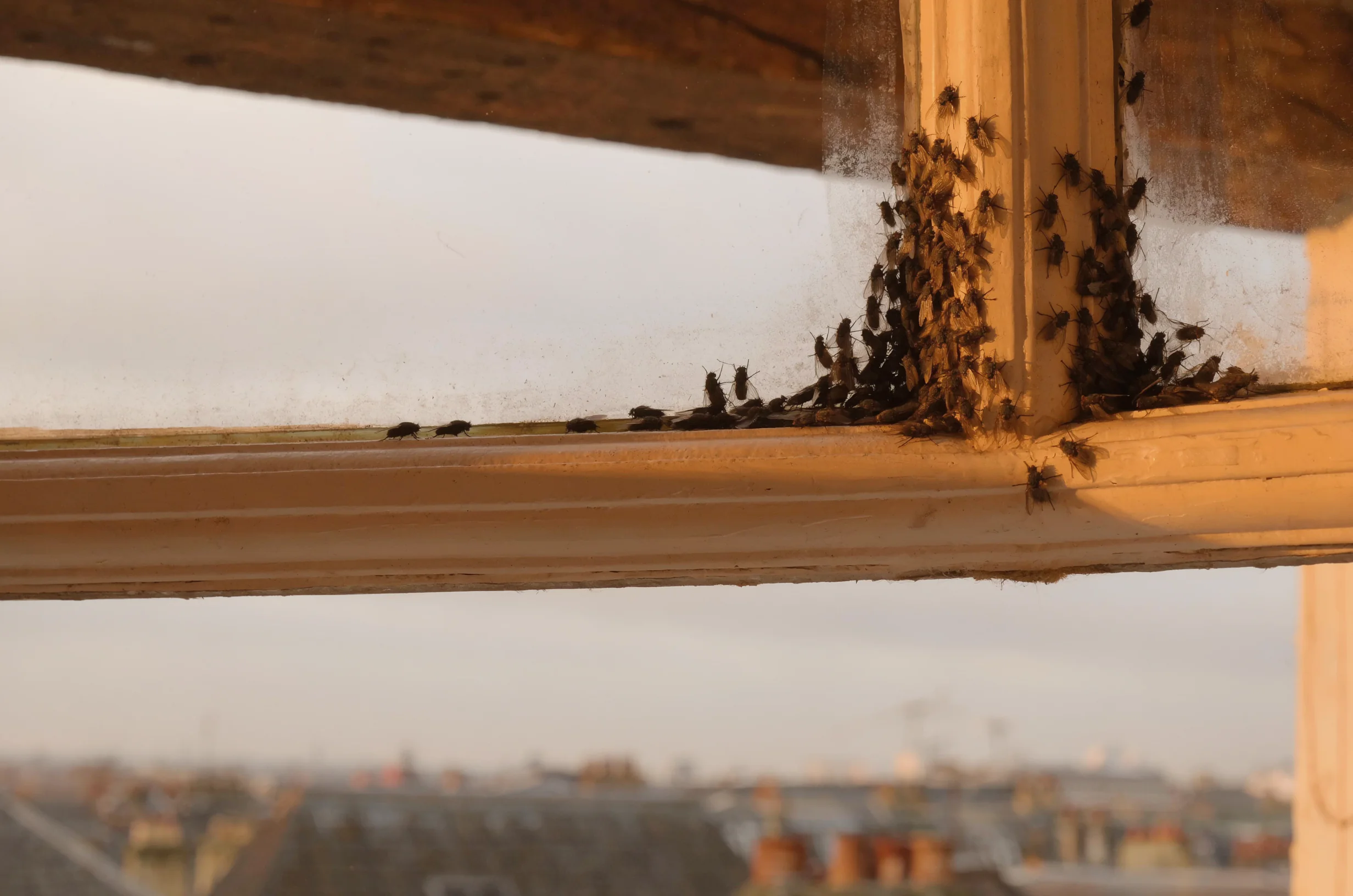
If you have cluster flies in house all of a sudden, the timing is almost never random. These insects are not breeding in your kitchen, feeding on your bins, or following a spill behind the sofa. They are looking for somewhere to sleep through winter, and your loft, wall cavity, or sash window frame looks like a good candidate. That single fact changes how you should respond.
This field guide sets out what the evidence shows about sudden cluster fly swarms in UK homes, why London's period housing stock is unusually vulnerable, how to inspect a property in the right order, and the point at which a technician should take over. It is written for homeowners, landlords, and business managers who need a clear decision rather than a scare story.
What the Evidence Says About Sudden Cluster Fly Swarms
Cluster flies are not a hygiene problem. They do not breed indoors, they do not lay eggs in food, and they carry no meaningful disease risk to occupants. The confusion arises because most people assume any indoor fly must be feeding on something. Cluster flies are not.
The behaviour is seasonal and predictable. As daylight hours shorten and temperatures fall, the flies seek out warm, dry, sheltered spaces to overwinter. Writing for Good Housekeeping, entomologist Luke Tilley explains that in autumn they "seek out warm, dry spaces to hibernate, often squeezing into lofts, wall cavities and around window frames," a behaviour triggered by falling temperatures and shorter daylight hours. British Pest Control Association professional development officer John Horsley makes the same point: during the cooler months the flies hibernate in a space protected from predators that offers a stable environment, gathering in a large group.
That clustering instinct is where the name comes from, and it explains the suddenness. You do not see one fly on Monday and two on Tuesday. A single wall void can hold hundreds or thousands, and they all become visible on the same warm afternoon.
The trigger for that visibility is temperature, not a new arrival. On a mild day in October, November, or even midwinter, central heating or a sunny south-facing wall warms the void enough to wake the resting adults. They move toward light, which means windows. A Hinckley & Bosworth Borough Council pest note describes the pattern precisely: cluster flies usually appear after the first frost on warm days when they emerge from lofts or similar spaces, gathering by windows in an attempt to get outside.
Three things follow from this, and they should shape everything you do next.
- The flies were probably already in the building before you noticed them, often for weeks.
- The swarm is a symptom of an entry route and a harbourage, not an infestation that started indoors.
- Killing the visible flies does not remove the population behind the plasterboard.
Why London's Period Housing Stock Attracts Them
Cluster flies are a nuisance almost everywhere in the UK, but the density of Victorian and Edwardian housing in central London makes certain boroughs repeat offenders. The reasons are structural rather than geographical.
Older buildings offer more of exactly what the flies need: uninterrupted voids, timber frames that have moved over a century of settlement, and rooflines that were never designed to be airtight. Merlin Environmental notes a pattern they see regularly, in which cluster flies become a persistent problem in older buildings, particularly those with ageing wooden window frames and deteriorating seals. The flies exploit even tiny gaps in the building fabric, entering wall voids and loft spaces where they overwinter in large numbers.
The critical detail for anyone living in one of these properties is the return rate. Merlin Environmental's field observation is blunt: once they have picked your property, they are likely to come back, and cluster flies return to the same building year after year. This is not a one-off event to be endured each autumn. It is a recurring pattern with a fixed cause.
A few property features raise the risk further.
- South-facing brickwork and render, which absorb midday and afternoon sun and warm the voids behind them.
- Loft conversions that leave original eaves voids sealed but not filled.
- Sash windows with perished draught seals or missing beading.
- Shared party walls in terraces and mansion blocks, where a void in one property connects to the next.
- Flat roofs with poorly detailed parapets, common on period commercial premises.
For a landlord or a restaurant manager, the practical consequence is that a single autumn swarm is a signal to inspect the whole building envelope, not just the room where the flies appeared. A ground-floor dining room with flies at the window may be showing you a problem that originates two floors up in a roof void.
Identifying a Cluster Fly Before You Act
Before you spend money or time, confirm what you are dealing with. Cluster flies look similar to house flies at a glance, but the differences matter because the treatment route is different.
| Feature | Cluster fly | House fly | Fruit fly |
|---|---|---|---|
| Size | Larger and broader, roughly 8–10mm | Around 6–7mm | Small, 2–3mm |
| Movement | Slow, sluggish, especially when cool | Fast, alert | Quick, hovering |
| Body appearance | Dull, dark, with golden hairs on the thorax | Grey with four dark stripes | Tan with red eyes |
| Where you find them | Window frames, loft hatches, wall vents, ceilings | Kitchens, bins, food prep areas | Fruit bowls, drains, drinks |
| Response to disturbance | Clumsy, short flights, often lands again nearby | Flies away readily | Scatters quickly |
The sluggishness is the most reliable field sign. A cluster fly that has just emerged from a cold void moves slowly enough to be caught by hand, and it tends to return to the same patch of window glass rather than escaping. If the insects you are seeing are fast, striped, and congregating around food waste, you have a different problem and a different set of causes.
There is also a lookalike worth knowing about. The yellow swarming fly, described by the National Pest Technicians Association, is small and harmless in appearance but can appear in hundreds or thousands, clustering on buildings or forcing their way indoors. In the UK it causes regular seasonal nuisance complaints, particularly to offices, schools, flats and commercial premises, and it is classed alongside the more familiar cluster fly species. The NPTA notes that it exploits gaps around windows, doors, cladding, soffits and service penetrations, then gathers in roof voids, wall cavities or upper rooms.
For a commercial premises, that distinction matters. A school or office block with a sudden fly problem in an upper-floor corridor is often dealing with a swarming species that entered through a service penetration rather than a domestic-style window gap.
Tracing the Entry Route Through a Period Property
Inspection is the part most people skip, and it is the part that determines whether the problem returns next year. Work from the outside in, and from the top down.
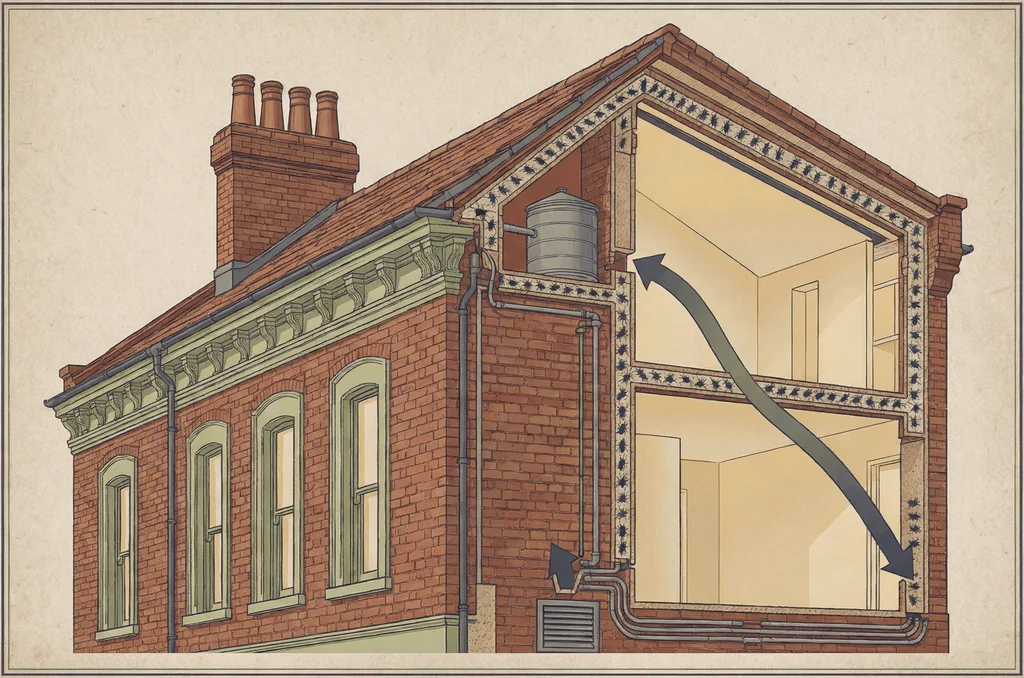
- Walk the exterior elevation in the afternoon. Note which walls are warm to the touch. South and west elevations that hold heat are the ones most likely to be drawing flies.
- Check window frames at first-floor level and above. Look for gaps between frame and masonry, perished seals, missing beading, and any frame that has been painted shut and then freed.
- Inspect the roofline. Broken or slipped tiles, gaps at the eaves, and poorly sealed loft hatch surrounds are common entry points.
- Look at service penetrations. Pipework, cabling, satellite and aerial entries, and ventilation outlets all create openings that are rarely sealed properly.
- Go into the loft with a torch. Look along the underside of the roof covering, around the water tank, and in the eaves for clusters of dark, sluggish flies or the small dark speckling they leave behind.
- Check internal voids. Under-floor vents, redundant chimney breasts, and boxed-in pipework all provide the stable, predator-free space the flies prefer.
- Record what you find with photographs and dates. If you later bring in a technician, this record shortens the survey and makes the treatment more precise.
Two cautions apply during inspection. First, do not seal a void while flies are still active inside it. You will trap the population and simply move the emergence point to another room. Second, do not use a household insecticide as a survey tool. A knock-down spray on a window frame kills the flies you can see and tells you nothing about the ones you cannot.
If your inspection finds nothing at all, that is useful information too. It suggests the entry point is in a neighbouring property, a shared roof space, or a part of the building you cannot access. In a terrace or mansion block, that is a common outcome and it changes the plan from treatment to coordination with the freeholder or managing agent.
What Actually Works, and What Wastes Your Time
The honest position is that a small, recent emergence can be managed, but a well-established harbourage cannot be resolved with a spray from a supermarket shelf. Understanding why saves money.
Cluster flies rest deep inside voids, behind plasterboard, and in the narrow gaps around window frames. A surface spray reaches only the insects that happen to be sitting on the treated surface at the time. The population behind the plasterboard is untouched and will emerge over the following days and weeks. This is why so many people report that the flies "come back" after treatment. They never left.
Where the flies are already inside and gathered in numbers, the approach that works is a space treatment. Anticimex describes the method: a trained technician uses a ULV (ultra-low volume) application to treat the void or room as a whole rather than relying on surface contact. That reaches resting insects in a way that a hand-held spray cannot.
Physical removal has a role alongside treatment. Vacuuming visible flies from window frames and ceilings reduces the immediate nuisance and, if done with a bagged vacuum that is then sealed and disposed of outside, removes a proportion of the population. It does not address the source.
Prevention is the part that determines next autumn. The measures that matter are unglamorous and mostly permanent.
- Seal gaps around window frames, doors, soffits, and service penetrations with a suitable filler or sealant.
- Repair or replace perished draught seals on sash and casement windows.
- Fit insect mesh to loft vents and any open ventilation openings.
- Maintain the roof covering and address slipped or cracked tiles promptly.
- Keep loft hatches and their surrounds properly fitted, with no gaps at the frame.
- Reduce external lighting near entry points, since lights draw flies toward the building at dusk.
Timing matters as much as method. Proofing work done in spring or summer prevents the autumn entry. Proofing work done in November, while flies are already inside, traps them and can make the visible problem worse before it gets better. If you are planning remedial work, schedule it for late spring.
When a Sudden Swarm Needs a Technician
Most people reach for the phone at the point where the swarm is large enough to be disruptive, and that instinct is usually right. The decision is easier if you work from clear signals rather than a general sense of frustration.
Call a professional if any of the following apply.
- You are seeing dozens or hundreds of flies rather than a handful.
- The flies have appeared in more than one room, or on more than one floor.
- You have treated the visible flies and they have returned within days.
- The building is a period property with voids, boxed-in pipework, or a loft conversion.
- The property is a commercial premises, rental, or any space where food is prepared or served.
- You cannot access the likely harbourage, or you suspect it sits in a shared or neighbouring void.
- The problem has occurred before in the same building, in the same season.
The last point carries the most weight. A repeat autumn emergence tells you the entry route is still open and the harbourage is still in use. Treating the visible flies each year is a holding pattern, not a solution.
For a London property, the practical constraints are access and timing. Voids in terraces and mansion blocks are often shared, roof spaces may need coordination with a managing agent, and a treatment that reaches the right space needs a survey first. That is why a technician will typically inspect before treating, and why the inspection findings, not the size of the swarm, determine the plan. Where the survey confirms a void-based harbourage, cluster fly treatment combines a space application with proofing work so the same building is not re-entered the following autumn.
A short interactive checklist can help you decide before you call. Score one point for each of the following: flies present for more than three days, flies seen in more than one room, a previous autumn occurrence, a loft or wall void you cannot access, a period window frame with visible gaps, and a commercial or food-handling use. A score of three or more points means the source is almost certainly structural, and a survey is the sensible next step rather than another can of spray.
Questions Homeowners Ask When the Flies Arrive
Do cluster flies bite or spread disease? No. They do not bite, they do not breed indoors, and they are not a public health risk. The problem is nuisance and the mess they leave, not infection.
Why did they appear on a warm day in the middle of winter? Because the flies were already inside. Central heating or a sunny wall warms the void enough to wake them, and they move toward the nearest light source. A midwinter emergence is normal and does not mean a new invasion has occurred.
Will they disappear on their own? The visible activity will reduce as temperatures drop and the flies settle again, and it may stop altogether in the coldest weeks. The population remains in the void and will re-emerge next autumn unless the entry route is sealed.
Can I just seal the loft hatch and forget about it? Sealing is part of the answer, but only if it is done when no flies are active inside. Sealing during an active emergence traps the population and pushes them into other rooms.
Does a dirty house cause cluster flies? No. This is the most common misconception and the one that causes the most unnecessary distress. Cluster flies are attracted to warmth, shelter, and stable voids. Cleanliness has no bearing on whether they enter.
How long does treatment take to work? A space treatment acts on the insects present at the time of application. Residual activity against flies emerging afterwards is limited, which is why proofing work follows the treatment rather than replacing it. Expect the visible problem to reduce quickly and the prevention work to take longer.
What the 2026 Picture Adds
Two shifts in the wider pest landscape are worth noting, because they affect how often this problem appears and how it is handled.
The first is climate. The BPCA's technical commentary on the Climate Change Committee's latest UK climate risk assessment makes the link directly: wetter winters, flash flooding, and overwhelmed drainage systems create conditions for pest activity, and the organisation argues that pest professionals have a larger role in adaptation than is often recognised. For cluster flies, the relevant effect is a longer and less predictable autumn. Warmer, more variable autumns extend the window during which flies are active and searching for harbourage, and milder winters mean more midwinter emergence events on warm days.
The second is the pattern of repeat call-outs. PGM Pest Control, reporting on a noticeable surge in cluster fly sightings across Herefordshire and Worcestershire, points to changes in weather patterns, including fluctuations in temperature and precipitation, as a possible driver, alongside alterations in land use. Their observation that the surge has caught the attention of homeowners, businesses, and pest control professionals alike is consistent with what London technicians see in period housing: more properties affected, and more of them affected repeatedly.
The practical reading of both trends is the same. Treating a sudden swarm as a one-off event is becoming less effective. Treating it as a survey finding, with proofing work attached, is becoming the more economical approach over a five-year horizon. For buildings where the entry route sits in a shared void or an upper-floor roof space, fly control services that begin with a survey rather than a spray are the ones that break the cycle.
If you are seeing cluster flies in the house all of a sudden and the swarm is large, repeated, or spread across more than one room, the source is structural and it will not close itself. A survey of the voids, roofline, and window frames is the step that ends the annual cycle rather than postponing it.