
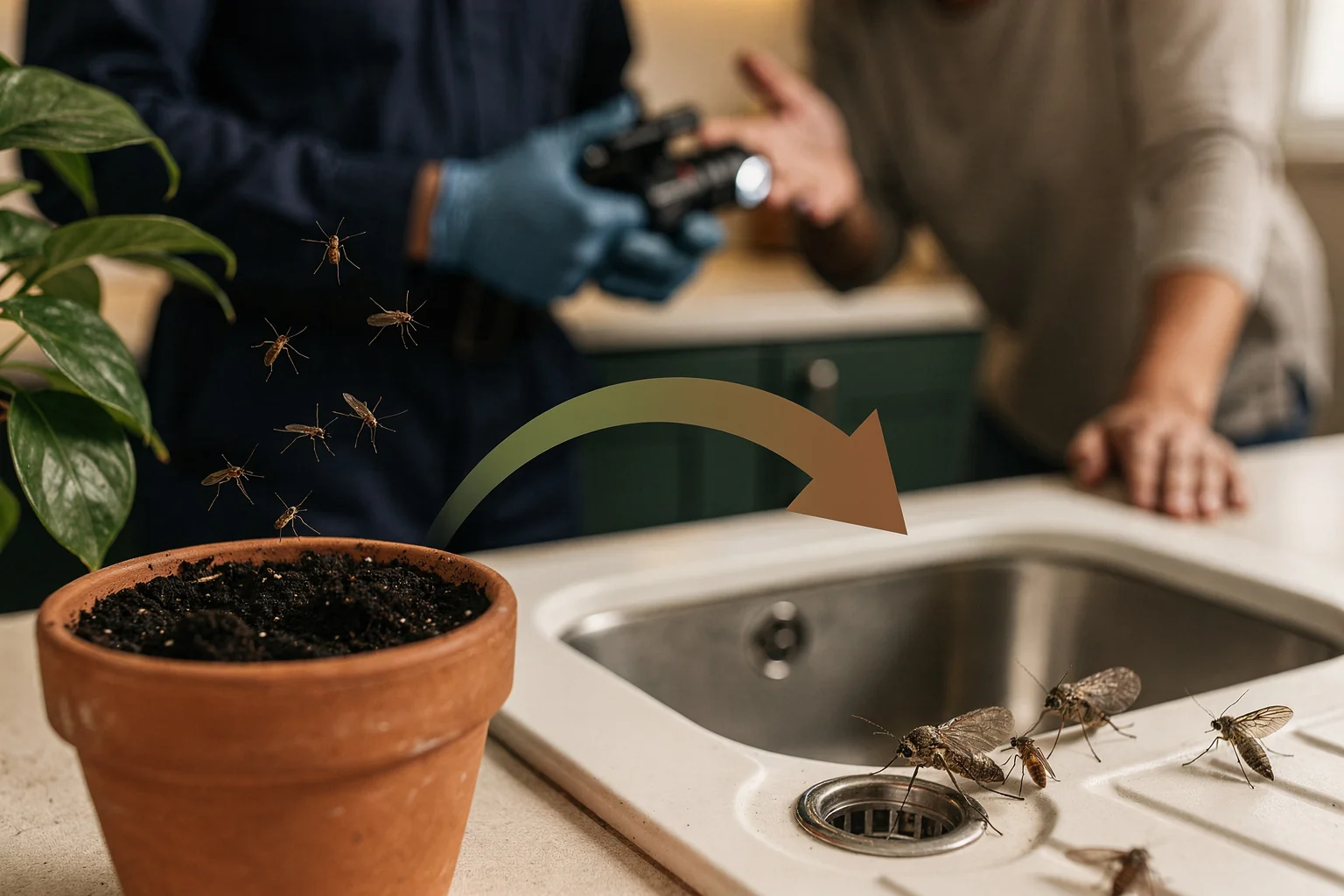
If the flies are gathering around your houseplants and compost, you have fungus gnats; if they are resting in a fuzzy cluster on the wall beside a sink, shower or floor drain, you have drain flies. That single observation settles most cases of fungus gnats vs drain flies before you buy anything or lift a plug.
Both are small, dark and annoying, and both turn up in kitchens and bathrooms across London. They are not the same insect, they do not breed in the same place, and the treatment that clears one will do almost nothing to the other. Get the identification wrong and you can spend weeks chasing flies that keep emerging from a source you never touched.
What is the fastest way to tell them apart?
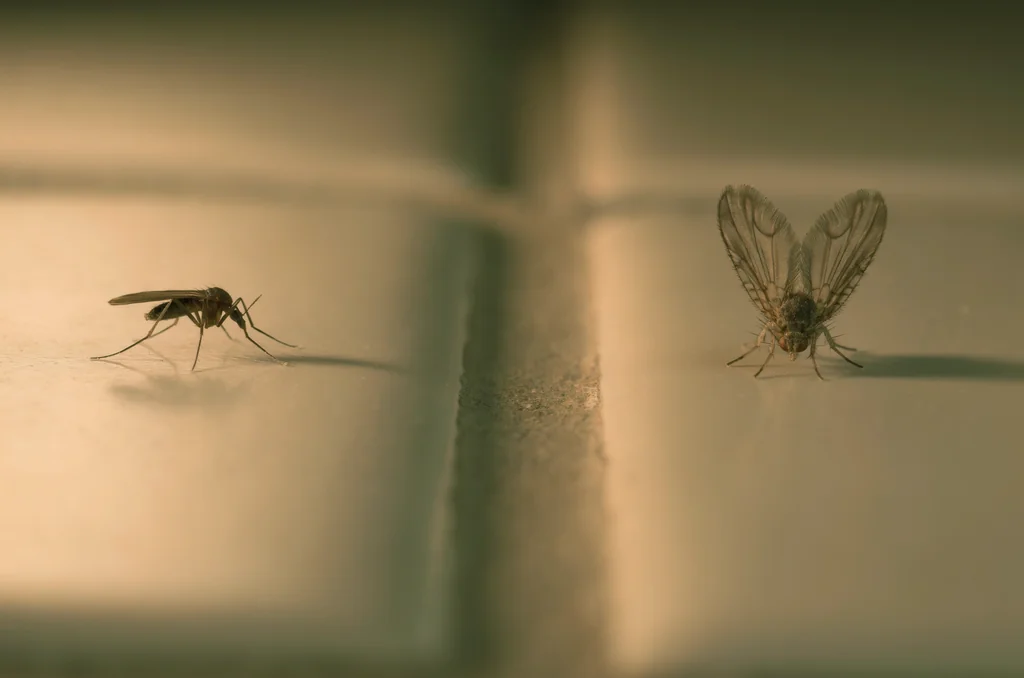
Look at the body shape and the resting position. A fungus gnat is a thin, delicate fly with long legs and a mosquito-like outline. A drain fly is chunkier and covered in fine hairs, so it reads as a tiny fuzzy moth. Drain flies hold their wings in a broad, heart-shaped roofline over the body when they land; fungus gnats sit with wings folded flatter along the back.
Where you find them matters just as much as what they look like.
- Fungus gnats hover in loose, drifting clouds a few centimetres above compost, saucers and pot rims. They scatter when you water.
- Drain flies sit still. You find them pressed against tiles, splashbacks and basin surrounds near a drain, often in a loose smear of a dozen or more.
- Fungus gnats turn up in offices, conservatories and any room with potted plants.
- Drain flies turn up in kitchens, bathrooms, utility rooms and basements — anywhere with a floor drain, trap or waste pipe.
Size is a weak clue because the two overlap. Drain flies run roughly 1/16 to 1/4 inch long, according to University of Maryland Extension, while fungus gnats are usually 1/16 to 1/8 inch, per UC Statewide IPM Program. Both are small enough that you will not measure them by eye.
One useful exception: fungus gnats can breed in drains too. A drain-based infestation does not automatically mean drain flies. If the flies are thin and mosquito-shaped rather than fuzzy and moth-like, treat it as a gnat problem even if the drain is the source.
Where is each one actually breeding?
Find the breeding site and you have found the answer. Fungus gnat larvae live in damp growing media and decaying organic matter. Drain fly larvae live in the gelatinous slime that coats the inside of drains and traps.
For fungus gnats, the source is almost always a plant pot. Larvae feed mainly on fungi and organic matter in soil, and they also chew roots, which is why badly affected plants sulk and stall. Overwatering is the usual trigger. Compost that stays wet for days on end gives larvae everything they need, and peat-based mixes hold moisture longer than most alternatives. Saucers that never dry out, self-watering pots, terrariums and trays of seedlings all do the same job.
For drain flies, the source is the slime layer itself. Adults lay eggs into that film, and the larvae graze on the algae, bacteria and fungi inside it. The University of Maryland Extension notes that drain flies also breed in sewer leaks and backups, dirty bins, saucers under potted plants, clogged storm drains, and condensate pans under fridges and air conditioning units. That last point catches people out: a slow-draining fridge tray in a restaurant kitchen can sustain a population that looks like it is coming from the sink.
A few practical checks will usually settle it in ten minutes:
- Water one plant and watch. Gnats rise in a cloud within seconds.
- Tape a clear plastic cup over a floor drain overnight. Flies trapped inside point to the drain.
- Pull the plug and shine a torch into the trap. A visible dark slime ring is drain fly habitat.
- Check under the fridge and around any condensate tray.
- Inspect plant saucers for standing water and floating larvae.
If you find nothing at the plants and nothing at the drains, widen the search. Bin stores, recycling caddies, dripping pipework behind units and damp skirting boards all support small fly populations.
Do they mean your home is damp or your plants are overwatered?
Usually one or the other, and rarely anything more serious. Fungus gnats are a reliable signal that compost is staying too wet. Drain flies are a reliable signal that organic sludge is building up in a drain or trap. Neither insect damages the fabric of a building, and neither is a sign of structural damp on its own.
That said, persistent drain flies in a property with slow drains, gurgling traps or a musty smell in a basement can point to a drainage issue worth investigating. The British Pest Control Association has flagged that wetter winters, flash flooding and overwhelmed drainage systems are likely to increase pest pressure in the UK, which makes a recurring drain fly problem a reasonable prompt to check pipework rather than just pour cleaner down the plughole.
For houseplants, the fix is a watering change, not a damp-proofing job. Let the top two to three centimetres of compost dry out between waterings, empty saucers within an hour, and stop watering on a fixed schedule. Most gnat populations collapse within a couple of weeks once the surface stays dry.
Are they harmful to people, pets or food?
Neither insect bites or stings, and neither is a disease carrier in the way mosquitoes are. The risk is contamination rather than infection.
Fungus gnats are a nuisance. Adults do not damage plants, though larvae can chew soft roots and set seedlings back. They are not known to spread disease to humans.
Drain flies are a different matter for food premises. They breed in slime that contains bacteria, and they can carry those microorganisms from egg-laying sites onto food and food-contact surfaces. The Maine Department of Agriculture, Conservation and Forestry guidance is blunt on this point: drain flies should not be tolerated in settings where food is stored, prepared or consumed. For a London restaurant, café or care kitchen, that makes a visible drain fly population a compliance issue as well as a nuisance.
If you are dealing with a nursery, a child's bedroom or a food preparation area, avoid aerosol sprays as a first move. Traps, drying out the source and mechanical drain cleaning solve most problems without scattering insecticide near food or bedding. Any treatment applied in a kitchen should be placed so it cannot contact surfaces or utensils.
What actually clears a fungus gnat infestation?
Dry the surface, break the lifecycle, and repeat. Fungus gnats are one of the more forgiving infestations to manage at home because the breeding site is small and accessible.
Start with watering. Let the top layer of compost dry between waterings and empty every saucer. Move affected pots away from other plants so the population does not spread. If a plant is badly infested, repot into fresh compost and wash the old mix off the root ball.
For adults, yellow sticky traps placed horizontally just above the compost surface catch a surprising number. For larvae, biological control works well. Steinernema nematodes watered into the compost, or Bacillus thuringiensis israelensis granules, target the larvae without leaving residue on foliage. The RHS lists fungus gnats as harmless in the wider ecosystem and treats them as a nuisance pest, which is a fair guide to how much force is needed here.
Expect two to four weeks for a full clear-out, because eggs and larvae already in the compost keep emerging. If you still see adults after a month of dry surfaces, traps and biological treatment, the source is somewhere you have not found yet — check other pots, cut flowers, and any bag of open compost in a shed or utility room.
What actually clears drain flies?
Mechanical cleaning beats chemical treatment. Drain flies live inside the slime layer, so anything that leaves the slime intact leaves the larvae intact.
Remove the drain cover and scrub the inside of the trap and pipe walls with a stiff brush. A drain snake or enzyme drain cleaner followed by hot water helps break down the film that larvae feed on. Repeat every few days for a fortnight, because adults live up to about two weeks and development from egg to adult takes roughly seven to 28 days, with flies emerging daily once an infestation is established. A single clean rarely ends it.
Deal with the secondary sites at the same time. Clean the condensate pan under the fridge, scrub the bin store, and check for leaks or backups behind units. If the drain is slow, fix the flow problem — standing water in a trap rebuilds the slime layer within days.
If drain flies keep returning after two or three rounds of cleaning, or if they are appearing in a commercial kitchen, that is the point to bring in professional help. Persistent populations often mean a deeper issue in the drainage run, a cracked pipe, or a shared stack serving several flats, none of which respond to retail drain cleaner. For confirmed cases, drain fly infestations need the breeding site treated rather than just the visible adults, and a technician can also confirm whether you are actually looking at gnats breeding in a drain instead.
Could it be fruit flies instead?
Yes, and this is the third possibility worth ruling out before you commit to a treatment plan. Fruit flies are small-bodied, under 1/8 inch long, and can pass through standard fly screens. They breed in fermenting fruit, vegetable scraps, spillage in bins and residue in bottles and cans.
The behavioural tell is straightforward. Fruit flies congregate around the fruit bowl, the bin, the recycling caddy and the drinks cabinet. They do not hover over compost and they do not sit in fuzzy patches on bathroom tiles. If your flies are circling a half-empty wine bottle or a bag of onions, you are looking at fruit flies, and the fix is removing the fermenting source and cleaning the bin thoroughly.
If you have ruled out plants and drains and the flies are still appearing in a kitchen, fruit fly identification covers the remaining breeding sites. In mixed-use properties — a flat above a restaurant, or a house with a utility room, a bin store and a conservatory full of plants — it is entirely possible to have two species at once, which is why treating only one source can feel like nothing is working.
When is it worth calling a technician?
Call for help when the source is not accessible, when the problem survives a proper DIY attempt, or when the setting raises the stakes.
The clearest triggers:
- Drain flies return within a week of a thorough clean, twice in a row.
- The infestation is in a commercial kitchen, care home, school or food business.
- You have a slow or backing-up drain, or a smell from a basement or utility area.
- Flies are appearing in a room with no plants, no drains and no obvious organic source.
- You have treated the plants properly and adults are still emerging after four weeks.
A technician can inspect the drainage run, identify the species under magnification, and treat the actual breeding site rather than the visible adults. For properties with several flats on a shared stack, that often means coordinating with the building rather than treating one kitchen in isolation. For broader small-fly problems across a building, professional fly control covers the range of species that turn up in London homes and how each is handled.
If you are in the City or nearby and want a local route, City of London fly control covers the same ground for that area, and readers near the eastern edge of the centre can book directly through Liverpool Street drain flies or Smithfield drain fly control once the identification is confirmed.
Which fly is in your kitchen right now?
Work through it in order. If the flies hover above compost and scatter when you water, it is fungus gnats — dry the surface, trap the adults, treat the larvae. If they sit in fuzzy patches beside a drain and return after cleaning, it is drain flies — scrub the trap, break the slime layer, and repeat. If they are circling fruit, bins or bottles, it is fruit flies — remove the fermenting source.
One extra check is worth building into your routine if you manage a commercial kitchen or a rental property: photograph the flies where they rest, note the room and the time of day, and keep a record of when you cleaned and what you used. That log turns a vague "we have flies" complaint into a clear brief, and it makes it far easier for a technician to confirm the species and treat the right place on the first visit.