

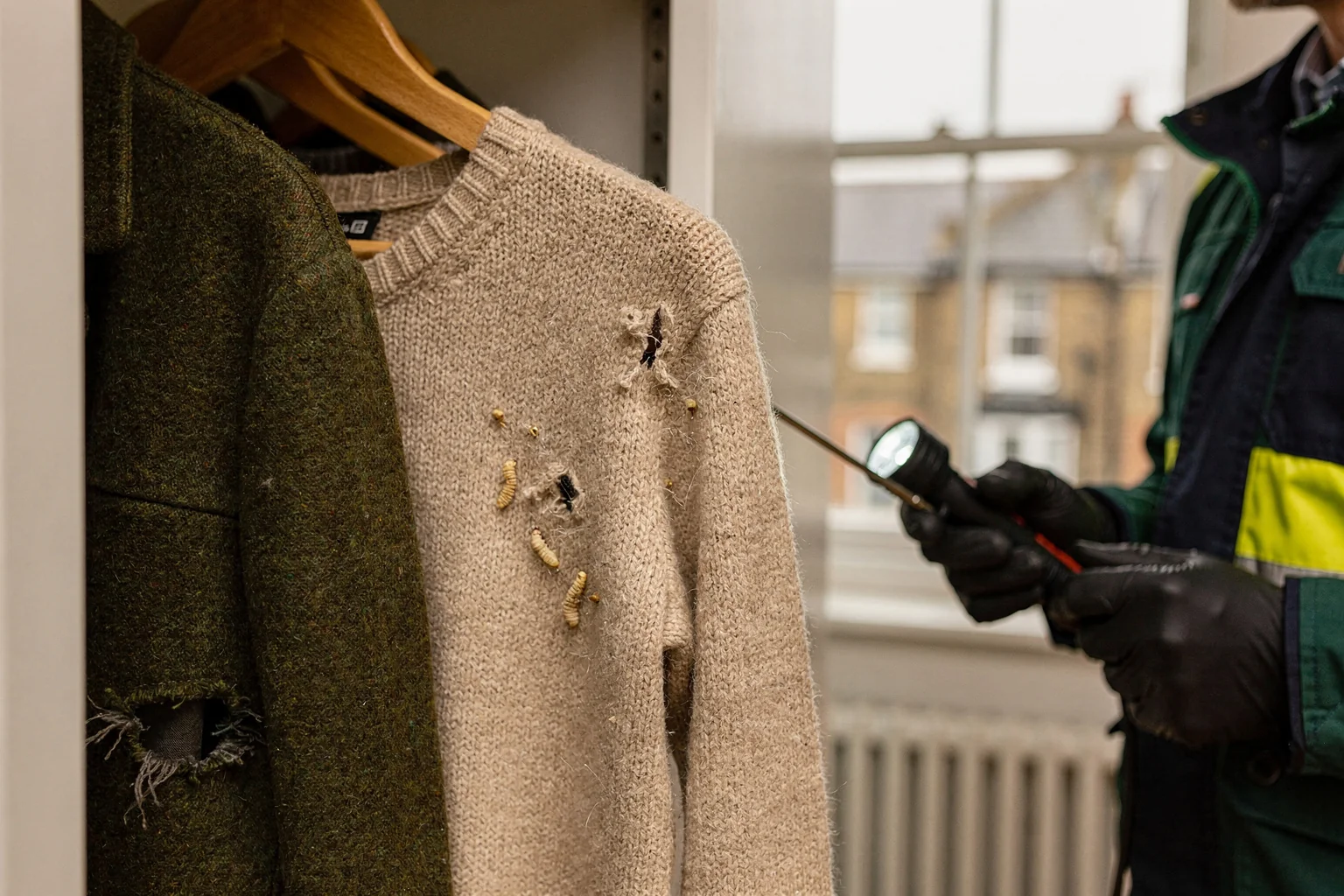
If you want to know what are the first signs of clothes moths, the honest answer is that they rarely announce themselves. There is no smell, no noise, no droppings on the worktop. The earliest evidence is usually a texture change you notice by accident: a patch of carpet that feels flatter underfoot, a jumper that seems thinner at the cuff, or a faint sandy grit in the bottom of a drawer you have not opened since last winter.
That quietness is exactly why infestations in London period properties run for months before anyone acts. By the time holes appear, larvae have been feeding for weeks. This guide sets out the evidence to look for, the order it tends to appear in, and the point at which a DIY approach stops being sensible.
Why Clothes Moths Go Unnoticed in London Flats and Period Homes
Two species cause almost all the damage in UK homes: the common or webbing Clothes Moth (Tineola bisselliella) and the case-bearing clothes moth (Tinea pellionella). The Natural History Museum's identification guide notes that infestations have become more common in recent years, with the common clothes moth encountered far more often than the case-bearing species.
The insects themselves are not the problem. Adult moths do not feed on fabric at all — only the caterpillars do, and they are the ones that chew irregular holes through wool, silk and other natural fibres. Adults live briefly, do not fly towards light, and will run or flutter into a dark corner when disturbed. In a dim bedroom or a wardrobe with the door shut, that behaviour makes them almost invisible.
London housing stock stacks the odds against early detection:
- Sash windows and original floorboards leave gaps and voids where larvae can feed undisturbed on dust, hair and dead insects.
- Fitted wardrobes create still, dark, humid microclimates behind the back panel.
- Underfloor and between-floor voids in converted Victorian terraces trap shed pet hair and old carpet offcuts.
- Flats above restaurants and shops stay warmer year-round, which shortens the time larvae need to develop.
The practical consequence is that the first sign you notice is usually not the first sign that existed. It is simply the first one that crossed your path.
The Earliest Clues: Grazing, Webbing and Grit
Before holes, there is surface damage. Larvae graze across the pile of a fabric rather than biting straight through it, which leaves a thin, flattened, slightly furrowed patch. On a wool carpet this reads as a worn track in a place nobody walks. On a jumper it reads as a thin spot under the arm or along a seam.
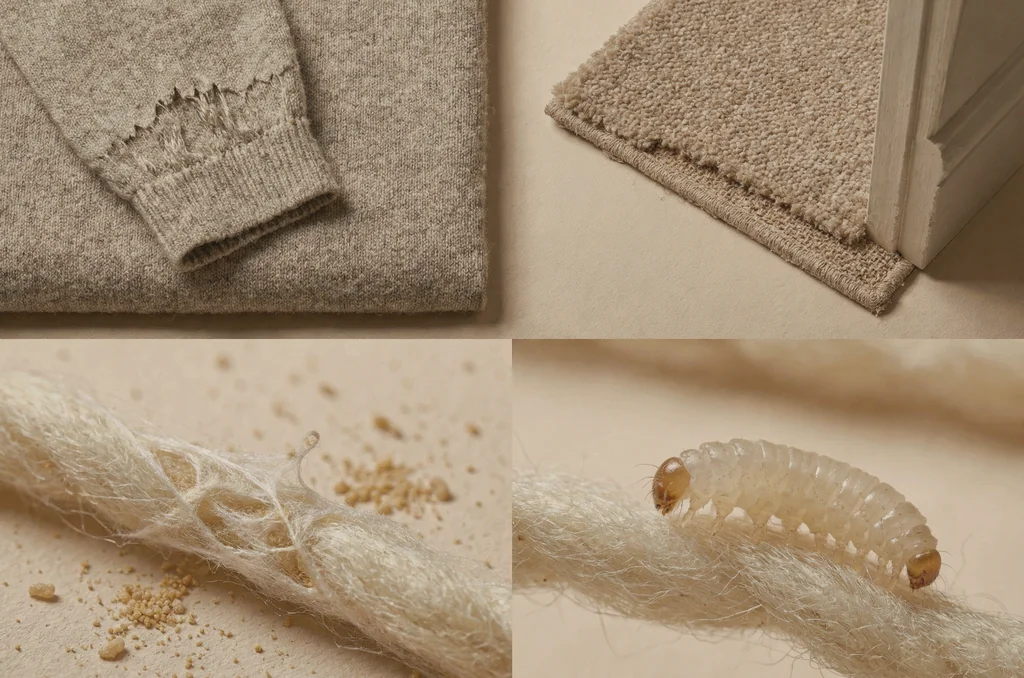
Alongside grazing, look for three pieces of physical evidence:
- Silk webbing or tunnels. Larvae spin silk as they feed. The common clothes moth produces loose webbing across the fibres; the case-bearing species builds a small portable case it drags around with it.
- Gritty frass. Larval droppings look like fine sand or dark specks caught in the fabric surface, often concentrated near the feeding site.
- Cream-coloured larvae. Mature larvae reach roughly 12–13mm, with white or cream bodies and a hardened brown head capsule. They are usually tucked under cuffs, collars, seams, furniture bases and the hidden parts of stored clothing.
The University of Florida's clothes moth extension guide is clear on the mechanism: damaged fabrics typically show irregular holes alongside silken threads or cases and faecal pellets on the surface. The same source notes that larvae can also feed on lint, dust, paper, cereal products and materials soiled with oil or dried food residue — which is why a thorough vacuum matters as much as treating the textiles.
One useful distinction: larvae digest keratin, the protein in wool, feathers, fur and hair. They cannot develop on materials made entirely of synthetic fibre. A 100% synthetic carpet is effectively moth-proof, while a wool-rich blend is not. If you are finding damage, the fibre content of the affected item tells you whether moths are a plausible culprit at all.
Telling Moth Damage Apart From Carpet Beetle and Wear
Not every thin patch is a moth. Carpet beetle larvae also feed on natural fibres and leave similar-looking irregular holes, so the diagnosis matters before you spend money on treatment.
| Evidence | Clothes moth | Carpet beetle | Ordinary wear |
|---|---|---|---|
| Surface pattern | Grazed furrows, thin patches | Ragged holes, often in clusters | Even thinning in traffic lanes |
| Silk | Webbing or portable cases | None | None |
| Larvae | Cream, brown head, hidden in folds | Bristly, banded, often in open | None |
| Frass | Fine sandy grit in fabric | Shed skins, brown hairy casts | Dust and fibre lint |
| Typical location | Wardrobes, under furniture, stored wool | Along skirting, under beds, near windows | Doorways, stairs, chair edges |
Two checks settle most cases. First, look at where the damage sits: moth activity clusters in undisturbed, low-light areas, while carpet beetle damage often appears along edges and under beds where shed hair collects. Second, look at what is left behind. Shed larval skins that look like small brown hairy husks point to carpet beetle; silk webbing and gritty frass point to moth. Where both are present, both need treating — the approach for carpet beetle control differs from moth work, and treating the wrong pest wastes the effort.
A Room-by-Room Inspection You Can Run in Half an Hour
Start with the safest useful action: do not move suspect textiles into other rooms, and do not shake them out over carpet. Bag them where they are, then inspect.
- Wardrobes and drawers. Lift stored knitwear and check under collars, cuffs, seams and labels. Look along the base of fitted units and behind the back panel if you can reach it.
- Carpet edges and under furniture. Pull furniture slightly away from skirting boards and check the pile in the shadow line. This is where grazing shows first.
- Under beds and in voids. Check the underside of the bed base, the carpet beneath it, and any gap between floorboards and skirting.
- Air-return vents and radiators. Larvae feed on trapped pet hair and dust in heating vents and behind radiators.
- Stored items. Suit bags, blanket boxes, spare bedding and anything containing wool, silk, cashmere, feathers or fur.
- Loft and cupboard voids. Old bird nests, dead insects and abandoned wasp nests in wall voids or attics are documented larval food sources, so activity can originate away from your clothes.
Record what you find and where. A written list with dates turns a vague worry into a pattern, and it is the single most useful thing you can hand to a technician if you escalate.
What to Do in the First 48 Hours
If you have confirmed larvae, webbing or fresh damage, act on the same day rather than waiting for a weekend clear-out.
- Wash or dry-clean every affected item. Heat and cleaning remove larvae and eggs that vacuuming cannot reach.
- Vacuum thoroughly, including skirting lines, under furniture, inside wardrobes and along carpet edges. Dispose of the vacuum bag or empty the canister outside immediately.
- Reduce humidity in the affected room. Damp, still air suits larvae; ventilation works against them.
- Isolate anything you cannot clean yet in a sealed bag.
- Recheck the same locations after seven days. Fresh frass or new webbing means the activity is ongoing.
If you find nothing on the first pass, repeat the inspection in two to three weeks rather than assuming you are clear. Moth populations build slowly, and a single missed drawer can restart the cycle.
When DIY Stops Being Enough
There is a clear escalation signal: evidence keeps returning after cleaning. If you have laundered the textiles, vacuumed properly and still find fresh webbing, new frass or live larvae within a month, the source is somewhere you have not reached — a wall void, a fitted unit, a neighbouring flat, or a shared loft space.
That pattern is common in London buildings. Moths move between flats through shared voids and service risers, so treating one wardrobe rarely solves a building-wide problem. Professional clothes moth control targets the harbourage areas rather than just the visible damage, which is the difference between a temporary reduction and a lasting result.
Call a technician sooner if any of the following apply:
- The affected items are valuable, antique or sentimental, such as inherited textiles, rugs or upholstery.
- Damage appears in more than one room, or in a room you have already treated.
- You are a landlord or managing agent dealing with a tenant complaint.
- You have found larvae in a food preparation or commercial storage area.
- You cannot identify the pest with confidence and want the diagnosis confirmed before spending on treatment.
Questions Homeowners Ask Before Booking
Do clothes moths bite or spread disease? No. They do not bite people and are not a public health risk. The damage is to textiles, not to occupants.
How quickly can moths ruin a wool carpet? Damage accumulates over weeks and months rather than days. Larvae feed slowly and stay hidden, which is why grazing shows before holes do.
Are moth traps worth using? Pheromone traps help confirm that adult males are present and show where activity is concentrated. They do not reduce a population on their own, so treat them as a monitoring tool rather than a solution.
Will a deep clean solve it permanently? Cleaning removes larvae, eggs and the dust and hair they feed on. It will not reach inside wall voids, fitted furniture cavities or shared building spaces, so recurring evidence points to a source beyond the room.
How long does professional treatment take? It depends on the size of the property and how many harbourage areas need addressing. A technician can give a realistic timescale after inspecting, which is why an accurate record of what you have found and where saves time on the visit.
What the Evidence Adds Up To
The first signs of clothes moths are almost always textural rather than dramatic: grazed pile, thin patches under cuffs, silk webbing in a drawer, fine grit in the fabric. Holes come later, and by then the larvae have been feeding for weeks. Check wardrobes, carpet edges, under-furniture shadow lines and stored wool first, because that is where the evidence concentrates. If fresh signs keep appearing after cleaning, the infestation has a source you have not found yet, and that is the point to bring in someone who can reach it.