

Best Carpet Beetle Sprays in the UK: What Actually Works
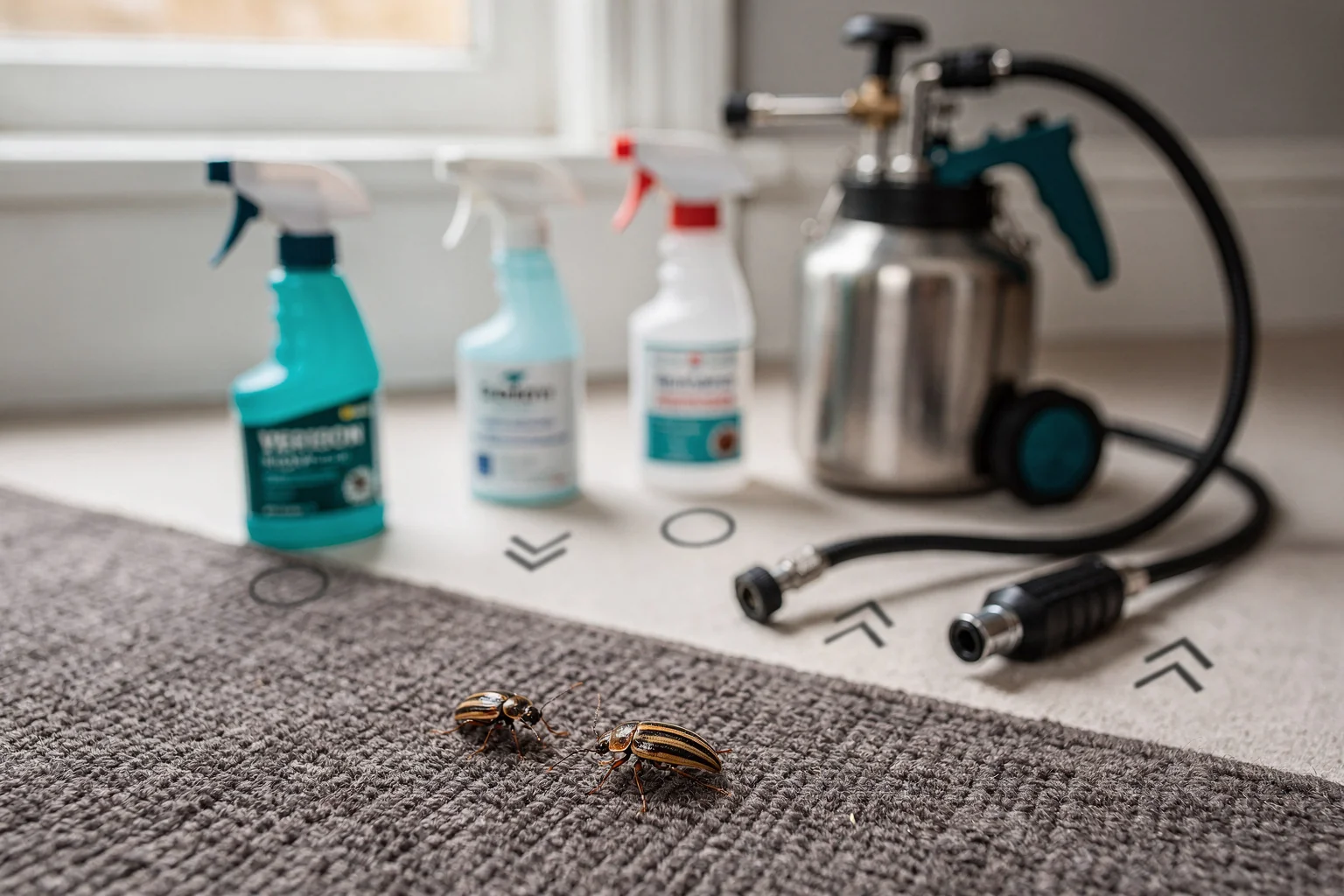
Finding the right carpet beetles spray means cutting through shelves of near-identical bottles to locate something that actually interrupts the life cycle. Adult beetles are easy to spot, but the larvae — those bristly "woolly bears" — do the real damage, chewing through wool carpets, cashmere, silk, and stored textiles. A spray that only kills visible adults leaves eggs and larvae untouched, so the problem returns within weeks.
This roundup evaluates UK-available sprays on four criteria that matter in practice: active ingredient and residual action, surface safety, coverage per litre, and whether the formulation targets eggs and larvae or just adults. Every product here is available to amateur users without a pest-control licence. Where professional treatment becomes the better route, we flag that too.
How Carpet Beetle Sprays Actually Work
Most domestic sprays rely on synthetic pyrethroids — lab-created versions of pyrethrins found in chrysanthemums. These compounds attack the insect nervous system on contact. The critical difference between products is whether they add a second mechanism: an insect growth regulator (IGR) such as pyriproxyfen, which stops larvae developing into breeding adults.
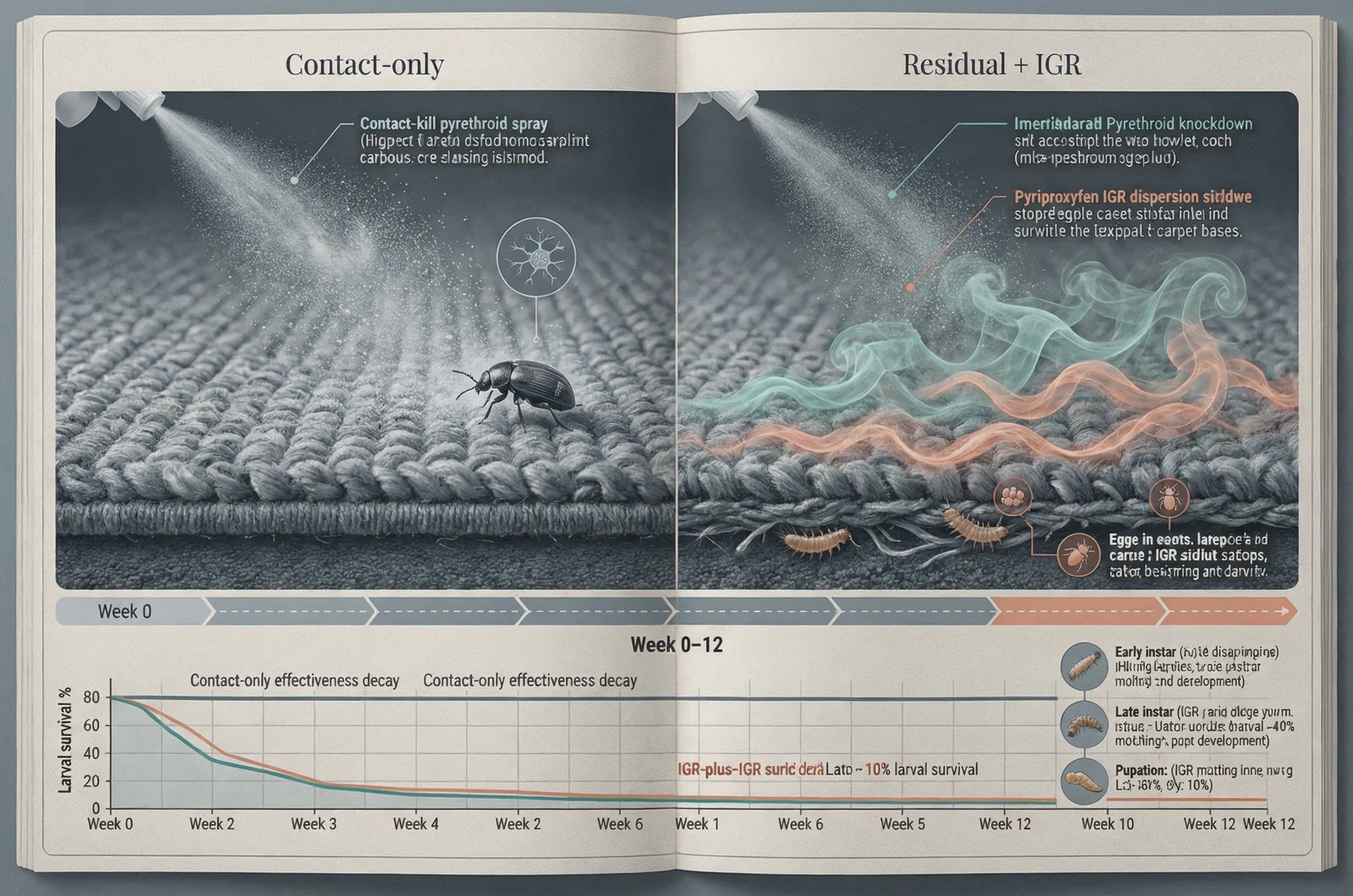
A contact-only spray gives immediate visible results. You see dead beetles and feel relief. But eggs hatch on their own schedule, often two to four weeks later, and larvae retreat into dark crevices where surface spraying misses them. Residual formulations leave an active film on fibres and skirting boards that continues killing for eight to twelve weeks. IGRs extend this protection by breaking reproduction even when a spray application was imperfect.
For London homes — especially period properties with original floorboards, built-in wardrobes, and multiple textile layers — residual action matters more than in newer builds with sealed edges and minimal storage clutter.
The Strongest Residual Option: Triple-Action Formulas
Pest Expert Formula C+ Advanced
The Pest Expert Formula Carpet Beetle spray sits at the top end of the amateur market for a specific reason: it combines three active ingredients rather than the usual one or two. The formulation includes pyriproxyfen as an IGR alongside two pyrethroids, creating both immediate knockdown and long-term disruption of the breeding cycle.
Coverage is substantial — one litre treats approximately 50 square metres, enough for two to three average rooms or one large open-plan living area with thorough application to skirting edges, under furniture, and inside emptied wardrobes. The water-based solution means it is safe on most carpets and soft furnishings that tolerate moisture, and it dries without staining or strong solvent odour. The residue remains active for up to twelve weeks according to manufacturer data.
Who this fits: Homeowners dealing with established infestations in wool-rich properties, or anyone who has already tried a single-ingredient spray and seen beetles return.
The honest limit: At the stronger end of amateur formulations, you must still keep children and pets off treated surfaces until fully dry — typically four to six hours with adequate ventilation. It will not penetrate deep into floorboard gaps or wall cavities where larvae sometimes cluster.
The Widely Available Single-Can Choice
Zero In Carpet Beetle & Moth Killer
Stocked by Tesco, Homebase, B&Q, and Amazon, this cypermethrin-based aerosol is the most accessible option for urgent spot treatment. A 300ml can covers roughly 12–15 square metres, making it practical for treating a single wardrobe, one carpeted bedroom, or a focused area where larvae have been spotted.
Cypermethrin works fast on contact and leaves a residual barrier, though shorter-lived than triple-action alternatives — typically four to six weeks rather than twelve. The aerosol format makes it easy to direct into corners and along carpet edges without oversaturating fibres.
Who this fits: Renters in furnished flats who need a quick, affordable intervention before contacting a landlord, or anyone confirming whether they actually have carpet beetles before committing to a larger treatment plan.
The honest limit: Single-can economics become expensive for whole-house treatment. The aerosol propellant also makes precise dosing harder than pump sprays, and there is no IGR component, so reapplication is likely.
The Budget Pump-Spray Alternative
Ready Steady Defend Carpet Beetle Killer Spray
This Carpet Beetle Killer Spray uses 0.1% cypermethrin in a water-based pump format, offering the same active ingredient as more expensive brands at a lower price point. The one-litre bottle provides broader coverage than aerosol cans, and the pump trigger allows controlled application to specific areas rather than broadcasting across whole rooms.
The formulation targets eggs, larvae, and adults, and dries to form a residual barrier claimed at up to three months. It is non-staining and low-odour, approved for direct use on carpets, rugs, and bedding storage areas.
Who this fits: Cost-conscious households treating multiple rooms, or those who prefer pump sprays for environmental reasons — no aerosol propellants, less packaging waste per square metre treated.
The honest limit: The lower cypermethrin concentration means heavier application is needed for equivalent knockdown. Without independent testing data, the three-month residual claim is harder to verify against the twelve-week benchmark of triple-action competitors.
When Sprays Alone Will Not Solve It
Even the strongest amateur spray has physical limits. Carpet beetle larvae thrive in undisturbed accumulation: dust beneath floorboards, bird nests in loft spaces, forgotten wool blankets in sealed boxes, pet hair compacted behind radiators. Surface spraying cannot reach these reservoirs.
Richard Collings, writing for Mothkill, notes that UK councils increasingly advise locating the breeding source as essential to long-term control, because hidden reservoirs allow reinfestation even after thorough surface treatment. Heat treatment — raising room temperature to levels lethal for all life stages simultaneously — is gaining ground as an alternative for severe or recurring cases, particularly in properties with complex architecture where chemical access is limited.
Signs that spray has reached its limit:
- New larvae appearing six to eight weeks after thorough application
- Damage continuing in rooms that were treated
- Beetles emerging from wall cavities, light fittings, or underfloor voids
- Multiple affected floors or widespread loft activity
At this stage, professional carpet beetle treatment becomes the practical choice. Technicians can apply commercial-grade formulations not available to amateurs, use targeted heat equipment, and identify structural access points that DIY approaches miss.
Application Safety in Homes with Children or Pets
All pyrethroid sprays require the same basic precautions, but the margin for error narrows with vulnerable occupants.
Before treatment:
- Remove fish tanks and cover them — pyrethroids are highly toxic to aquatic life even at low airborne concentrations
- Clear toys, feeding bowls, and pet bedding from treatment zones
- Plan to keep children and pets out of treated rooms for four to six hours minimum
During application:
- Open windows for cross-ventilation
- Spray skirting boards, carpet edges, and under furniture rather than carpet centres where contact is heaviest
- Avoid oversaturation — a fine mist that dries quickly is safer than soaking
After treatment:
- Vacuum thoroughly 24–48 hours later to remove dead insects and stimulate any remaining larvae to cross treated surfaces
- Wash any textiles that were directly sprayed before returning them to storage
For households with crawling infants or pets that sleep on carpets, consider treating only non-contact areas initially (wardrobe interiors, under-bed storage, behind furniture) and monitoring whether this perimeter approach reduces activity before broader application.
Matching the Spray to Your Situation
| Your situation | Best fit | Why |
|---|---|---|
| Established infestation in wool carpets, multiple rooms | Triple-action residual spray | IGR component breaks the breeding cycle; 50 sq m coverage per litre |
| Urgent spot treatment, limited budget, need tonight | Cypermethrin aerosol from major retailer | Immediate availability, no waiting for delivery |
| Whole-house prevention after previous infestation | Pump-spray cypermethrin with residual barrier | Lower cost per square metre, controlled application, less packaging |
| Recurring problem despite previous spraying | Professional assessment | Likely hidden reservoir requiring structural access or heat treatment |
| Renter, need evidence for landlord dispute | Documented purchase + dated photographs of damage and larvae | Creates paper trail; many landlords will then arrange professional treatment |
The Option Most People Overlook: Integrated Cleaning First
Sprays work better on clean surfaces. Vacuuming removes eggs, larvae, and the dust-hair debris they feed on, while also stimulating hidden larvae to move across treated areas. Hot-washing affected textiles at 60°C kills all life stages without chemicals. Freezing smaller items for 72 hours achieves the same result.
A methodical clean-and-spray sequence — vacuum, wash or freeze textiles, apply residual spray to edges and storage areas, then vacuum again after 48 hours — often outperforms spraying alone. Many users skip the cleaning step, apply spray to dirty carpets, and wonder why beetles persist.
For Covent Garden carpet beetle control in compact flats with limited storage, this integrated approach is especially relevant: every square metre matters, and clutter reduction doubles the effective coverage of any spray used.
What the 2026 Market Tells Us
Two trends are reshaping how UK households approach carpet beetle control. First, the British Pest Control Association has raised regulatory concerns about future access to effective amateur insecticides, with parliamentary discussions in September 2026 focusing on UK REACH and chemical availability. This makes current formulations worth understanding while they remain accessible — professional-grade restrictions may tighten.
Second, pest professionals report rising carpet beetle enquiries since 2019, driven by warmer winters extending breeding seasons and wool-rich modern carpets providing abundant food. The Netmums spring 2026 warning about beetles emerging from winter dormancy in March reflects this broader pattern: what was once a sporadic issue has become a seasonal expectation for many households.
For London properties specifically, the density of period housing with original features — floorboard gaps, chimney breasts, built-in storage — creates more harbourage than the average UK home. This does not mean sprays fail; it means they need realistic deployment alongside physical cleaning, and earlier escalation to professional help when structural access is required.
Choosing Your Next Step
If you are at the research stage before purchase, start with a single can or bottle of your preferred format and treat one room thoroughly as a test. Document results over four weeks. Visible reduction in new damage or larvae confirms you have identified the right product and applied it correctly. Continued activity signals either a hidden reservoir or a need to escalate.
For Bloomsbury carpet beetle removal or other central London locations where rapid response matters, same-day professional assessment remains available when DIY timelines feel too slow for the scale of damage. The decision point is not failure — it is efficiency, protecting textiles that may carry significant replacement cost.
The most common mistake is repeated identical spraying: same product, same method, same result. If one application pattern does not work, change the approach — deeper cleaning, different active ingredient, or professional intervention — rather than hoping the third identical attempt succeeds where the first two failed.
References
- Pest Expert Formula 'C' Carpet — # Pest Expert Formula 'C' Carpet Beetle Killer Spray 1L ... Pest Expert Formula 'C+' Advanced is the new and improved formulation of our best-selling carpet beetle killer spray.