
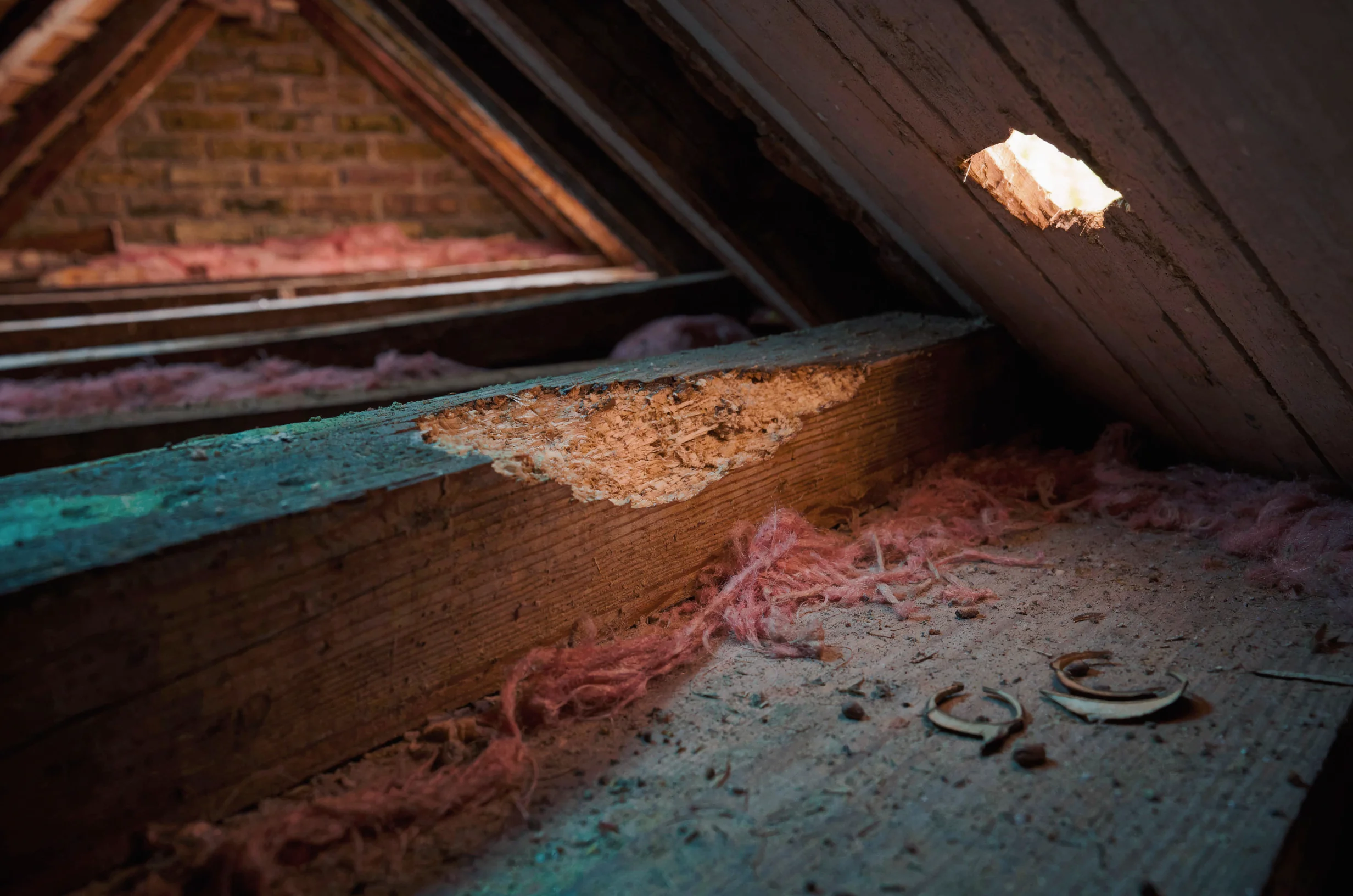
The early signs of squirrels in attic spaces include repeated daytime scurrying, fresh gnaw marks near roof gaps and disturbed insulation. A squirrel seen entering the roof provides stronger evidence than noise alone.
For homeowners, tenants and property managers, the immediate task is to connect sounds with physical clues without disturbing the animal. Start with observations from occupied rooms and ground level. You do not need to enter an unfamiliar loft, handle droppings or move a nest to begin narrowing down the cause.
What do squirrels in the loft sound like?
Squirrels can produce quick running sounds, scratching and short bursts of gnawing, often during daylight.
Movement may seem to travel across the ceiling before stopping near the eaves, where the roof meets the outside wall. Scratching can sound surprisingly close when an animal moves above plasterboard or beside a thin partition.
Listen for the pattern as well as the volume. Note whether activity happens around the same time, follows a consistent route or accompanies a squirrel appearing on the roof. Repeated observations are more useful than one loud disturbance.
Sound alone remains uncertain. Loose roofing, branches touching the building and other animals can produce similar noises. A heavy thump does not reliably establish the animal’s size or the number present.
If the sound seems to come from a wall, the guide to scratching noises in walls addresses that separate location.
Make a short recording from the room below if possible. Include the time and room name in your notes. Continued movement in the same roof area, especially alongside visible entry activity, gives an inspector a useful place to begin.
How can you tell squirrels from rats, mice or birds?
Use the combination of activity timing, movement, physical evidence and entry location to distinguish likely visitors.
The following clues help organise an inspection, but none identifies an animal conclusively on its own.
| Possible visitor | Noise pattern to note | Supporting evidence to check |
|---|---|---|
| Squirrel | Running, scratching or gnawing, often by day | A squirrel entering a roof gap, disturbed insulation or gnawed edges |
| Rat | Scuffling or gnawing, often noticed after dark | Droppings, repeated travel routes and damage around access points |
| Mouse | Light scratching or movement, often noticed after dark | Small droppings and signs elsewhere inside the building |
| Bird | Fluttering, calls or movement near the roof edge | Birds entering a gap, feathers or visible nesting activity |
These patterns overlap. Animals may move outside their usual activity periods, while the ceiling structure changes how their movements sound.
Check whether evidence appears downstairs too. Signs near kitchen cupboards or lower walls warrant a wider inspection. The guide to mouse entry through air bricks covers one possible route to consider.
Avoid choosing a treatment from the sound description alone. If the clues point towards different animals, record that uncertainty and arrange identification before anything is sealed or placed in the loft.
What do squirrel droppings and nests look like?
Squirrel droppings may appear as dark, elongated pellets, while nesting material can include leaves, twigs and disturbed insulation.
Neither finding is distinctive enough for confident identification by itself. Droppings can resemble those of other rodents, particularly in poor light or photographs without scale. Their appearance also changes with age and conditions.
Photograph anything visible without touching or rearranging it. A wider image should show its position beside a joist, stored box or roof edge. That context may be more useful than a close-up alone.
An untidy patch of insulation is not automatically a nest. Previous building work, stored belongings and earlier pest activity can leave similar disturbance. Look for associated clues, such as repeated sounds nearby or a roof entrance directly above the area.
A nest may also sit beyond the visible part of the loft. An apparently clear central space does not establish that the eaves are empty.
Do not pull nesting material apart to check for occupants. Leave material in place during identification, and tell the inspector if you have heard small calls or movement from that precise location.
Which damage suggests an animal is using the attic?
Fresh gnaw marks, displaced insulation and chewed cable coverings can indicate animal activity, although they do not identify squirrels specifically.
On accessible roof edges or visible timber, look for changes that appear recent: exposed surfaces, loose fragments or damage absent from an earlier photograph. Weathering and old repairs can make age difficult to judge.
Distinguish surface marks from damage that needs a separate assessment. A few scratches cannot tell you whether a timber is structurally sound. Suspected damage to supporting woodwork needs advice from someone qualified to assess the building.
Cable damage deserves particular care. Do not touch, move or test a suspect cable to get a better view. Tell a qualified electrician where it is and whether the area can be accessed safely.
Insulation may show flattened routes, scattered material or a concentrated hollow. These are useful observations, but compression can also result from storage or previous access.
Take photographs from the same safe position when documenting changes. A dated record helps separate old defects from continuing activity. If fresh damage appears alongside repeated roof entry, arrange an inspection without waiting for a larger patch to develop.
Where should you look for squirrel entry points?
Check the roofline from ground level for gaps, damaged edges and places where you have actually seen an animal enter.
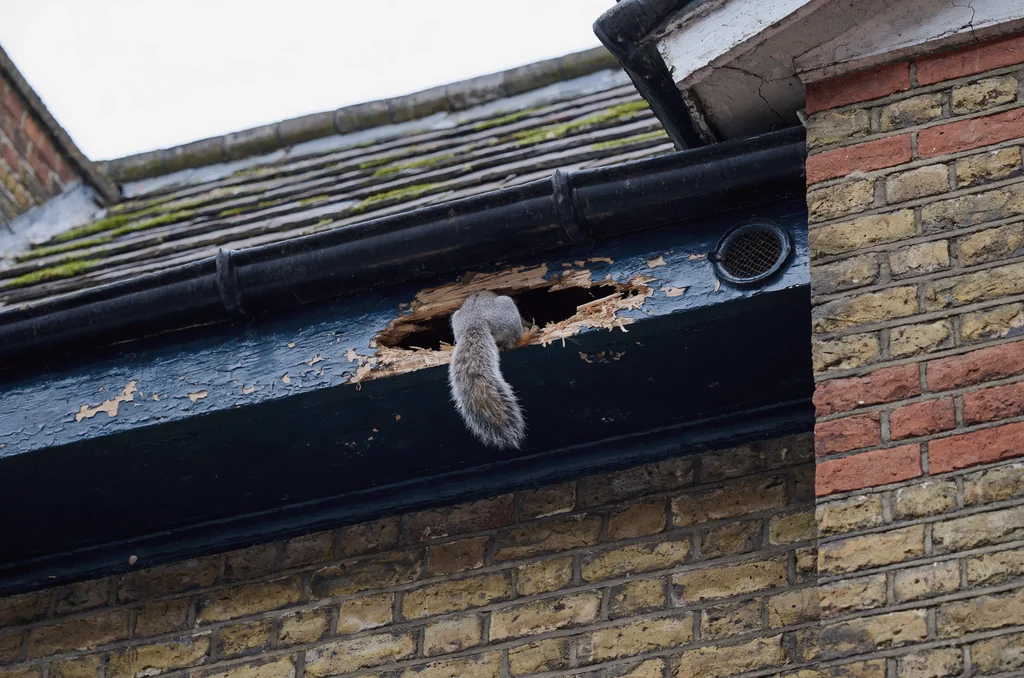
Relevant areas include the eaves, fascia boards, roof junctions, vents and spaces around dormers. A fascia is the board along the roof edge, often behind the gutter. You do not need to reach these areas yourself to record a suspected opening.
Use binoculars or a phone’s zoom from a safe position. Photograph the whole roof section first, then the suspected gap. A close-up without surrounding detail can be difficult to locate later.
A squirrel running along a gutter does not prove it lives inside. Watch for the animal disappearing through a specific opening, and record where that happens.
In terraces, converted houses and blocks of flats, the apparent entrance may be away from the room where sounds are heard. Shared roof spaces can complicate the inspection boundary.
Avoid climbing onto roofs or leaning from upper windows. If a gap is out of view, mark its approximate position on a photograph and leave access to someone equipped to inspect it safely.
How can you check a loft safely?
Begin with a visual check from a secure position, and stop if access, footing or the condition of the space is uncertain.
An identification check should leave the loft undisturbed. There is little benefit in reaching a suspected nest if doing so means crossing an unboarded area or moving unknown materials.
Use this sequence:
- Record noises from the room below, including their time and direction.
- Observe the outside roofline from ground level.
- Look through the hatch only if it can be opened and viewed safely.
- Photograph visible disturbance without reaching into it.
- Note anything that prevents a clear view, such as stored boxes or inaccessible eaves.
Keep children and pets away from the inspection area. Do not put hands into insulation, behind stored items or through roof gaps. Avoid sweeping, vacuuming or handling droppings during the check.
For a shared household, an interactive evidence checklist could collect noise times, roof sightings and photographs in one place. Mark uncertain observations clearly so they are not later mistaken for confirmed sightings.
If the hatch reveals damaged cables, extensive contamination or an animal close by, end the check and pass those details to the appropriate professional.
Can squirrels be present when the loft is quiet?
Yes, a quiet period does not establish that squirrels have left or that a suspected nest is empty.
An animal may be outside while you are listening. Activity may also take place beyond the room you normally occupy. Changes in household noise can affect how readily you notice movement overhead.
One sighting does not establish how many animals use the space. Equally, several sounds do not prove there are several squirrels. A single animal moving across different surfaces can produce quite different noises.
Young animals may be difficult to detect from outside the nest. Do not use silence as the reason to dismantle nesting material or close an entrance.
Seasonal expectations are also a poor substitute for checking the building. The condition of your roof, observed entry activity and evidence inside the loft matter more than assumptions about what should happen at that time of year.
Continue the record without disturbing the space. If a suspected entrance remains open, ask how occupancy will be checked before repairs. The person inspecting should explain what evidence would support treating the roof void as clear.
Should you block the gap or try to remove squirrels yourself?
Leave suspected active entrances open until occupancy and the handling plan have been assessed.
Closing a gap too early can leave an animal inside or separate it from dependent young. An incomplete inspection can also miss another entrance, so patching the most obvious hole may leave the original problem unresolved.
Do not push cloth, foam or loose material into a suspected route as an experiment. That changes the evidence and may interfere with animal movement before you know what occupies the space.
Repellents, noise devices and strong smells cannot establish that a loft is empty. Even if activity becomes less noticeable, the inspection and repair questions remain.
Trapping requires particular care. Before considering it, read the separate explanation of grey squirrel release rules. Ask a competent professional to explain the requirements that apply to the identified animal and proposed approach.
Do not improvise traps or place rodent products in the loft based on a guess. Keep any proposed work paused until you understand how occupants will be identified, how nesting concerns will be addressed and when the entrance can be repaired.
When does attic activity need urgent attention?
Suspected electrical damage, an animal entering occupied rooms or rapidly developing property damage needs prompt professional assessment.
You can begin that assessment with photographs and observations; you do not need to complete a personal loft search first. Tell the person attending about any access restrictions or hazards already visible.
Different problems may require different trades. A pest inspection establishes animal activity and access routes. An electrician assesses damaged wiring. A roofer or building professional assesses defects affecting the roof or supporting structure.
If an animal appears in an occupied room, keep people and pets away and seek advice. Do not chase, corner or try to catch it with your hands.
Repeated noise without visible damage still merits investigation, but it does not establish an emergency by itself. Record what you can observe and describe the evidence accurately when arranging attendance.
Tenants should report the suspected activity and any damage to the landlord or managing agent in writing. Include the affected room, noise times and photographs. Where several flats may share the roof, ask who will coordinate access so the inspection can cover the relevant space.
What should a squirrel inspection establish?
An inspection should identify the likely animal, assess current occupancy and explain the order of any removal, repair and cleaning work.
The findings should connect to evidence in your property. Ask which signs support the identification and which areas remain inaccessible. Uncertainty should be recorded plainly.
A useful plan for squirrel control and proofing should address:
- The observed or suspected entry points.
- The areas checked for nests or dependent young.
- Any hazards requiring another trade.
- The sequence of animal management and roof repairs.
- The follow-up needed to check for continuing activity.
Ask whether the whole relevant roof space has been considered. In a shared building, an inspection limited to one hatch may leave adjacent areas unresolved.
Request a written breakdown of the proposed work. Clarify whether access equipment, return visits, cleaning, insulation work and repairs are included or separately quoted. A treatment quote alone does not explain the scope of roof repairs.
If identification is still uncertain, ask what further observation would resolve it. Keep the evidence record available so the inspector can compare your reports with the conditions found during the visit.
How do you know the attic is secure afterwards?
Confidence comes from completed repairs, a documented occupancy check and follow-up observations that show no renewed activity.
Ask for photographs of repaired entry points where they cannot be seen from the ground. The record should make clear which openings were addressed and whether any areas still need attention.
Proofing work must also account for the building’s ventilation and condition. Ask how necessary airflow has been maintained and whether damaged roof materials require further repair. Keep these details with the inspection report.
Check that separately identified problems have been addressed. Stopping animal access does not repair a chewed cable or restore damaged insulation. Confirm who is responsible for each outstanding item.
Continue noting sounds and roof sightings after the work. A squirrel crossing the roof is different evidence from one entering it, so describe exactly what you see.
Avoid judging success by one silent evening. Use the follow-up arrangements set out in the work plan. If fresh damage or entry activity appears, add its time and location to the original record and arrange reassessment of that route.