
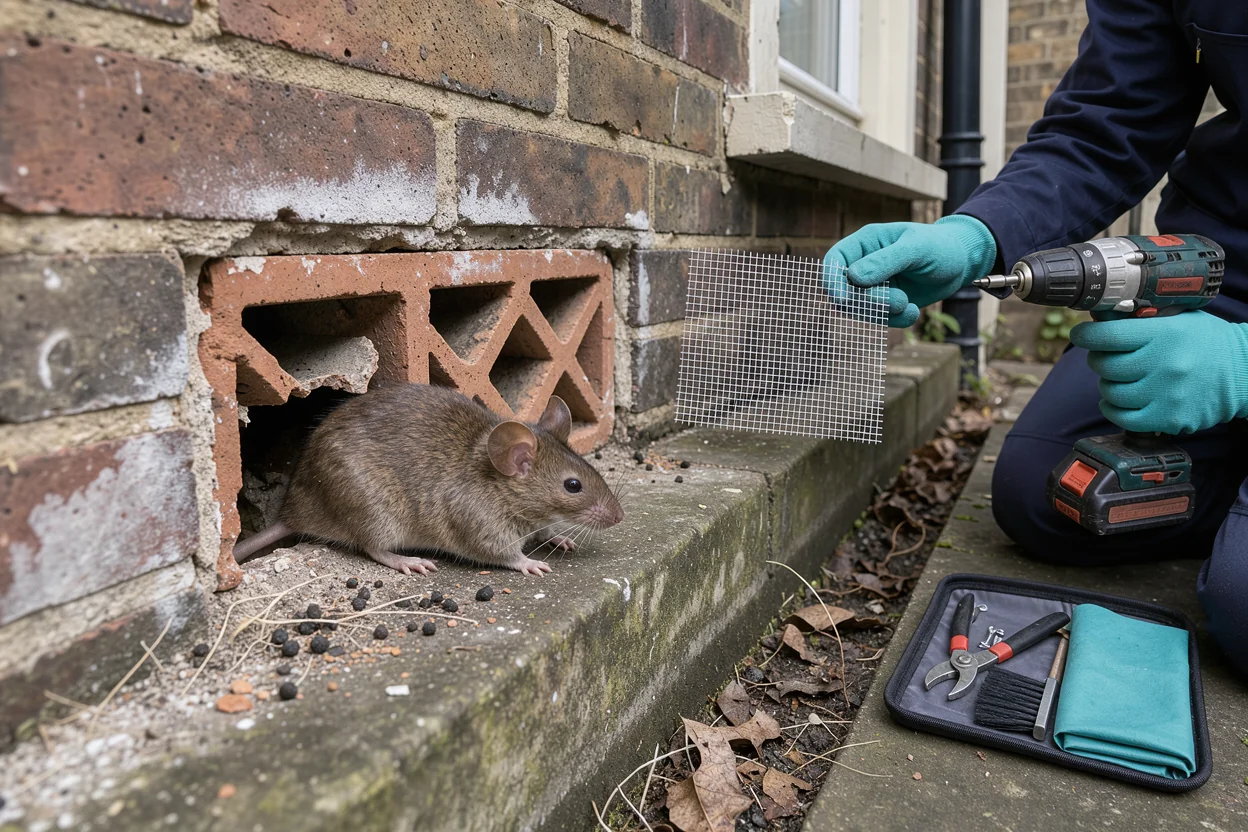
Yes, mice can enter through air bricks where the openings, damaged sections or surrounding gaps are large enough. Understanding how to rodent proof air bricks starts with fitting a secure metal barrier that preserves ventilation, alongside dealing with any mice already indoors.
The first job is to establish what the vent serves. An air brick beneath a suspended timber floor needs to keep moving air through the space below it. Filling the holes may close one entry route, but it can create a separate moisture problem.
What size air-brick opening can a mouse get through?
An opening of around 6 mm can be enough for a mouse, so small holes and narrow gaps deserve attention.
Treat that measurement as a warning threshold, rather than an exact test of whether a particular mouse will pass through. The shape of the opening, its edges and the animal’s size all matter. A long slot can be easy to overlook because it appears much narrower than a broken hole.
Check the air brick itself and the joint around it. Possible routes include:
- Original ventilation holes with openings large enough for access.
- A broken corner or missing internal divider.
- Loose mortar between the vent and surrounding brickwork.
- A lifted edge beneath an existing cover.
An intact-looking front face does not rule out a gap underneath. Use a torch and ruler to inspect the perimeter, especially where paving, soil or a planter hides the lower edge.
You do not need to push objects deep into the vent. Photograph the opening beside the ruler, then check its size against the proposed guard’s specification. If the brick moves when lightly touched, arrange a masonry repair before attaching a cover.
How can you tell whether mice are using an air brick?
Evidence around the vent can identify a likely entry route, but an accessible air brick alone does not prove mice are using it.
Look for droppings nearby, disturbed material, gnawed edges or marks along a sheltered approach. Photograph anything suspicious without handling it. Dirt and weather staining can resemble animal marks, so use several clues together.
Indoors, check where the suspected route could lead. In a house with suspended floors, that might include gaps around pipework, floorboard edges and openings behind kitchen units. Scratching beneath the floor suggests activity in that space, but it does not identify the external entrance.
A simple inspection record helps:
- Photograph each vent and its surroundings.
- Note visible damage and the largest accessible opening.
- Record where indoor signs appear and when noises occur.
- Mark areas you cannot inspect safely.
Guidance on mouse activity and control can help you connect indoor evidence with the wider inspection.
Avoid pulling apart a vent to look for a nest. If fresh signs continue or several possible routes exist, a technician should assess the building before you settle on one repair. Keep your photographs dated so later changes are easier to identify.
Why must air bricks stay open after rodent proofing?
Air-brick proofing must preserve the ventilation the building needs, particularly where vents supply the space beneath a timber floor.
Air moving through that space helps moisture escape. A solid cover, packed material or badly clogged mesh can restrict that movement. The result may be a damp problem that remains hidden beneath the floor.
Do not judge ventilation by the outside dimensions of a cover. Its frame, mesh and any backing all reduce the opening available for air. Product information may describe this as the free area: the space through which air can actually pass.
A guard that fits neatly over the brick can still restrict airflow too much. Check its published ventilation information and whether it is suitable for the existing arrangement. Where that information is missing, ask the supplier or a building professional before fitting it.
Some wall vents serve a room or a fuel-burning appliance instead of a floor void. Their requirements need separate assessment. Ask an appropriately qualified engineer to specify any guard for an appliance air supply.
If you cannot identify the vent’s purpose, pause the alteration. Photograph its position outside and the corresponding area indoors, then have its function confirmed.
Which mesh or covers should you use on air bricks?
Choose a purpose-made metal guard suitable for excluding mice, with documented openings, secure fixing points and ventilation information.
Stainless steel mesh or a suitably protected metal cover can provide a durable barrier when correctly specified and fitted. Material alone does not establish suitability. A strong guard with large holes will still leave an entry route, while thin mesh may distort at its edges.
For mouse exclusion, look for clear openings below 6 mm and check the manufacturer’s stated use. The clear opening is the space between wires, rather than the distance between their centres. Wire thickness and resistance to damage matter too.
Check these details before buying:
- The guard covers the whole vent and reaches sound surrounding material.
- Its openings are suitable for mouse exclusion.
- The frame and mesh resist bending or lifting.
- Its fixings suit the wall.
- Ventilation information is available for the complete product.
A label saying “vent cover” or “insect mesh” does not establish rodent resistance. Where rats are suspected, choose a barrier specified for that problem rather than assuming a lightweight mouse screen is sufficient.
An interactive guard selector would be useful if it checked vent dimensions, mesh openings and airflow data, then flagged missing information. Until those details are clear, keep the product on your shortlist rather than fitting it.
How do you fit an air-brick guard without leaving gaps?
Fit the guard to sound material around the vent, following its instructions and checking the entire perimeter for accessible gaps.
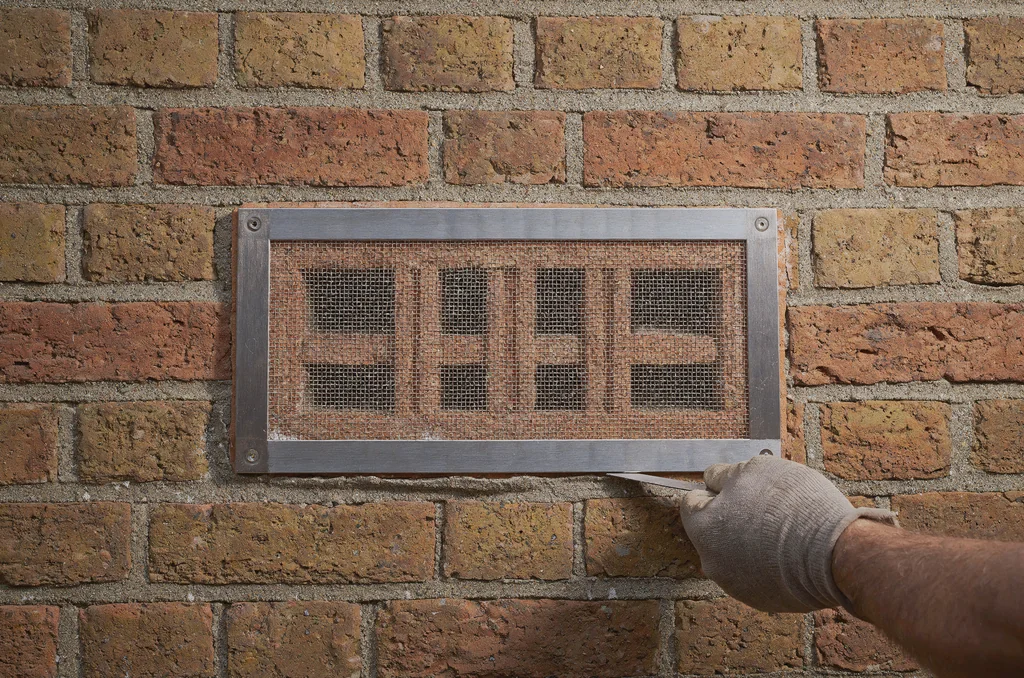
The mesh needs support on every side. Covering the middle of the air brick while leaving a loose lower edge gives rodents another opening to investigate.
Prepare the vent and surrounding wall
Clear away leaves and surface debris so you can see the whole vent. Wear suitable gloves when handling cut mesh, and avoid disturbing suspected rodent contamination.
Measure the vent and the surrounding area available for fixings. Check whether the wall is flat enough for the proposed frame. Old mortar joints, uneven brick faces and projecting edges can stop a flat cover from sitting securely.
Repair loose masonry with materials suitable for the building. A guard should not depend on a crumbling joint for support. On older properties, ask a builder to assess damaged brickwork if the repair extends beyond a small, straightforward defect.
Check for concealed services before drilling. If there is no sound fixing position, choose a different fixing design or have the surrounding wall repaired.
Secure the cover and inspect its edges
Use the fixing method specified for the guard and wall type. Do not substitute adhesive-only attachment unless the product is designed for that method and the surface meets its requirements.
After fitting, inspect the top, bottom and both sides. Look closely at corners and changes in the wall surface. The frame should sit securely without a gap beneath it, and the mesh should remain firmly held.
Keep the ventilation openings clear of sealant and mortar. Take a close photograph of the finished perimeter, including the underside if accessible.
Record the product used and retain its ventilation information. If an edge lifts, the frame rocks or the wall breaks away around a fixing, correct the installation before treating the vent as protected.
Can expanding foam or wire wool replace an air-brick cover?
Expanding foam and loose wire wool are unsuitable substitutes for a properly fitted, ventilating rodent barrier across an air brick.
Foam can obstruct airflow, and exposed foam is vulnerable to gnawing. Filling each ventilation hole also makes the vent harder to inspect and restore.
Loose wire wool creates a different problem. It is difficult to secure evenly, can shift and may collect debris. Some products also corrode outdoors. Stuffing material into the vent leaves you without a clear measure of the remaining ventilation.
Separate a damaged wall joint from the vent openings. A gap around the frame may need a suitable masonry repair; the openings through the air brick need a guard that allows air through.
Plastic insect mesh is another poor shortcut where gnawing is possible. Select a product intended for the pest you are excluding.
If a vent is already packed with foam or other material, establish its purpose before removing or replacing anything. Arrange controlled clearance and repair where the material conceals damage or contamination.
Should you fit covers while mice are still inside?
You can plan proofing during an active infestation, but fitting covers alone will not remove mice already within the building.
Mice in a floor void may also have access to rooms, service ducts or adjoining parts of the property. Closing an external opening does not tell you how many animals remain or which routes they can still use.
Coordinate control, monitoring and structural repairs. A technician can assess whether the suspected entrance is active and decide how the proofing fits into the treatment plan.
Meanwhile, reduce access to food. Keep dry goods in secure containers, clear crumbs and store pet food securely. Keep traps and any pest-control products away from children and pets, and follow their instructions.
Do not push bait into an air brick or place a trap where it cannot be inspected. An inaccessible location makes checking activity and retrieving equipment difficult.
Ask whoever handles the infestation to explain:
- Which routes have supporting evidence.
- What monitoring will continue after the guards are fitted.
- Which repairs are complete.
- What signs should trigger another visit.
If fresh droppings or scratching continue after installation, report where and when they occur. Do not assume the remaining animals will simply disappear.
Why are mice still appearing after the air bricks are covered?
Continued activity can mean mice remain indoors, the guard has a weakness or another entry route is still open.
Inspect the installation first. Check for lifted mesh, loose fixings, damaged corners and gaps beneath the frame. Compare the current condition with your completion photographs.
Then extend the inspection beyond the vents. Check accessible gaps around incoming pipes, cable entries, external doors and junctions between extensions and the original building. Indoors, examine the routes between floor voids and occupied rooms.
In a terrace or converted building, adjoining spaces may also need assessment. Proofing one exposed wall cannot resolve a route elsewhere in a shared structure.
Build these checks into your autumn pest prevention, and repeat them after building work or alterations near the vents. Keep leaves, stored items and soil away from the openings so damage remains visible.
Distinguish old evidence from new activity through dated photographs and a monitoring plan. A stain that remains on the wall does not establish continuing entry. Fresh signs after proofing warrant a wider inspection before you add more material to the same vent.
Who should arrange air-brick proofing in a flat or rented home?
In rented or shared buildings, report the defect promptly and establish who can authorise work to the external wall.
Responsibility depends on the property arrangement and the cause of the problem. Avoid assuming that either the occupier or landlord is automatically responsible for every repair.
Send photographs of the vent, a description of indoor signs and the dates you noticed them. Ask the landlord, managing agent or freeholder who will inspect the area and approve alterations. Keep the correspondence with the inspection record.
Shared ventilation needs particular care. A vent beside one flat may serve a larger space beneath the building, so its position does not establish who benefits from it.
In a converted Camden terrace, for example, a mouse control inspection should consider shared floor voids as well as the air brick below one flat.
Ask for the work’s scope in writing. It should identify the vents being protected, any masonry repairs and the arrangements for checking continuing activity. Where access crosses occupied flats or communal areas, agree those arrangements before the contractor arrives.
When does air-brick proofing need professional help?
Get professional help when the vent’s purpose is uncertain, masonry is damaged, access is difficult or rodent activity continues.
A straightforward external guard may be manageable for someone competent with the required tools. The decision changes when the work needs ventilation assessment, structural repair or investigation inside an occupied building.
Ask a pest technician to explain the evidence for each suspected route. Guidance on finding a BPCA contractor can support contractor selection. Where the job involves damaged brickwork or an appliance air supply, another trade may need to assess that part.
For a quote, request the number of vents included, proposed guard specifications, fixing method and any ventilation checks. Confirm whether the price includes masonry repairs, infestation treatment, monitoring and return visits. These rodent control cost checks can help you compare the scope of different quotations.
At handover, inspect the visible edges and retain photographs, product details and written recommendations. Agree who will check the covers for damage and debris.
If the vent is sound and there are no indoor signs, focus on a suitable guard and continued inspection. If mice are already active, arrange control and proofing together, with a clear plan for checking fresh evidence afterwards.