
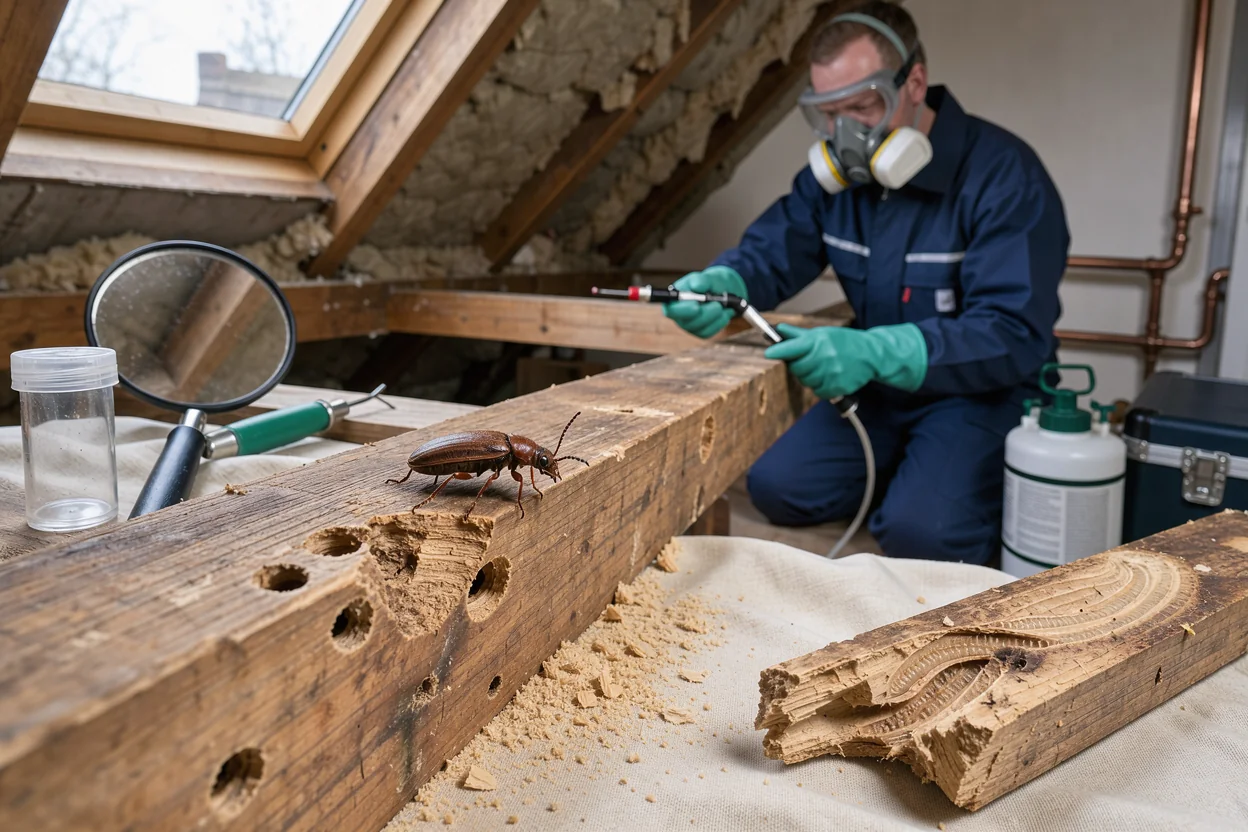
Are there termites in the UK? Not as settled, spreading colonies. Cold, damp winters have so far stopped termites from taking hold, and the holes, dust and crumbling timber that people blame on them almost always come from beetles. This guide rounds up the four wood-boring beetles that genuinely live in British buildings: the common furniture beetle, the deathwatch beetle, the powderpost beetle and the wood-boring weevils. For each one you will see who it affects, what it leaves behind, where identification goes wrong and what to do next.
Why termites do not live in British homes
Termites are warm-climate insects. The subterranean species found around the Mediterranean need steady warmth to keep a colony growing, and a British winter slows that growth sharply. Their colonies also depend on soil moisture and timber sitting close together, which is harder to find under a cold, paved city street than in warmer countries. Established populations do live in France, a short train ride away.
There is one well-known exception. In the 1990s a colony of subterranean termites was found in a house in Saunton, Devon, and the discovery led to a long government-backed eradication effort. No wider outbreak followed. Heated buildings can shelter insects that the outdoor climate would kill, so a rare indoor find is possible, but termites have never become a national pest.
The more realistic route in is trade. Termites can travel inside imported timber, furniture and plant containers, so isolated finds linked to imports remain possible, though rare. If something looks like a termite, treat it as a find to confirm. Photograph the insect and the damage, keep a sample in a sealed container, and arrange a professional termite inspection instead of relying on an online image match.
What counts as a real wood pest in a British home
A beetle earned a place here by passing three tests. It breeds inside British buildings today. Its evidence is something an ordinary householder can find with a torch and a ruler. And it changes what you do next, because each species points to a different timber, a different level of risk or a different underlying problem.
Three things stayed off the list. Termites are one, for the reasons above. The house longhorn beetle is another: a serious pest of softwood roof timbers, but largely confined to parts of Surrey and Hampshire, with oval exit holes roughly 6 to 10 mm wide that are hard to confuse with anything else. The third group is look-alikes that do not bore wood at all, such as flying ants and fungal rot.
One note on the word native. The common furniture beetle and deathwatch beetle are long-standing British residents. The powderpost beetle and some wood-boring weevils are thought to have arrived with imported timber. All four now breed in British buildings, and that is what matters to a homeowner.
The four wood-boring beetles found in British timber
Each profile covers who the beetle tends to affect, what it leaves behind, where identification can mislead and how seriously to take it.
Common furniture beetle: the usual cause of woodworm
Most people who say woodworm mean this one. Anobium punctatum is a small brown beetle, roughly 3 to 5 mm long, whose larvae tunnel through softwood floorboards, joists, stair strings and older furniture. It is the beetle most likely to turn up in older houses, especially where softwood floors sit above a damp or poorly ventilated void.
Say you lift a carpet in a Victorian terrace and find a scatter of pin-prick holes in the pine boards. That is the textbook scene. Look for round holes about 1.5 to 2 mm wide. The dust beneath them is gritty and made of tiny lemon-shaped pellets, visible under a hand lens. Adults emerge from about May to August, after feeding as larvae for three years or more, so fresh holes with pale dust below them in summer point to a living infestation.
The honest limit is the hole count. Dozens of dark, dusty holes often mark an infestation that ended years ago, so check the age of the holes and the moisture in the timber before you worry. In short, this beetle is common, treatable and rarely urgent unless it runs through load-bearing joists or roof timbers.
Deathwatch beetle: the specialist of old, damp oak
Xestobium rufovillosum is larger, around 6 to 9 mm, with a mottled brown body flecked with pale hairs. It favours oak and other hardwoods that damp or fungus has already softened. That puts it in medieval roofs, church beams, timber-framed houses, converted barns and the oak wall plates built into older brick. The oak roof of Westminster Hall is one of its best-known victims.
Its flight holes are round and around 3 mm across, and the dust contains coarse, bun-shaped pellets. In spring, usually April to June, adults tap their heads against the wood to attract mates. That faint ticking in a quiet room gave the beetle its name. The larvae develop slowly, often over many years, so damage builds quietly before anything shows.
The limit is that ticking alone proves nothing, because pipes and cooling timber tick too. Confirm with holes and pellets. This beetle is rare in ordinary twentieth-century houses and serious in old oak. Because it favours timber already weakened by damp, the repair is as much about stopping the leak as treating the insect, and any load-bearing oak needs a specialist's eye.
Powderpost beetle: flour-fine dust from newer hardwood
Lyctus brunneus is a slender, reddish-brown beetle about 3 to 7 mm long. Its larvae feed on the starchy sapwood of hardwoods such as oak, ash and elm. Unlike the two beetles above, it prefers newly seasoned or recently made timber, so it appears in new oak flooring, parquet, imported hardwood furniture and panelling rather than in old joists. It matters most to anyone who has recently bought or fitted hardwood.
The holes are small and round, about 1 to 1.5 mm wide, and the dust is so fine that it feels like talcum powder. Tap a board and a thin stream can fall out. Adults emerge from early summer, so the first signs often arrive in the first or second summer after fitting.
The limit works in your favour. Larvae need starch, and once the sapwood has little left, an infestation tends to fade. Before then, it can leave a board hollow beneath a sound-looking surface. Usually this is a local problem, often fixed by replacing the affected board or item, and worth reporting to the supplier while the purchase is fresh.
Wood-boring weevils: the damp-timber warning
Pentarthrum huttoni and Euophryum confine are small, dark beetles, roughly 3 to 5 mm long, with a clear snout. The other three beetles choose timber by species or age. Weevils choose by condition. They attack wood that is already wet and rotting, which sends them to cellars, basement flats, ground-floor skirtings, joist ends and the boards under a leaking bath. Adults and larvae both feed.
Look for very small, irregular holes around 1 mm wide, wood that crumbles into fine granular dust, and tunnelling that follows the wet area. From a distance the damage resembles common furniture beetle work, which is the main trap. Treat the timber and ignore the leak, and the problem returns.
Finding weevils means you have found a moisture problem with a beetle attached. Drying the timber and repairing the source of water does much of the work, and wood that has lost its strength may need replacing.
Matching the hole to the beetle
Hole size, dust texture and timber type narrow the field quickly. You need a ruler or a printed millimetre scale, a torch, a hand lens and a sheet of dark card to catch dust.
| Beetle | Flight hole | Dust | Timber it favours |
|---|---|---|---|
| Common furniture beetle | 1.5 to 2 mm | Gritty, lemon-shaped pellets | Softwood floors, joists and older furniture |
| Deathwatch beetle | About 3 mm | Coarse, bun-shaped pellets | Damp-softened oak and other hardwoods |
| Powderpost beetle | 1 to 1.5 mm | Talc-fine and floury | Sapwood of new hardwood |
| Wood-boring weevils | About 1 mm, irregular | Fine and granular | Wet, rotting timber |
Season adds a second clue. Fresh holes have clean, pale edges, while old ones turn dark and dusty. To test for activity, lay dark paper or card under a cluster of holes in late spring and leave it through the summer. Fresh dust on the paper means larvae are still feeding or adults are emerging. A clean sheet is encouraging, though one quiet summer is not a guarantee.
A simple flight-hole selector would speed this up. You would enter the hole width in millimetres, the dust texture and the timber type, and it would name the likeliest beetle and say whether a survey is worth booking.
What gets mistaken for termites in a British home
Many suspected termite sightings turn out to be flying ants. Winged reproductive ants leave their nests on warm, humid days in mid-summer, often in July and August, and crowd around windows and lights. They look alarming, but they usually come from ant nests in lawns, walls and paving.
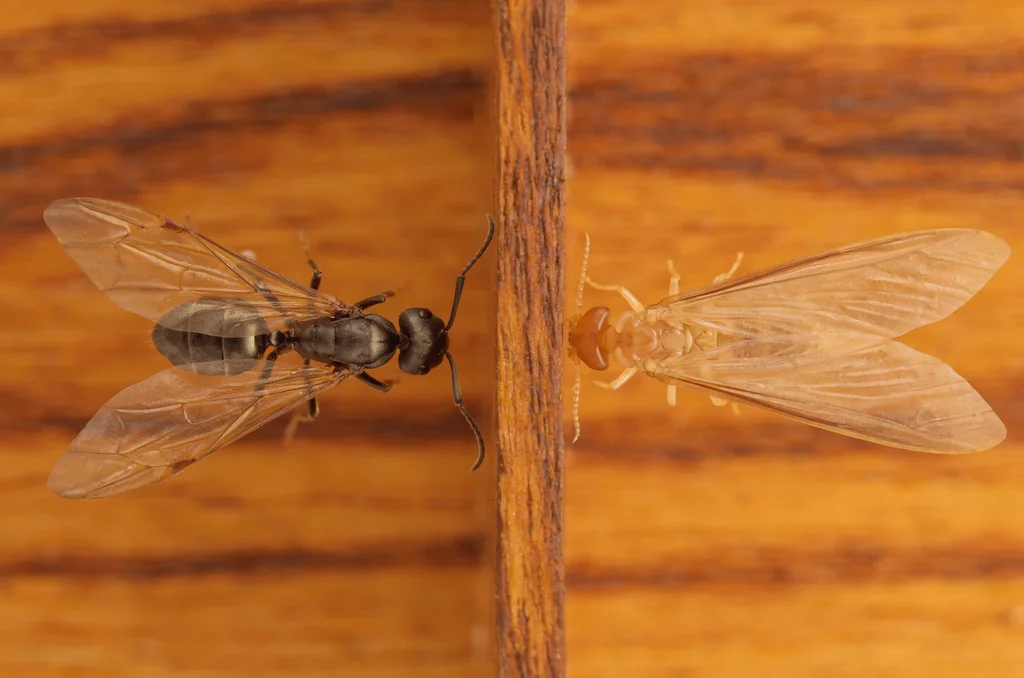
Three checks separate flying ants from termite swarmers. Ants have elbowed antennae, a pinched waist and front wings longer than the back pair. Termite swarmers have straight, beaded antennae, a thick waist with no pinch and four wings of equal length. If an insect matches the second description, photograph it and keep a sample.
Damage patterns help too. Wood-boring beetles leave round exit holes and loose dust. Termites hollow timber from the inside, leave a thin outer skin and pack their galleries with soil, and subterranean species build mud tubes across masonry. No British beetle does that.
Fungal rot gets blamed for insect damage as well. Dry rot and wet rot are fungi. Dry-rotted wood turns brittle and cracks into cube-shaped pieces, while wet-rotted wood darkens and softens. Neither needs an insect, although rotting timber is exactly what the deathwatch beetle and weevils prefer. Some ants also nest in damp, decayed wood and push out fine debris that can pass for woodworm dust, so look for the ants themselves before you reach for insecticide.
When a hole needs a surveyor, and how to choose one
A few old holes in a stored chair are a small job. These signs move a case towards a specialist visit:
- Holes or dust in joists, roof timbers, wall plates, beam ends or stair strings.
- Fresh pale dust that reappears after you have vacuumed.
- Timber that gives way when you press a screwdriver tip into it.
- A ticking sound in oak beams on spring evenings.
- Damp patches, a musty smell or a leak near the affected wood.
- Any insect or swarm that matches the termite description above.
For light cases, such as one chair, a stored wardrobe or a short run of skirting, a shop-bought woodworm fluid used exactly to the label can be enough. Treat these products as insecticides. Ventilate the room, wear gloves, and keep children, pets and food preparation areas clear until the timber is dry. Fluids penetrate thick timber poorly, so they are no substitute for assessing a joist.
Anything structural, or any case driven by damp, needs a proper survey. Residential pest control firms and timber-treatment specialists can confirm the species from photos and a sample, judge whether the infestation is active and say whether the wood is still sound. Landlords and food business managers should also keep dated photos and notes from the first sighting, because a clear record makes later decisions easier.
Check credentials before you book. This guide to the official BPCA directory explains how to verify a pest control firm's membership of the British Pest Control Association. For structural timber repair, also ask whether the firm holds timber-treatment credentials, for example through the Property Care Association.
Which beetle to suspect first, by situation
The right first suspect depends on the room, the timber and the season.
- Pin-prick holes in softwood floorboards or a pine wardrobe in an older house: suspect the common furniture beetle, then check whether the void underneath is damp.
- A ticking sound at night from oak beams in a period or converted building: suspect the deathwatch beetle and ask a specialist to examine the oak before anyone drills or treats it.
- Floury powder from a new hardwood floor or imported hardwood furniture: think powderpost beetle, and contact the supplier while the purchase is recent.
- Tiny holes and crumbling wood in a basement, cellar or beneath a leaking bathroom: this is the weevil pattern, so trace the water first.
- Pale, soft-bodied insects in timber, mud tubes on masonry, or a swarm you cannot tie to ants: collect a sample and arrange termite identification the same day.
The overlooked pick is the wood-boring weevil. It is small and unglamorous, and its holes look like ordinary woodworm. Yet it tells you more about the building than the other three, because it only thrives in wet timber. Spotting one is an early warning of a leak, penetrating damp or poor ventilation, and fixing the water protects nearby timber from rot as well.
Questions about termites and woodworm in UK homes
Is woodworm another name for termites?
No. Woodworm is the grub stage of wood-boring beetles. Each grub lives alone in the timber. Termites are social insects, related to cockroaches, that live in large colonies.
Can termites survive a British winter indoors?
Outdoors, a cold British winter stops them from establishing. Inside a heated building a colony might persist, so any suspected find deserves confirmation rather than a shrug.
Do old woodworm holes mean the infestation is still active?
No. Holes last for the life of the timber. Look for clean-edged holes, fresh pale dust and the paper test described above before assuming anything is still alive.
Can I treat woodworm myself?
For one small item, yes, using a product to its label and following the safety steps above. For floors, joists or roof timbers, get a survey first. If any holes are still producing fresh dust after a full summer, book a survey whatever the item.