
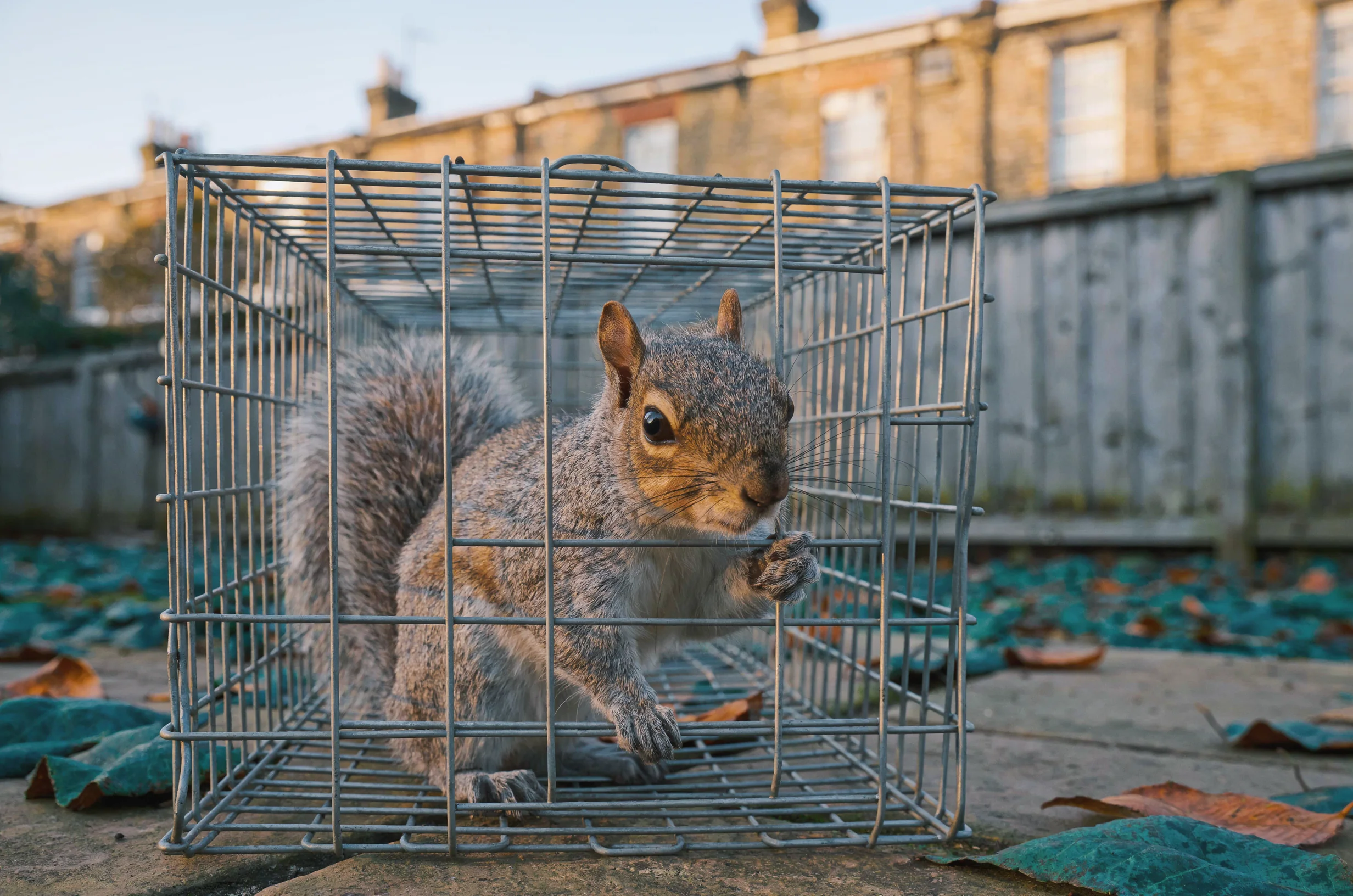
Is it legal to release trapped squirrels in the UK? For deliberately trapped grey squirrels, ordinary catch-and-release into a garden, park or woodland is prohibited. Householders need to understand the lawful outcome before setting a live trap. The restriction predates the 2019 invasive species enforcement changes, as Defra’s 2019 announcement explains.
The more recent policy context is England’s 2026 policy statement, updated on 6 February 2026. It identifies competition with native red squirrels, the spread of squirrelpox and damage to trees as reasons for managing grey squirrel populations. Its programme includes training, coordinated management and research.
For someone facing a squirrel in a cage today, the immediate decisions concern species, capture circumstances and welfare. Freeing an animal accidentally tangled in netting is a different situation from opening a deliberately set trap. Care and transport rules also differ between UK nations.
The law restricts release even where grey squirrels already live
The release restriction applies to grey squirrels despite their familiar presence in gardens and parks. Seeing them locally does not give a householder permission to release another captured animal.
What Section 14 controls
In England and Wales, Section 14 of the Wildlife and Countryside Act 1981 controls releases of specified animals into the wild. Schedule 9 includes established non-native species whose further release remains regulated.
The official Section 14 guidance explains the purpose: preventing ecological, environmental and other harm from releases. Grey squirrels fall within this legal framework.
For householders, a garden boundary does not create an exemption. Releasing a deliberately caught grey squirrel on your own land still raises the release prohibition. Moving the cage to woodland creates no general permission either.
For example, someone considering Hampstead squirrel control should establish the proposed handling method before trapping begins. Nearby woodland should never be assumed to be an acceptable release destination.
What changed in 2019
Defra’s announcement of 1 March 2019 explained that the Invasive Alien Species (Enforcement and Permitting) Order 2019 would take effect that October. Release without a licence was already an offence.
The announced change included Natural England ceasing to issue grey squirrel release licences. Defra said this brought England into line with established policies elsewhere in the UK.
That history matters when older advice recommends rehabilitation followed by release. A dated rescue account or an old licence arrangement cannot establish what a householder may do now. Check the current national guidance before taking an animal into captivity.
Why woodland release remains restricted
The conservation concern extends beyond damage inside a particular house. Grey squirrels compete with red squirrels and can transmit squirrelpox, which is usually fatal to reds. Bark stripping can also weaken or kill trees.
The policy implication for a homeowner is straightforward: a wooded destination does not make relocation harmless or lawful. Establish how the animal will be handled before agreeing to its capture.
Accidental restraint has a specific exception
A grey squirrel tangled unintentionally in wire netting presents a different situation from one caught in a baited cage.
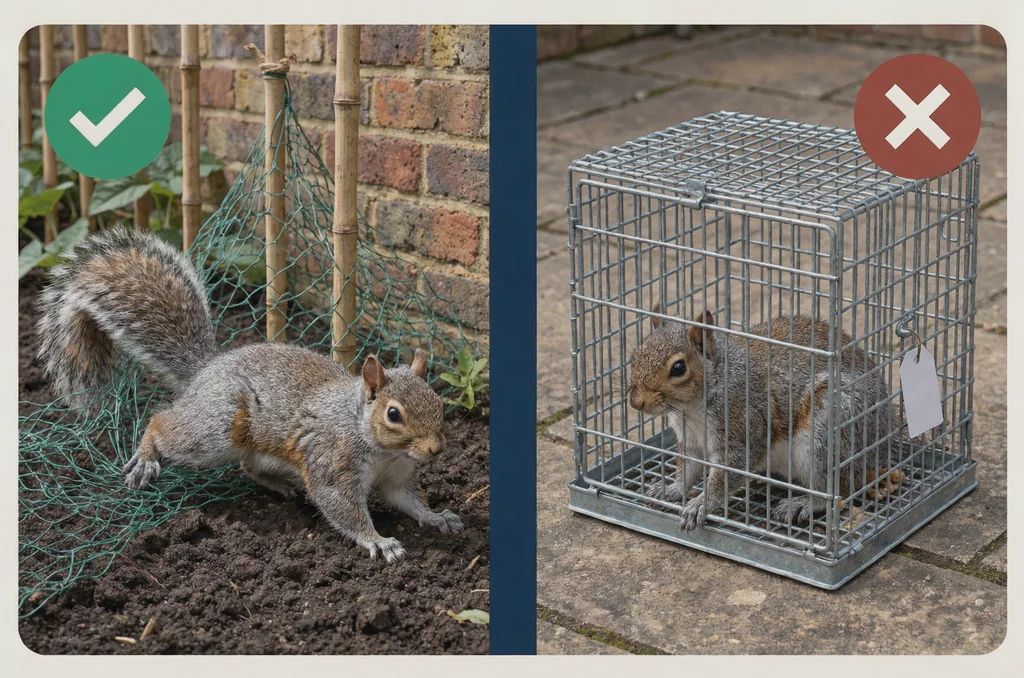
The England and Wales guidance expressly allows an accidentally restrained animal to be freed. It gives wire netting as an example and explains that this is not treated as an intentional release. Separate provisions also address accidental capture during ringing or monitoring operations.
Describe the circumstances accurately when seeking advice. Useful details include what restrained the animal, whether equipment was deliberately set to capture wildlife, and whether the squirrel has already been removed from the location.
Do not treat every unexpected catch in pest-control equipment as permission to release. A cage set for another species needs advice about that particular situation. The word accidental alone does not resolve every legal question.
For a squirrel loose inside a room or trapped within a structure, explain its position before attempting capture. Avoid turning a situation that needs assessment into deliberate confinement without a handling plan.
A practical incident record should distinguish an animal caught in netting, one loose indoors and one confined in a live-catch trap. Note when it was found and whether it appears injured. Keep people and pets away while obtaining advice, and do not attempt to untangle an animal if doing so would expose you to bites.
Handling rules differ between the UK nations
Grey squirrel release is restricted across the UK, but instructions about possession, rescue and transport need to match the country involved. Advice written for England should not automatically be applied in Scotland or Northern Ireland.
England and Wales
Government guidance directs people who have already taken a listed invasive animal from the wild towards a facility with the appropriate licence or permit. It also addresses humane control by people with suitable training and equipment.
A facility’s permission and willingness to accept the animal must be established first. Ask the relevant authority about an appropriate facility before arranging transport.
For readers in London, the relevant starting point is England’s guidance. A rescue organisation elsewhere may operate under different permissions.
Scotland
NatureScot’s explanation dated 27 October 2025 describes offences involving keeping, possessing and transporting grey squirrels. It states that there is no provision to license their keeping for rehabilitation and release.
NatureScot’s published legal explanation also addresses proposed journeys from Scotland to rescue facilities in England or Wales. A nearby English facility does not automatically make that journey lawful.
Someone dealing with a grey squirrel in Scotland should obtain advice from NatureScot, a vet or the Scottish SPCA before taking possession or attempting transport. Explain whether the animal is injured, confined or merely present on the property.
Northern Ireland
Northern Ireland’s control guidance states that trapped grey squirrels must not be released and must be humanely dispatched. It connects the restriction with protecting native red squirrels.
An untrained householder should arrange competent assistance. Describe the capture circumstances and the animal’s condition when seeking help from the relevant wildlife authority or a suitably experienced professional.
A live trap brings immediate welfare responsibilities
A deliberately trapped grey squirrel needs prompt attention. The restriction on release does not remove the obligation to avoid unnecessary suffering.
The RSPCA squirrel trapping guidance explains that wild animals under human control are covered by animal welfare requirements. It recommends checking live-catch traps several times a day and advises that control should be carried out legally and humanely by trained professionals.
Arrange help before handling the cage
If a grey squirrel is already confined, keep children, pets and unnecessary activity away. Avoid putting fingers through the mesh or opening the trap to inspect the animal.
When contacting someone who may take over, provide:
- The property’s location and UK nation.
- Whether the animal is definitely a grey squirrel.
- How it became confined.
- When the trap was last known to be empty.
- Any visible injury, collapse or breathing difficulty.
Ask what should happen while assistance is being arranged. Do not attempt a killing method you cannot perform humanely, and do not leave the animal unattended while assuming another person will deal with it.
A proposal for professional squirrel control should explain who checks traps, who handles captures and what happens if a different species is caught. Establish the arrangements for evenings and weekends before equipment is set.
A rescue centre needs the right permission
In England and Wales, government guidance identifies appropriately licensed or permitted facilities as a possible route for animals already taken from the wild. This requires an actual receiving arrangement.
Ask whether a facility can lawfully accept a grey squirrel and whether it can take this particular animal. Acceptance should never be assumed.
Humane dispatch or veterinary euthanasia may be the outcome. A householder does not need to improvise that procedure personally; the practical task is to obtain competent help promptly.
Before moving a cage, confirm the destination and obtain advice about lawful transport. Record the name of the person who agreed to receive the animal.
Loft repairs need an occupancy check before proofing
Removing one trapped squirrel does not establish that a roof space is empty. For homeowners and landlords, the repair plan should include an assessment of remaining activity before access points are sealed.
Record activity without disturbing the roof space
If you hear movement above a bedroom, note the time, location and whether it recurs. From a safe position, record any visible movement through roofline gaps.
Photographs can help explain the location to someone assessing the property. Avoid climbing onto a roof or moving insulation to pursue an animal.
For a hypothetical Camden terrace with a shared roofline, the inspection may need to consider adjoining access routes. A discussion about squirrel removal in Camden should identify which parts of the building will be inspected and who can authorise access.
Ask the assessor to identify the evidence behind the diagnosis. Scratching sounds alone should not settle the species or treatment plan. Where wiring appears damaged, keep away from it and arrange an electrical safety assessment.
Agree who checks before holes are closed
Before proofing begins, ask how the assessor will establish whether animals or dependent young remain inside. Do not block an occupied entrance as an improvised solution.
A written work plan should identify the suspected entrance, the inspection required and the condition that must be met before sealing. It should also say who returns if activity continues.
In a rented property, report the location and timing of noises to the landlord or managing agent. Where several flats share a roof space, nominate someone to coordinate access and keep the inspection record.
After work, record fresh noises or visible entry rather than assuming they are unrelated. A new sound in an adjoining room is a reason to review the occupancy assessment before further gaps are closed.
Questions householders ask about trapped squirrels
The answers depend on the species, the capture circumstances and the UK nation. These distinctions should be settled before anyone opens or moves a trap.
Can I release it back into my own garden?
For a deliberately trapped grey squirrel, returning it to the garden does not provide a general exemption. Ownership of the land does not override the release restriction.
Accidental restraint has a separate exception in England and Wales. Describe exactly how the animal became confined when obtaining advice.
Can I take it somewhere with no red squirrels?
A householder cannot create permission by choosing a destination they believe is suitable. The absence of visible red squirrels does not establish a lawful release site.
Do not load a deliberately trapped grey squirrel into a car for relocation. Arrange competent advice about the animal where it is confined.
Does this mean I must trap squirrels visiting the garden?
In England and Wales, the government’s invasive species guidance says people do not have to take action merely because a widely spread listed animal is on their land.
The decision to intervene should start with the actual problem. Record any building entry or damage before deciding whether control is needed.
Are red squirrels covered by the same release ban?
Red squirrels have a different legal status. They and their resting places receive protection, as NatureScot’s red squirrel guidance explains.
Do not apply grey squirrel control instructions to an unidentified squirrel. If identification is uncertain, stop and obtain species-specific advice before further handling.
Will the council deal with a trapped squirrel?
Ask your council whether it handles squirrels and whether it can respond to an animal already confined. Establish availability before relying on that route.
A guide to council pest control charges can help with cost questions. For an animal already trapped, confirm who can take responsibility and when.
What to establish when arranging squirrel work this week
A householder arranging squirrel work needs a clear account of the proposed method and the outcome after capture. Ask for these details before authorising a trap.
- What evidence identifies grey squirrels and confirms where they are entering?
- Who checks each trap, and how often will checks happen?
- Who is trained and equipped to handle a captured animal humanely?
- What happens if another species is caught?
- How will the roof space be assessed before proofing?
- What follow-up is included if activity continues?
A BPCA pest control directory guide can help organise the search for a contractor. Ask directly about experience with squirrel work, access arrangements and the proposed handling method.
A simple digital incident checklist could record the UK nation, suspected species, capture circumstances, time found and signs of injury. Its output should be a short factual record for the person taking over.
For future legal changes, watch guidance published by the relevant national wildlife authority. Research announcements about population management should be assessed separately from permissions governing an individual captured animal.
At the property, the signal to watch is fresh movement or visible entry after work. Record its time and location, then have the occupancy assessment reviewed before further sealing.