

How much do the council charge for pest control? There is no single UK tariff, and council treatment versus a private firm may overlook a third option: an existing arrangement through your landlord or managing agent.
The amount payable depends on the service available for your address, the pest, your eligibility and the work included. A useful comparison needs your council’s applicable charge and a private written quote for the same problem. Without those figures, a precise national price range would be guesswork.
Start with the full treatment cost, the first available appointment and the return-visit terms. Neither a council booking nor a private appointment automatically represents better value. A low initial fee can become expensive if necessary follow-up work sits outside it.
Find the council charge that applies to your property
A council price is useful only when it applies to your address, property type and pest. A tariff for another district, a different insect or a commercial premises cannot answer what your household will pay.
Before comparing providers, establish whether the council accepts bookings for your situation. Ask about the exact pest and affected area: mice inside a kitchen, suspected rats beneath decking or insects in several bedrooms.
Use these questions to identify the applicable charge:
- Does the service cover this pest at this address?
- Is the quoted amount for an inspection, one treatment visit or a treatment course?
- Does the domestic tariff apply to the property?
- Is any concession or no-charge arrangement available, and what evidence is required?
- Does the amount shown include all applicable taxes and booking charges?
A concession matters only if you qualify. Check its scope too: a reduced charge for one pest does not establish the price for another.
Keep treatment and investigation separate when reading the booking terms. If you have heard scratching but have no clear identification, ask what happens if the inspection finds a different pest. Also ask whether the inspection payment counts towards subsequent treatment.
Save the applicable tariff or written estimate with its date. Confirm that it remains valid when you book, particularly if the appointment falls after a published pricing change.
Compare council treatment, private treatment and housing arrangements
Council and private treatment should be judged against the same needs: confirmed pest, property access, treatment scope, appointment dates and total payable. An existing housing arrangement deserves a separate check before you commit money.
Council treatment when its package matches the problem
Council treatment is worth considering when the available service covers your pest and the appointment fits your circumstances. A clearly defined package can make budgeting straightforward.
Its suitability depends on the actual terms. Establish whether the booking covers one room, the whole dwelling or a specified course of visits. Ask how additional activity is handled after that course ends.
The council route becomes less useful if the required work falls outside its service. For example, you may need a separate quotation for repairs or work in shared areas. Include those costs in the comparison.
Private treatment when the quote covers your priorities
A private firm is worth considering when its written proposal matches your required timing, access needs and treatment scope. Ask it to separate inspection, treatment, return visits and prevention work.
Check any advertised availability against an actual appointment. A general promise of rapid attendance does not establish when a technician can reach your property.
Private treatment can also become expensive when an attractive starting price leaves necessary work undefined. Request the conditions under which the total could increase. For help assessing credentials alongside price, use this BPCA directory guidance.
An existing landlord or managing-agent arrangement
If you rent or occupy a managed building, ask whether a pest contractor is already appointed. Provide photographs, dates and the locations of sightings.
This route may help coordinate access where several flats or shared spaces need inspection. Payment responsibility and service coverage still need confirmation; an existing contract does not establish that your particular problem is included.
Before arranging your own treatment, ask who can authorise work, which areas the contractor can enter and whether reimbursement requires advance approval.
Match the treatment fee to the pest and affected area
A council rodent package and a private insect treatment are different purchases. Compare quotations for the same identified pest, affected rooms and proposed work.
Rats and mice: separate treatment from entry-point work
For a rodent quotation, describe where activity has occurred and what evidence you have. Kitchen cupboards, a loft and an outside bin store may require different access arrangements.
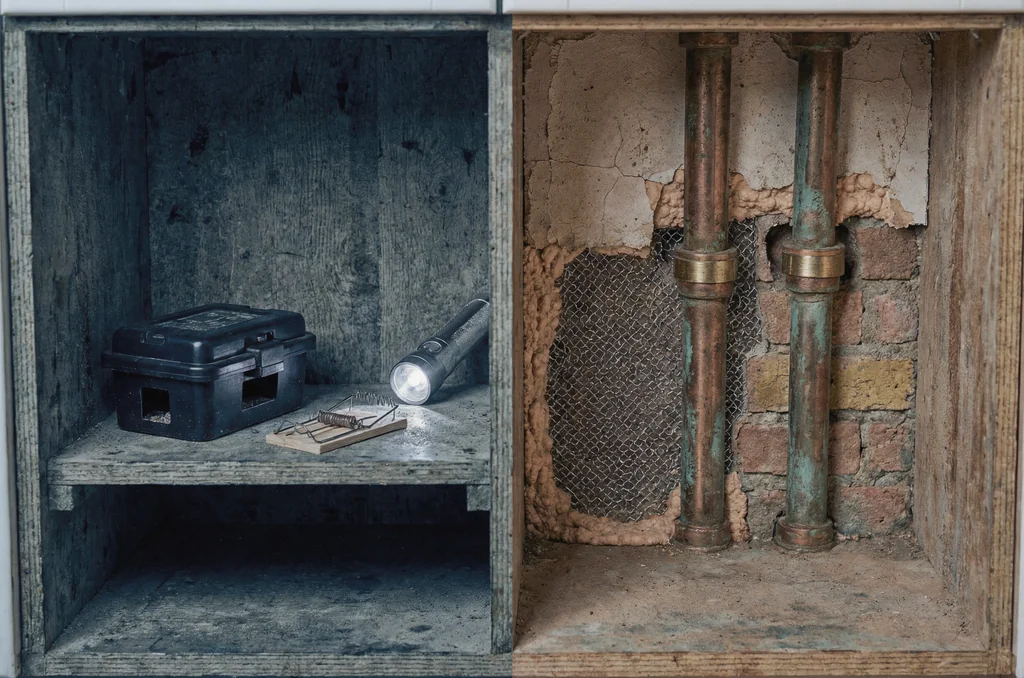
Ask whether the price includes an inspection for possible entry points. Then establish whether closing those openings is included, separately priced or outside the contractor’s work.
A quotation that covers treatment alone needs a different budget from one that also includes specified repairs. Request a description of each proposed repair, its location and its price.
The rodent treatment cost checks provide a more focused way to examine rat and mouse quotations. Keep any London examples separate from the tariff applicable elsewhere.
Bed bugs and cockroaches: define rooms and follow-up
For suspected bed bugs, state how many rooms have signs and whether identification has been confirmed. Ask what preparation is required, which belongings need attention and how follow-up is arranged.
When comparing bed bug treatment, request the proposed method and the conditions attached to further visits. Do not assume that two quotations with the same pest name cover identical work.
For cockroaches, describe sightings by room and location. Ask how the quotation changes if activity is also found in another kitchen, a service cupboard or an adjoining unit.
Readers dealing specifically with that pest can examine council cockroach treatment charges. For this broader comparison, the deciding question remains whether both quotes cover the same affected area and follow-up.
Wasps: distinguish treatment from physical nest removal
For wasp nest removal, describe the visible activity and where the suspected nest sits. State whether access involves a loft, roofline, wall cavity or outbuilding.
Ask whether the charge covers treatment, physical removal, or both. Clarify what happens if the technician cannot reach the suspected location.
Confirm any extra access cost before accepting the booking. Photograph the location from a safe distance rather than disturbing the nest to obtain a closer view.
Calculate the full cost before comparing headline fees
The useful council-versus-private calculation includes every agreed charge needed to complete the proposed work. Keep optional improvements separate so they do not obscure the treatment comparison.
Add the visits each quotation actually requires
Use the same calculation for both options:
Total payable = initial charge + chargeable return visits + agreed additional work + any applicable taxes or fees.
First establish whether return visits are included. An initial fee and a complete treatment-course price should not be compared as equivalent purchases.
For a hypothetical example, suppose one quotation charges £90 per visit and requires two visits. Its treatment total is £180. A competing package covering both visits at £150 would cost £30 less.
Those figures illustrate arithmetic; they are not current council tariffs or private market rates. Either provider could use either charging structure.
Where the number of visits is uncertain, request the additional visit price and the trigger for charging it. Record the uncertainty rather than treating it as a zero-cost item.
Keep preparation and repairs visible
Your practical budget may also include preparation, access arrangements, cleaning or separately commissioned repairs. Ask which tasks are necessary for the proposed treatment and who must arrange them.
Avoid adding speculative costs. Include an expense only when it applies to your property or the written treatment instructions.
A useful comparison calculator could total the initial charge, paid revisits, agreed repairs and applicable fees for each quote. Unknown amounts should remain flagged rather than default to £0.
Before payment, ask each provider to identify every item that remains outside its quoted total.
Compare appointment dates with the whole treatment schedule
Council and private response times need an actual booking comparison. Request the earliest available appointment from each, then ask how later visits will be scheduled.
A first visit and a completed course have different dates
A same-day inspection can answer questions without completing treatment that day. Equally, a later first appointment may come with clearly arranged follow-up.
Ask what the first visit is intended to achieve: identification, inspection, treatment or a combination. Establish what must happen before work can begin.
Useful scheduling questions include:
- When is the first appointment available?
- Can treatment begin during that visit?
- Are further visits booked immediately or arranged later?
- What access must remain available between appointments?
- Who should receive reports of continued activity?
For a household, preparation time may affect which appointment is workable. For a business, access and operating hours may shape the treatment plan. Give both providers the same constraints before comparing dates.
Ask for treatment-specific instructions concerning children, pets, food preparation and any period away from treated areas. Obtain those instructions before agreeing to a time you cannot accommodate.
Read the return-visit promise and guarantee separately
An included revisit is part of the purchased service. A guarantee is a separate promise governed by its written conditions.
Request the duration, scope and exclusions of any guarantee. Ask how continued activity is assessed, whether an inspection charge applies and what action the provider promises.
Also establish what happens after the included treatment course. Further sightings might lead to advice, reassessment or another charge, depending on the terms.
Neither a council service nor a private company should receive credit for an unspecified guarantee. Compare the written response to continued activity and record any deadline for reporting it.
Shared buildings need a clear scope and payer
Council and private quotes can both fall short if nobody has established who can authorise access beyond your own rooms. In a block of flats or mixed-use building, raise that question before accepting a narrowly defined treatment.
Describe any reported activity in communal corridors, bin stores, service cupboards or neighbouring units. Distinguish what you have personally seen from what someone else has reported.
Ask the landlord, freeholder or managing agent to confirm:
- Which parts of the building can be inspected.
- Whether an existing contractor should attend.
- Who authorises treatment and separately quoted repairs.
- How neighbouring occupiers will receive access requests.
- Who receives the inspection findings.
These questions help establish the scope of a quotation. They do not decide legal responsibility for payment.
For a rented home, report the issue in writing and retain the response. Ask for payment responsibility to be confirmed before assuming that you must pay or will be reimbursed.
For a business, distinguish an immediate treatment booking from an ongoing monitoring contract. Request separate prices and service descriptions. A domestic treatment fee cannot establish the cost of a commercial arrangement with different access and reporting requirements.
Questions about council fees before you book
The remaining council-versus-private questions usually concern eligibility, uncertain identification and the point at which another charge can arise. Settle them while both options are still open.
Is council pest control always cheaper?
No. Compare the council’s applicable total with the private quote for equivalent work. Included visits, eligibility and separately priced repairs can change the result.
A lower initial charge establishes only the starting payment. Check what you would owe if the proposed course needs an additional visit.
Can council pest control be free?
Check whether a no-charge service or concession applies to your address, pest and circumstances. Do not assume that council tax, benefit entitlement or a particular tenancy automatically establishes eligibility.
Ask what evidence is required and whether approval must be obtained before booking or payment.
What if the technician cannot identify the pest?
Ask about this before paying. Establish whether the inspection charge remains payable, whether another visit costs extra and whether photographs or a safely obtained specimen would help identification.
If you have only an unexplained noise or a skin mark, describe that uncertainty accurately. Request the cost of identification before authorising a pest-specific treatment course.
What should be confirmed before payment?
Obtain the pest being treated, affected areas, initial fee, included visits, additional visit charges and preparation instructions. Add the appointment date, cancellation terms and any written guarantee.
For a confirmed problem within a clearly defined area, choose the quotation whose total and schedule fit the work required. Where identification, shared access or payment responsibility remains uncertain, resolve those points before accepting a treatment package.