

Search for Camden Town London restaurants and you will find lists of where to eat: the street food stalls around Camden Lock, the Greek tavernas on Plender Street, the new openings that keep arriving in NW1. What those lists never show is the other side of a Camden food business, the part that decides whether a restaurant stays open at all. This article is built around a filmed walkthrough of Camden's food scene, the WORST vs BEST food at Camden Market video by Eating With Tod, which captures the sheer density of hot food trading in one postcode. We use that footage as a starting point, then go where food vlogs never go: behind the pass, under the sinks and along the rear yard, with the same checklist a pest-control technician uses when inspecting a working NW1 kitchen.
What the Camden Market footage shows and what it misses
The video follows a queue forming at a Camden Market stall before half ten in the morning. Within minutes there are dozens of customers waiting, and the stall is already frying, portioning and serving at full pace. That is a fair snapshot of trading in this part of London. Camden's food economy starts early, runs late and produces a continuous stream of waste: chip scoops, sauce pots, cooking oil, packaging, spilt drinks.
What the camera never sees is where all of that goes at the end of the night. Every stall and restaurant within a few streets of the market shares the same drainage runs, the same service yards and, in many cases, the same party walls. A rat does not distinguish between a viral street food stall and the quiet café next door. It distinguishes between a yard with a lidless bin and a yard without one.
This matters more now than it did a few years ago. Industry analysis from IBISWorld notes that warmer, wetter UK winters are shortening rodent dormancy and lengthening breeding seasons, pushing rats deeper into towns and cities and lifting demand for prevention-led contracts. Pest control firms across the country report rats as their most common callout, with year-on-year increases in rodent work of over 40 per cent in recent seasons. Camden, with its canal, its market and its concentration of food premises, sits near the front of that trend. The borough's own draft Clean Air Action Plan attributes more than 28 per cent of local PM2.5 emissions to commercial cooking, which tells you how many hot food kitchens are packed into NW1 and how much organic waste they generate between them.
The route a technician takes through an NW1 kitchen
A proper commercial inspection follows the rat's logic, not the customer's. The technician starts at the back of the building, because that is where most infestations start too.
The rear yard and bin store
Before stepping inside, the yard gets a slow look. The technician is checking for droppings along the wall line (rats prefer to travel with one side of the body against a surface), gnaw marks on bin lids and the bottoms of doors, and grease trails where a regular run crosses a step or threshold. In Camden's older terraces, the yard is often the weakest point: shared access, rotting fence panels, drain covers that no longer seat properly. If a takeaway stores its waste oil in an open container here, everything else the business does indoors is undermined.
Under the sinks and behind the white goods
Inside, the first stops are the voids nobody cleans daily. Under a commercial sink there is warmth, water and, frequently, a pipe entry hole cut far larger than the pipe itself. A gap of 15 millimetres admits a mouse; a rat needs only slightly more at the skull. The technician runs a torch along the pipework and looks for smear marks, the dark greasy rubs left where fur brushes the same edge night after night. Smears are more useful than droppings for telling you a run is active rather than historic, because fresh grease shines under torchlight.
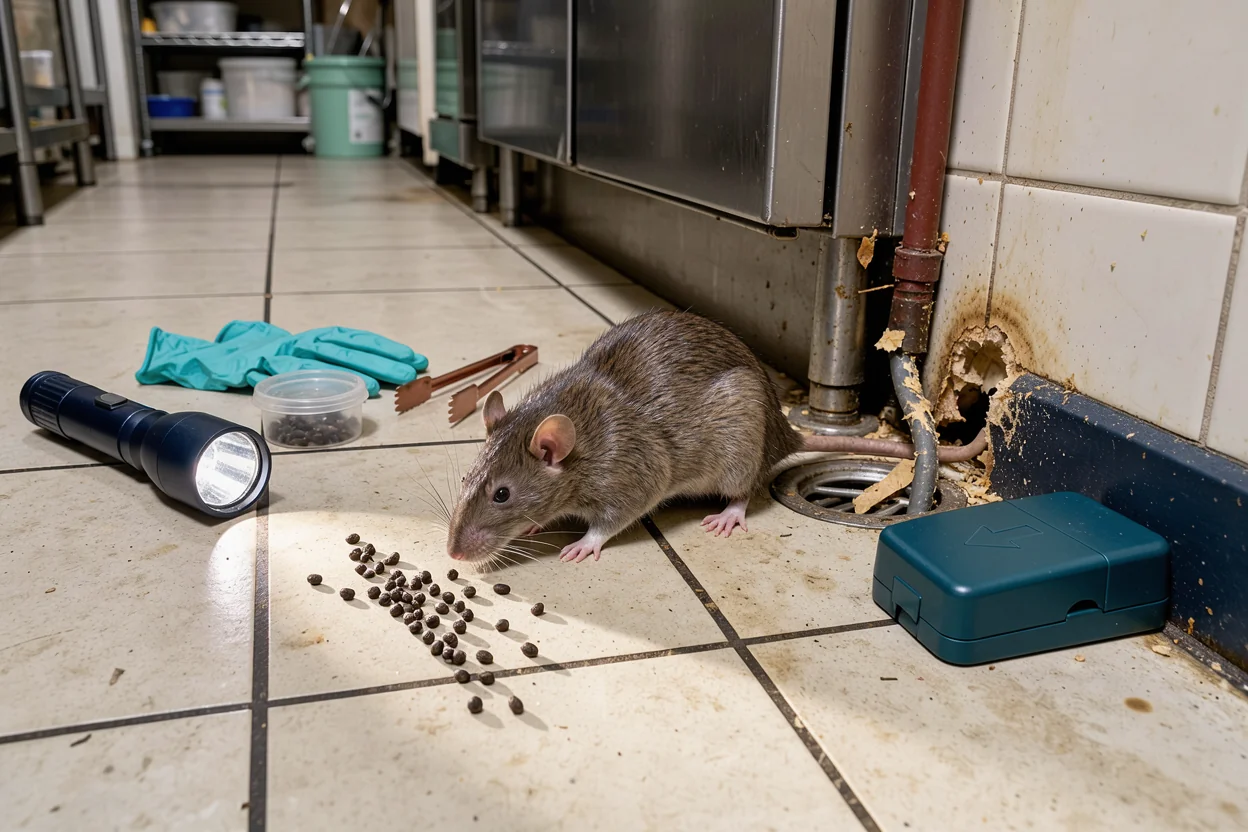
Behind fridges and freezers, the condenser warmth creates a favoured harbourage. Chewed cardboard, shredded packaging used as nesting material and a faint ammonia smell are the usual findings. In the inspection this article describes, the clearest evidence sat exactly there: a drag line of droppings behind an under-counter fridge, leading to a cable hole a previous contractor had punched through the party wall and never sealed.
The dry store and the pass
Dry goods tell their own story. Gnawed corners on flour bags, scattered grain beneath shelving, and urine pillars (small mounds of grease, dirt and urine that build up on repeated routes) indicate feeding activity rather than simple transit. Around the pass, the technician checks the gap between cooking equipment and walls, the space cleaners can rarely reach, and the floor junction behind the fryer line where food debris accumulates nightly.
Drains, risers and the ceiling void
Finally, the structure itself. Many Camden Town premises have Victorian drainage with disused branch connections, and rats travel sewer-to-cellar through failed covers and broken gullies. A technician will lift accessible covers, check the interceptor, and look up: ceiling voids above kitchens carry pipework from flats above, and droppings on top of a suspended ceiling tile often reveal activity the kitchen staff have only ever heard, never seen.
The signs in plain terms, so you can check tonight
You do not need equipment to run a basic version of this check after service. You need a torch, ten minutes and honesty about what you find.
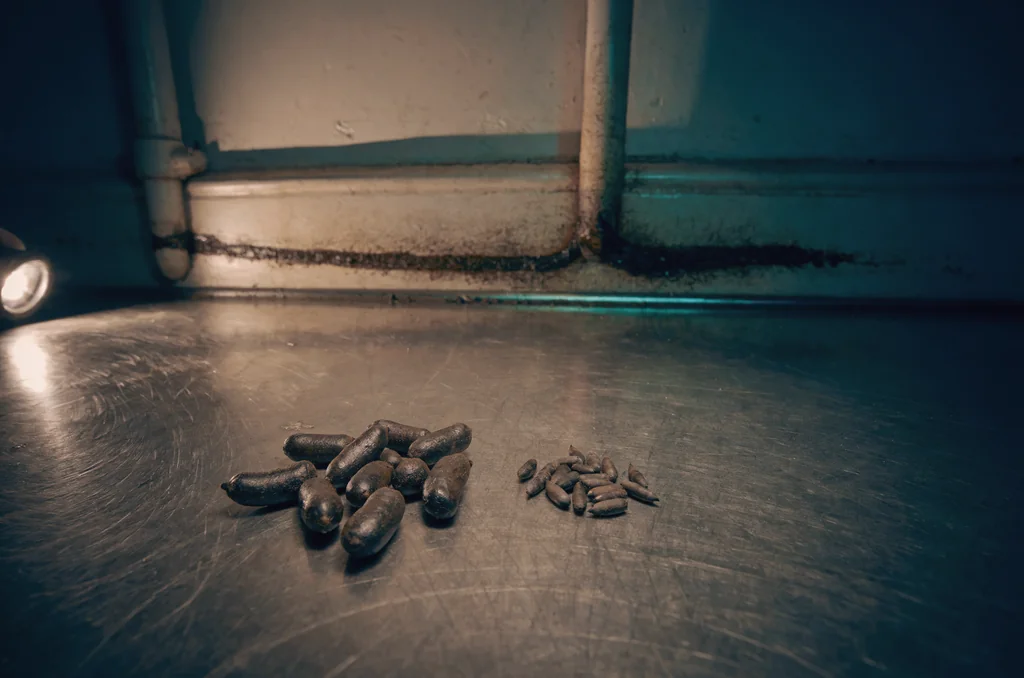
- Droppings. Rat droppings are 10 to 20 millimetres, spindle-shaped and dark. Fresh ones are soft and shiny. Mouse droppings are 3 to 8 millimetres and pointed at the ends, which is the quickest way to tell the two apart. If what you find is small and scattered across many surfaces, you are more likely dealing with mice, and our page on mice control Camden Town covers the differences in treatment.
- Smear marks. Greasy dark streaks on skirting, pipes and the lips of holes. Shine a torch at a shallow angle and they catch the light.
- Gnawing. Rats must gnaw to keep their incisors short. Look at the bottom edges of wooden doors, plastic containers and cable insulation. Fresh gnawing is pale; old gnawing darkens.
- Sounds after close. Scratching in the ceiling void or behind equipment in the hour after the kitchen goes quiet is often the first thing staff report, and it is worth taking seriously even when nothing is found visually.
- Smell. An established infestation has a distinct musky, ammonia-heavy odour, strongest in enclosed voids.
One or two old droppings under a sink that has since been sealed is a record of a solved problem. Fresh droppings appearing between daily checks is a live one.
Why Camden kitchens face more pressure than most
Location does the damage here. Camden Town combines factors that each raise rodent risk on their own, and NW1 has all of them at once.
The market and its surrounding streets run hot food from morning to past midnight, seven days a week. New operators keep arriving: Bleecker opened its tenth London site in Camden Lock Market in August, and Hot Dinners reports Rum Kitchen being revived in Camden under new ownership, while long-standing venues like the Camden Road Arms have reopened after major refits. Every fit-out disturbs the building. Holes get drilled for new services, old ones get abandoned open, and any resident rat population in the walls or drains gets pushed into neighbouring premises for weeks at a time.
The canal adds a permanent wildlife corridor at the bottom of the market. The Victorian building stock adds failed drainage, cellar voids and shared party walls. And the density of premises means one business's poor waste handling becomes its neighbour's infestation. Local pest specialists who work the borough note that businesses near Camden Market, Camden High Street and Kentish Town Road face the highest inspection frequency precisely because of that density. If your kitchen sits just outside NW1, the same pressures apply across the borough, which our Camden rat control page covers in more detail.
What the law expects from a food business
This is the part the food vlogs never mention, and it is the part that ends businesses.
Under the Food Safety Act 1990 and the Food Safety and Hygiene (England) Regulations, a food business must be able to demonstrate due diligence. That phrase has a specific meaning: it is not enough to say you have no pests. You must be able to prove, with records, that you have a proactive system preventing them. An Environmental Health Officer can arrive on any working day, and inspection intervals for higher-risk premises can be as short as six months.
The consequences are real and recent. Last month a restaurant in Sheerness was fined over £15,000 after an inspection revealed a mouse infestation, and London cases regularly reach similar figures once hygiene improvement notices and closures are factored in. Camden's Environmental Health Officers enforce under the Housing Act 2004, the Environmental Protection Act 1990 and food safety legislation, and they expect a documented pest management programme in any food premises.
In practice, a defensible programme for a Camden kitchen looks like this:
- Monthly checks of tamper-resistant bait stations and monitoring points, with a dated log.
- Quarterly proofing surveys of drainage, pipe entries and external doors.
- Waste stored in lidded metal or heavy-duty bins, on a hard surface, away from doors.
- Daily cleaning that reaches behind and under equipment, not just around it.
- A named contractor and a written record of every visit, finding and action.
One more legal point has changed the shape of rodent work recently. The Glue Traps (Offences) Act 2022 makes it a criminal offence in England to set a glue trap for rodents without a licence, so the old habit of leaving sticky boards under the counters is off the table for restaurant staff. Modern integrated pest management relies on monitoring, proofing and targeted treatment instead, which suits food environments anyway because it keeps rodenticide away from preparation areas.
When the same inspection finds something else
Rats are the focus here because they do the most structural and legal damage, but a kitchen walkthrough rarely finds only one issue. Warm, moist voids behind the dishwash and around floor drains suit cockroaches, and German cockroach activity behind the pass is a common secondary finding in NW1 kitchens, particularly in premises sharing walls with late-night takeaways. If staff have reported seeing small tan insects scatter when the lights come on, that is a separate treatment track, and cockroach control Camden Town explains what that involves.
Flies are the other frequent companion finding, especially where waste oil or drain sludge is allowed to build up. Small flies breeding in a floor drain are a hygiene offence in their own right, even with no rodent activity present. The fly control Camden Town page covers drain treatments and the seasonal spikes. The point is that a single inspection visit usually pays for itself in breadth: one technician, one log, every pest risk mapped at once.
Questions restaurant managers ask us
How quickly do I have to act if I find a dropping in the kitchen? Treat one fresh dropping as a live issue. Close off and clean the area, record what you found with a photo and date, and arrange a professional inspection within days, not weeks. A single rat inside a food premises can produce 40 droppings a night, so "wait and see" gives you a week's evidence before you act.
Can I handle proofing myself? Some of it. Escutcheon plates around pipe entries, bristle strips on door bottoms and properly lidded bins are sensible DIY. Drain repairs, cavity work and anything involving rodenticide in a food area belong with a professional, partly for safety and partly because EHOs want to see contractor records.
Will treatment disrupt service? Monitoring-led programmes are designed around trading hours. Technicians typically work before opening or after close, and the child-safe, food-safe approach used in commercial kitchens avoids anything that would compromise preparation surfaces.
Does a rat problem mean a failed hygiene rating? Not automatically, but a discovered infestation with no management records almost always does. Businesses that can show a current contract, a recent visit log and corrective actions fare far better at inspection.
How much does a contract cost compared with a one-off visit? For most small Camden kitchens, a quarterly or monthly monitoring contract costs less over a year than two emergency callouts, and it is the only version that satisfies due diligence.
The check that protects your kitchen
The detail food videos always miss is the one that matters most: nothing in a Camden kitchen stays pest-free on its own, because the pressure outside never stops. The canal, the market, the refits and the drains make sure of that. Your next step is the ten-minute torch check after tonight's service: under the sinks, behind the fridges, along the yard wall. If you find fresh droppings, smears or gnawing, that is the escalation point, and rat control Camden Town is where a same-day inspection starts. Kitchens in neighbouring NW5 streets face the same pressure, and rat control Kentish Town covers that side of the border. Bring the problem forward by a week and it is a proofing job; leave it a month and it is a hygiene rating, a fine and a closure notice.