
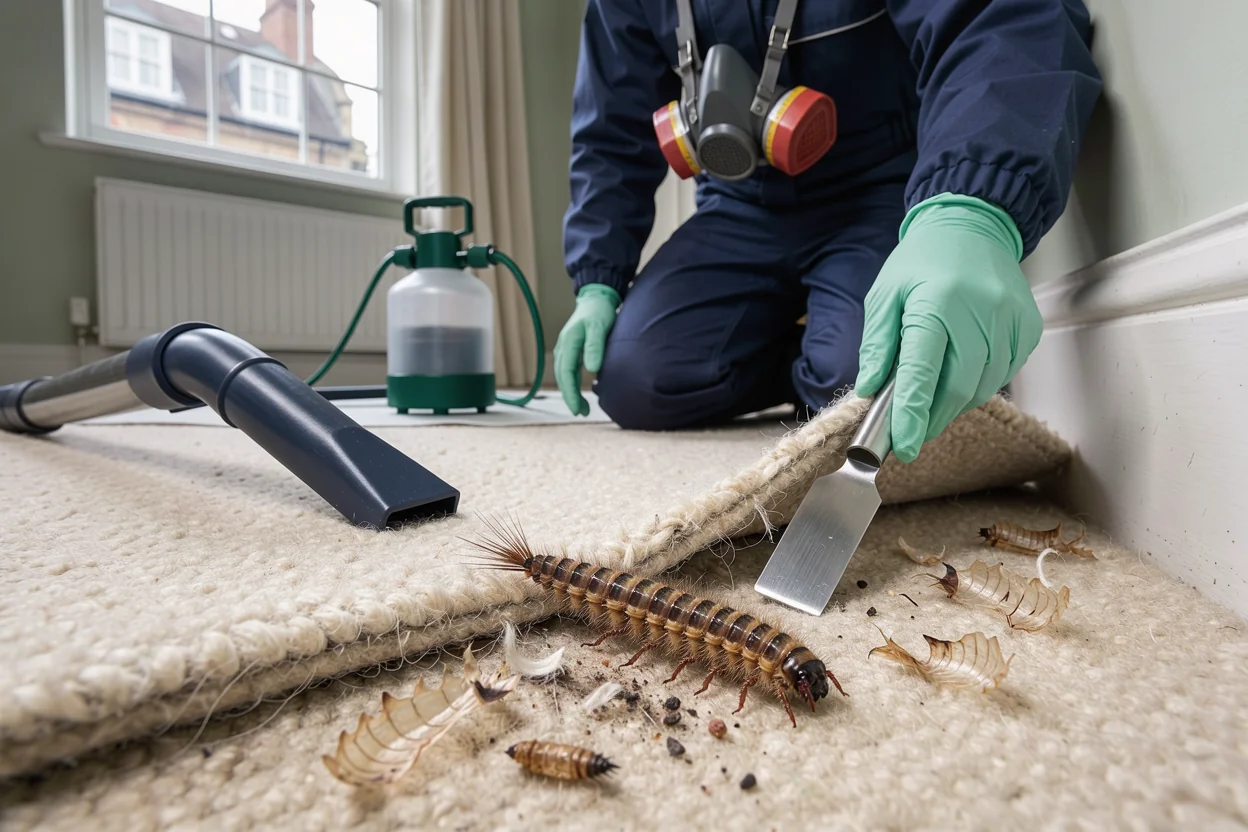
The short answer: to get rid of carpet beetles larvae, you need to vacuum every harbourage point in the property, treat or remove infested textiles with heat or freezing, apply a residual insecticide along carpet edges and skirting boards, and remove whatever is feeding them, including bird nests in the loft. Miss any one of those steps and the infestation restarts, because a single clutch of eggs you didn't find will be feeding again within weeks. That is the whole answer. The rest of this guide explains why so many people do most of it and still find larvae three months later.
Carpet beetle larvae, often called woolly bears, are the damaging stage of the beetle's life. The adult beetle you spot on a windowsill is harmless; the hairy, slow-moving grubs living in the dark under your sofa are the ones eating wool, silk, feathers and stored textiles. Most DIY failures happen because people treat the beetle they can see and not the larvae they can't.
Why the larvae are so hard to reach
Carpet beetle larvae prefer dark, undisturbed places, and a typical UK home offers dozens of them. They feed on keratin, the protein in animal fibres, so their menu includes wool carpets, silk ties, feather cushions, pet hair in carpet pile, dead insects in wall cavities and the felt lining inside old furniture.
The University of California's Statewide IPM Program puts the control problem bluntly:
"Carpet beetles are among the most difficult indoor pests to control because they can find food in obscure places and disperse widely throughout a building." — UC IPM
Two parts of that sentence matter for a homeowner. "Obscure places" means the larvae are rarely where you sprayed. "Disperse widely" means finding larvae in the spare bedroom does not mean the spare bedroom is the source. In UK homes, the source is very often a loft. Adult beetles live outdoors on flowers through spring and summer, then enter buildings to lay eggs. An old bird nest in the eaves, a wasp nest from last year, or a dead squirrel in the roof void gives larvae a permanent food supply, and they wander down through gaps into the rooms below. You can clean the bedroom perfectly and still have a fresh supply arriving every few weeks.
The lifecycle adds to the problem. Depending on species and conditions, the larval stage can last from a few months to well over a year. The NC State Extension guide to fabric pests notes that larvae moult repeatedly as they grow, leaving the bristly, translucent shed skins that most people notice before they ever see a live grub. That long feeding window is why a single missed pocket of larvae keeps producing damage long after you thought the job was done.
The hiding spots that restart infestations
Before you clean anything, you need a map of where the larvae actually are. In a London flat or terrace, the recurring trouble spots are consistent:
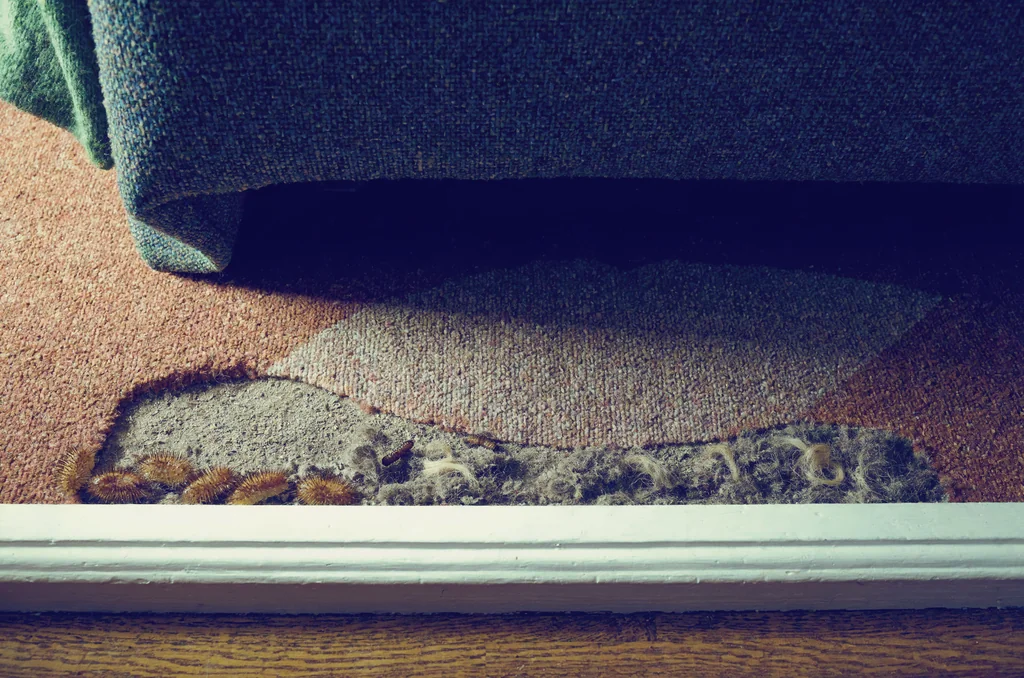
- Carpet edges and beneath fitted carpet. Larvae feed along the tack strip and under the carpet backing where a vacuum head never reaches. Bare or threadbare patches in the pile, especially in corners, are the visible sign.
- Under and behind heavy furniture. The strip of floor beneath a sofa or wardrobe that hasn't moved in two years collects pet hair, lint and dead insects, which is a complete larval diet.
- Air vents and around radiator pipework. Dust and debris accumulate where heat and draughts carry it, and larvae shelter in the gap behind the skirting.
- Wardrobes, drawers and storage boxes. Folded wool, cashmere and silk left undisturbed for a season is the classic indoor food source.
- Lofts, eaves and chimney voids. Bird nests, old wasp nests and accumulated insect debris. In period properties, this is the single most common reason an infestation recurs.
- Felt-lined furniture, piano felt and taxidermy. Older pieces harbour larvae in padding that no surface spray reaches.
The British Pest Control Association has warned homeowners to check exactly these areas, advising regular vacuuming under furniture and in corners, and a close inspection of any holes appearing in carpets, rugs or furnishings. They also note that items made from synthetic fibres are usually safe; it is the natural fibres that are at risk.
Shed skins tell you where to work. A cluster of bristly skins along a skirting board or inside a drawer marks an active feeding zone, so treat those areas as confirmed harbourage even if you find no live larvae.
The removal method that actually works
Once you know the map, the removal sequence matters. Do it in this order, because each step depends on the one before.
Vacuum with intent, not enthusiasm
Thorough vacuuming is the foundation, and it removes eggs, larvae, shed skins and the lint and hair that feed them. But the technique matters more than the frequency. Use the crevice tool along every carpet edge and skirting junction, pull furniture out and vacuum the floor and the underside of the piece, and run the tool into radiator gaps and around vent grilles. UK pest identification guidance stresses one detail most people skip: vacuum bags and contents should be disposed of immediately after use, sealed in a plastic bag and put in an outside bin. Eggs and larvae survive inside the vacuum and crawl straight back out if the bag sits in a cupboard.
One honest caveat: vacuuming alone does not penetrate deep into carpet pile or reach the backing where larvae feed. It is the essential first step, not the whole treatment.
Treat infested textiles with heat or cold
Every washable wool, silk or feather item that shows damage or was stored in an affected area needs processing. A hot wash at 60°C where the fabric allows, or tumble drying on a hot cycle, kills larvae and eggs. For items that cannot be washed, freezing works: seal the item in a plastic bag and leave it in a domestic freezer for at least 72 hours, as advised in this removal guide from How To Pest Control. Dry cleaning is also effective for delicate pieces.
Items that are badly infested, like a cheap wool rug or an old cushion full of feathers, are often better bagged, sealed and thrown out. Martha Stewart's guide to removing carpet beetles for good makes the same point: eliminate the food source first, seal infested items in plastic bags, and only then treat the room. Keeping a heavily infested item as a "test" to see whether treatment worked just leaves a breeding reservoir in the house.
Apply a residual insecticide where larvae walk
After vacuuming and clearing textiles, a permethrin-based household spray applied along carpet edges, skirting boards, behind radiators and inside emptied wardrobes leaves a residue that kills larvae crossing treated surfaces for 8 to 12 weeks afterwards, according to PestPro Index's treatment guidance. Two rules keep this safe and effective. First, the spray must reach where larvae actually move: lift loose carpet edges and treat the underside and the floor beneath, because a mist on top of the pile does nothing for larvae feeding on the backing. Second, never spray surfaces that touch skin directly, like bedding, clothing or sofa seats you sit on. Keep children and pets out of treated rooms until everything has dried, and ventilate as the label directs. For a closer look at which products hold up in practice, our guide to carpet beetle sprays that work compares the main UK options.
If you would rather avoid chemicals, diatomaceous earth dusted into carpet edges and under furniture abrades the larvae's outer coating and dehydrates them. It is slower and messier than a residual spray but genuinely effective in dry, undisturbed spots. Essential oils such as cedarwood, lavender and eucalyptus act as repellents, and pest control specialists quoted by Homebuilding & Renovating recommend sachets of them in wardrobes and drawers. Be clear-eyed about what repellents do: they discourage beetles from settling and laying eggs there, they do not kill an established larval population.
Cut off the source
This is the step that separates a one-off clean from a permanent fix. Check the loft for bird nests, old wasp nests and carcasses, and remove them carefully once any live activity has been dealt with. Block gaps around eaves and pipework where adult beetles enter. Fix or replace damaged window screens. Cut back flowering plants pressed against windowsills in late spring, since adult beetles feed on pollen and fly in through open windows. If the adults cannot get in and find nothing to lay eggs near, the cycle breaks.
Why infestations keep coming back
If you have cleaned thoroughly and larvae reappear within a month or two, one of three things is happening.
The first is an untreated source, almost always a loft, wall cavity or chimney void. Household sprays cannot reach into a roof void with a nest in it, and no amount of bedroom cleaning compensates. The second is an inaccessible pocket: larvae under a fitted wardrobe, beneath tongue-and-groove panelling, or inside a sofa you cannot empty. Vacuuming fails here not because vacuuming doesn't work, but because the tool never reaches the site. The third is timing. Eggs laid before your treatment hatch afterwards, and pupae tucked into crevices are far more resistant than larvae. A single follow-up vacuum and spot treatment four to six weeks after the first pass catches this second wave before it feeds.
Traps help you tell which problem you have. Sticky traps placed in several rooms and checked weekly show where adult beetles are appearing, which points back towards the source. UC IPM recommends exactly this monitoring approach: traps placed throughout a building to reveal where beetles are coming from and whether your control work is holding. If traps in one room keep catching beetles while everywhere else stays clean, that room, or the space above it, still has an active source.
When professional treatment is the sensible option
DIY works well for a contained, first-time infestation where you can reach everything: one room, cleanable textiles, no loft involvement. It stops being the right tool when any of these apply:
- Larvae or damage appear in more than two rooms, which points to a building-level source.
- The infestation has returned after two full DIY cycles, meaning a harbourage is out of reach.
- The property has a loft, cavity walls or disused chimneys you cannot safely inspect.
- The textiles at risk are valuable: antique rugs, tapestries, museum or archive material, or a restaurant or hotel's upholstered stock.
- Anyone in the household is sensitive to the hairs larvae shed, which can irritate skin and airways.
Professional treatment adds two things a household cannot replicate. The first is residual insecticides applied into carpet backing, voids and harbourages with the equipment to reach them, plus a structured re-treatment schedule matched to the multi-year larval lifecycle. The second is heat treatment, which raises room or container temperatures high enough, for long enough, to kill eggs, larvae, pupae and adults in a single visit. UK specialists describe heat as particularly useful for established infestations spread across carpets, furniture, stored textiles and several rooms at once, which is exactly the scenario where sprays fail. If that sounds like your situation, a dedicated carpet beetle treatment visit will usually resolve in days what repeated DIY attempts have failed to shift in months.
Councils across England now routinely signpost residents to British Pest Control Association members rather than providing pest services themselves, so a BPCA-registered technician is the standard benchmark if you go down this route.
Your next seven days
Work through this sequence and you will know, by the end of the week, whether you have beaten it or need help.
- Day one: full inspection. Torch, moved furniture, wardrobe contents checked, loft looked at. Note every spot with shed skins or damage.
- Day two: deep vacuum of every mapped area, bag sealed and binned outside immediately.
- Day three: wash, freeze or bag up all at-risk textiles from affected rooms.
- Day four: apply residual spray to edges, skirting and voids, keeping rooms ventilated and clear until dry.
- Day five: deal with the loft or entry points, or book someone who can.
- Day six: set sticky traps in each previously affected room.
- Day seven and weekly after: check the traps and re-vacuum edges. Fresh larvae or trapped adults after week two means a source remains, and that is your escalation signal.
If you want a simple aid for the inspection, a one-page printable checklist of the harbourage spots above, with a tick box per room, makes the day-one sweep much harder to do half-heartedly.
Questions readers ask about carpet beetle larvae
Are carpet beetle larvae harmful to people? They do not bite, and they are not known to spread disease. The problem is their hairs. The bristly hairs on larvae and their shed skins can irritate skin, causing an itchy rash sometimes mistaken for bed bug bites, and can aggravate airways in sensitive people. The real harm is to property: wool, silk, feathers and leather are all food.
Do carpet beetle larvae go away on their own? Not while food remains. Because the larval stage can run for many months, an untreated infestation persists for a year or more and adults keep laying new eggs each season. Removal requires breaking the cycle, not waiting it out.
Will vinegar or natural sprays kill them? A vinegar wipe-down helps clean surfaces and remove residues that attract beetles, and essential-oil sachets work as repellents in wardrobes and drawers. Neither kills an established larval population. For active larvae, you need physical removal, heat or freezing for textiles, and either a residual insecticide or diatomaceous earth for harbourages.
How do I know the larvae are really gone? Three clean signals: no fresh shed skins, no new holes in natural-fibre items, and sticky traps staying empty across four to six weeks. Since pupae and late-hatching eggs can produce a second wave, treat the one-month mark as the confirmation point rather than the day you finish cleaning.
Do I need to throw the carpet away? Usually not. Carpet that has been properly vacuumed, edge-treated with residual spray and monitored often recovers fully. Disposal makes sense when damage is severe, the infestation is entrenched in the underlay, or the carpet is a cheap synthetic-backed piece in a room you are clearing anyway.