
If you've spotted a steady stream of wasps disappearing under your roof tiles or into the garden shed, you're asking the right question: how to remove a wasp nest without getting stung half to death. The honest answer is that wasp nest removal sits on a sliding scale. A golf-ball-sized nest in April is a very different job from a football-sized colony in August, and the gap between a safe DIY fix and a trip to A&E is smaller than most guides admit.
This article is a curated rundown of the realistic options, not a ranked list of products. Everything below earned its place because it either works in a defined scenario or fails in a predictable way you should know about. I've grouped the options by the job they do: identifying what you're dealing with, treating a small nest yourself, the mistakes that make things worse, and knowing when the job stops being DIY. The scenario each option fits, the evidence behind it, its honest limit, and a plain verdict are all in the text, so you can match the approach to your actual situation.
Confirm it's wasps before you touch anything
The first job is identification, because the right treatment depends entirely on the insect. Three species cause most of the confusion in British gardens.
Common wasps and German wasps build the classic grey, papery nest from chewed wood pulp. You'll see it in lofts, wall cavities, shed roofs, and underground in old rodent burrows. The giveaway is flight traffic: dozens of workers following the same flight path into a single entry point, busiest in warm midday hours.
Hornets are bigger, with a deeper buzz, and their nests look similar but are often higher up in trees or chimneys. A disturbed hornet nest is considerably more dangerous than a wasp nest, and identification errors here are the ones that end badly. If the insects are over 2.5cm long with a brownish-yellow body, treat it as a hornet nest removal service job from the start rather than a wasp job.
Bees are the critical distinction. Honeybees are fuzzier and rounder, bumblebees are larger and very hairy, and neither should be treated with insecticide. Bees are ecologically important, several bumblebee species are in decline, and reputable pest controllers will not destroy a bee colony. If what you have is bees, the route is relocation through bee removal experts or a local beekeeper, not a spray can.
Verdict: spend ten minutes watching flight patterns from a safe distance before doing anything else. If it's bees, stop. If it's hornets, stop faster.
The timing window that decides everything
Wasp nests are annual. A queen emerges from hibernation in spring, builds a starter nest roughly the size of a golf ball, and raises the first workers alone. By July that same nest can hold 3,000 to 6,000 wasps, and by late August the workers become more aggressive as the colony's food supply changes.
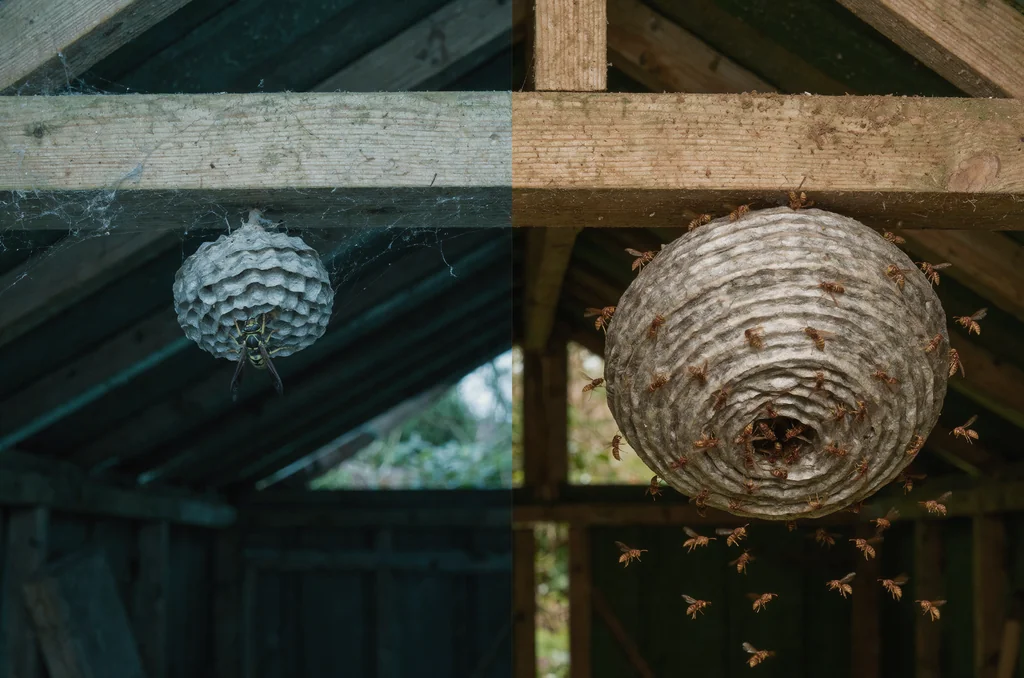
This creates a genuine DIY window. A nest the size of a golf ball or a tennis ball, found in April, May, or early June, contains a queen and perhaps a few dozen workers. The risk is low and the colony hasn't invested enough to defend it fiercely. A nest the size of a football in August contains thousands of workers with a strong defensive response and far more to lose.
Michigan State University's extension guidance on getting rid of wasp nests makes the same point: early-season nests are small, lightly defended, and far simpler to deal with than late-summer colonies. It also notes that all nests die out naturally over winter, which matters for the "do nothing" option covered below.
Verdict: check your loft, shed, eaves, and air bricks each April. Early detection is the single most effective form of wasp control, and it costs nothing.
DIY options that genuinely work on small nests
Two approaches earn a place here, and both come with strict conditions. Neither applies to a large or established nest.
Insecticidal dust or foam on a small, accessible nest
This is the standard DIY method and the one with the best evidence behind it. You apply a wasp-killing dust or foam, sold in UK hardware shops and garden centres, directly into or around the nest entrance. Workers carry the active ingredient inside, and the colony dies over 24 to 48 hours.
Who it fits: a homeowner with a nest smaller than a tennis ball, at ground level or easy ladder reach, outdoors, with a clear escape route. It does not fit nests inside wall cavities (you can't reach the nest itself, and spraying the entry point just drives wasps into the house), nests near children's play areas where drift matters, or anyone with a known sting allergy.
Work at dusk or just before dawn, when workers are inside and sluggish. Wear thick clothing covering everything, including gloves and something over your face. Apply the product per the label, then leave the area immediately. Health Canada's guidance on managing wasps around the home stresses exactly this: treat at night, plan your exit in advance, and never stand on a ladder if you cannot retreat quickly, because a swarm response takes seconds.
The honest limit: label instructions on consumer products are written for small, exposed nests. Once a colony is established inside a cavity, the dose a homeowner can safely apply rarely reaches the queen.
Physical removal of a brand-new queen nest
In April and May, a queen nest hanging from a shed roof or under a windowsill can sometimes be knocked into a bag and disposed of. It has no workers to defend it. Professionals do use manual nest removal at this stage, particularly where insecticides are undesirable, such as near food production or watercourses.
Who it fits: someone who finds a nest smaller than a golf ball, with the queen visibly alone, in an easy-to-reach outdoor spot. The method is simple: a thick bag, a quick detaching motion, seal it, done. The honest limit is that this window is measured in weeks. Miss it, and the option disappears for the rest of the year.
Verdict: for a small, early, accessible nest, insecticidal dust applied at dusk is the best DIY option. For anything else, the risk-to-reward ratio collapses.
The methods that fail and why people keep trying them
A roundup is only useful if it says what was left out and why. These three approaches circulate constantly online and fail in consistent ways.
Blocking the nest entrance. This is the most common homeowner mistake. Sealing the hole does not kill the colony; it traps thousands of wasps inside a cavity that connects to your house. They find another way out, and that way is frequently through a light fitting, a crack in the plasterboard, or a vent into a bedroom. Pest professionals consistently report that blocked entrances turn a manageable external problem into an internal emergency.
Household aerosol sprays on an established nest. A fly spray can kill a wasp in the air. It cannot penetrate a papery nest housing thousands of workers, and the ones it misses become highly aggressive. As one UK pest controller put it in recent press coverage of this exact mistake, disturbing a nest with a domestic spray makes the insects more aggressive and the situation worse. You end up stung, and the nest is still there.
Fire, water, and petrol. Burning a nest is a fire risk to your roof and barely reaches the inside of the structure. Flooding a ground nest with a hose sometimes works on paper and more often produces a soaked, furious colony. Petrol is dangerous, environmentally reckless, and solves nothing a dust wouldn't solve safely.
Verdict: if your plan involves sealing a hole, a supermarket aerosol, or an open flame, the plan is the problem.
What professional treatment actually involves
Professional wasp nest removal earns its place in this list because it outperforms DIY on every established nest, and because most people misjudge what it costs and how it works.
A technician applies a professional-grade insecticidal dust to the nest entrance or directly into the nest, usually with an extension lance. The treatment itself typically takes 10 to 15 minutes. The colony is dead within 24 to 48 hours, and in most cases the nest is left in place rather than physically removed, because wasps never reuse an old nest and the dead structure is harmless. UK prices for a single nest commonly run from £50 to £80, with London and the South East at the higher end.
Who it fits: any nest larger than a tennis ball, any nest in a wall cavity, loft, chimney, or roof void, any nest near where children play or food is prepared, and anyone with an allergy or a low tolerance for being stung. Say you manage a café in Soho and the nest is in the wall above your outdoor seating; that's not a DIY decision at all, it's a same-day call.
The honest limit: it's a cost, and for a genuinely tiny early nest it's more firepower than you need. Some households also prefer to avoid insecticides entirely, which is a legitimate preference but narrows your options to physical removal or tolerance.
Verdict: for any nest you'd describe as "active" rather than "starting", a professional wasp nest removal treatment is the option that actually matches the risk, and it's cheaper than most people assume.
The option everyone overlooks: leaving the nest alone
For nests at the bottom of a large garden, in a hedge well away from paths, or in a disused shed, the best option is often none. Wasps are predators of garden pests, the colony dies naturally with the first hard frosts, and an undisturbed nest in a low-traffic spot poses little real risk. The nest will never be reused next year.
The decision hinges on proximity and people. A nest two metres from where children play, beside a doorway, or anywhere near someone with a sting allergy doesn't qualify for the leave-it option. A nest fifteen metres from the house at the end of a vegetable patch often does. If you're unsure whether your situation sits on the safe side of that line, a quick call to London pest control services will get you a straight answer before you commit either way.
A useful way to think about it: the risk from a wasp nest is almost entirely the risk of disturbing it. A nest nobody touches, in a place nobody goes, is a pest control problem that solves itself by November.
Picking your route by situation
Match the option to the scenario, not to how brave you feel:
- Queen nest, golf-ball size, April to May, easy outdoor reach: physical removal or dust at dusk. DIY is reasonable.
- Small nest, tennis-ball size, early summer, clear escape route: insecticidal dust at dusk. DIY is defensible with full protective clothing.
- Nest inside a wall cavity, loft, or chimney at any size: professional treatment. DIY cannot reach it and entry-point spraying makes it worse.
- Any nest larger than a football, or July onwards: professional treatment. The defensive response at this stage is genuinely dangerous.
- Hornets, or anything you can't confidently identify: professional, full stop.
- Nest far from people with no allergy risk: leave it until winter, then remove the dead structure or leave that too.
- Bees: relocation, never treatment.
One practical extra worth building: a simple pre-summer checklist covering loft, eaves, sheds, air bricks, and wall cavities, done each April. It turns wasp control from a July emergency into a ten-minute spring inspection.
Questions readers ask about wasp nests
Do wasps return to an old nest? No. Colonies are annual and old nests are never reused. A new queen builds a fresh nest each spring, though she may choose a nearby spot if the location is attractive, which is why proofing entry points in winter is worthwhile.
Will a nest in a wall cavity damage my house? Usually not structurally, but a large nest can stain or soften plasterboard as it grows, and trapped wasps chew through plaster to escape into rooms. Treat the colony; don't seal it in.
Is it illegal to destroy a wasp nest in the UK? No. Wasps have no legal protection. Bees are a different matter in practice, since reputable controllers won't treat them, but the law restricts only which pesticides you may use and how, not whether you can remove a wasp nest.
What should I do if I'm stung while checking a nest? Move away calmly and quickly; swatting releases alarm pheromones that attract more stings. A cold compress helps most stings. If you get swelling beyond the sting site, difficulty breathing, or dizziness, treat it as an emergency and call 999, because those are signs of anaphylaxis.
If the nest on your property fits any of the professional-treatment rows above, the next step is a phone call rather than a ladder. Technicians handle these jobs daily, the treatment takes minutes, and it's the option that never ends with a swarm in your hallway.