

Can you see dust mites with the human eye? The short answer is no. House dust mites measure between 0.1 and 0.5 millimetres, and their bodies are translucent, so even a sharp-eyed person staring at a mattress seam in good light will not spot one, according to the ECARF Foundation. What people usually see instead — pale specks on bedding, drifting dust in a sunbeam — is a mix of shed skin, fabric fibres, and dried faecal pellets, not the mites themselves.
That answer leaves a practical problem. If you can't see them, how do you confirm they're there? This roundup covers six tools, in rough order of accessibility, that genuinely help: two that magnify the mites themselves, two that collect physical evidence, and two that confirm the allergen rather than the animal. Each entry explains who it suits, what it can prove, and where it falls short.
Why dust mites stay hidden from the naked eye
Size is only half the story. The Asthma and Allergy Foundation of America puts adult mites at roughly one-quarter to one-third of a millimetre — about the width of a sharp pencil line — and notes that under magnification they look like tiny white bugs with eight legs, relatives of spiders rather than insects. DermNet NZ describes the adult as transparent and 0.25 to 0.33 mm long, with a three-month life cycle running from egg through larva and two nymph stages to adult.
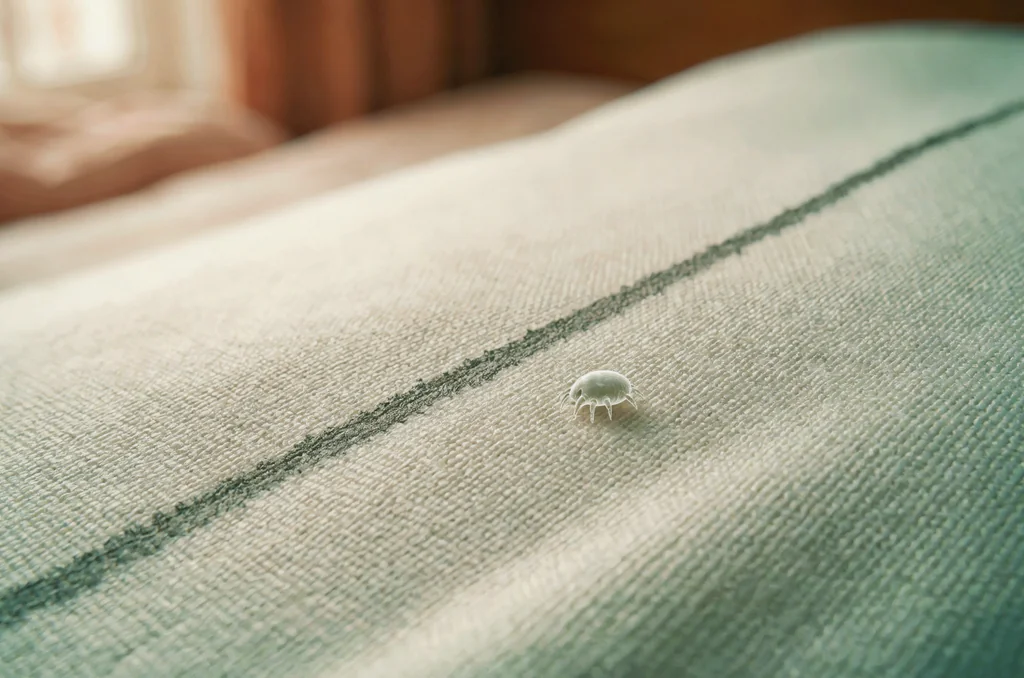
Transparency matters as much as size. A 0.3 mm dark speck might just catch your eye against white cotton; a colourless 0.3 mm mite against cream bedding will not. Fantastic Pest Control makes the same point: their translucent bodies make spotting them almost impossible without assistance, which is why homeowners reach for magnification.
One more fact shapes the whole detection question: dust mites don't bite. The ECARF guidance is clear that they neither bite nor transmit disease. The harm comes from inhaling or contacting allergenic proteins, mostly from the membrane around their faecal pellets, as DermNet explains. So the tools below split into two jobs — seeing the animal, and measuring the allergen it leaves behind.
What earned a place on this list
Every tool here meets three tests. It has to be something a householder can actually buy or access in the UK without laboratory training. It has to produce evidence you can act on, not just a vague sense of unease. And its limits have to be honest — a UV torch that shows you nothing proves nothing.
Excluded outright: smartphone camera zoom on its own (nowhere near enough magnification), sticky insect traps (mites don't wander into them the way crawling insects do), and any spray marketed as a "detector". None of those produces verifiable evidence of mites.
Magnifying tools that show the mite itself
Clip-on phone microscope lenses
A clip-on macro lens turns a phone camera into a 60x–100x viewer for well under £20, and it's the lowest-commitment way to attempt a direct sighting. Orkin notes that adult female mites are around 500 microns long and "not visible without using a microscope", with males smaller still — so the roughly 100x magnification these lenses deliver sits right at the lower edge of what's needed.
Who it fits: curious homeowners who want a quick look before spending more. The method matters more than the gadget. Tap a dark sheet of card against a mattress seam or vacuum the carpet first, then examine the collected debris on the card under the lens in bright light.
The honest limit: image quality at this price is soft at the edges, lighting is fiddly, and a translucent mite in a clump of skin flakes is easy to miss. A negative result proves nothing. Verdict: a fair first experiment, not a confirmation tool.
USB digital microscopes
A USB or Wi-Fi digital microscope (typically £25–£60, offering 50x–1000x on screen) is the cheapest tool that can genuinely show you a mite's eight-legged outline. Fantastic Pest Control's identification guidance is blunt about this: to see dust mites clearly, you need a microscope, and under magnification they appear as miniature eight-legged arachnids.
Who it fits: anyone who wants a definitive visual answer — a parent checking a child's bedding, a landlord documenting a furnished flat, a tenant building evidence. Collect a dust sample with a lint-free cloth from the mattress surface, transfer it to a plain slide or dark card, and scan slowly at 100x–200x.
The honest limit: there's a learning curve. Dust is full of fibres and skin scales, and telling a mite from debris takes patience and a reference image. Some buyers give up after one frustrating session. Verdict: the best visual confirmation tool on this list for the money, provided you accept an evening of practice.
Collection tools that gather the evidence
Tape lifts and dust sampling
Sometimes the smartest move is not to look harder but to collect a sample properly so someone better equipped can look for you. Press clear adhesive tape against mattress piping, sofa creases, or carpet pile, stick it to a slide or dark card, and you have a stable specimen that a pest technician, an amateur microscopy group, or a lab can examine. Guidance on how to check for dust mites covers similar sample-and-inspect approaches using household materials.
Who it fits: readers who tried a magnifier, found ambiguous specks, and want a second opinion without buying more kit. It's also the right move when visible insects are involved, because a clear specimen settles the identification quickly.
The honest limit: a tape lift on its own tells you nothing — it's a courier, not a detector. Its value depends entirely on who examines the sample. Verdict: near-free, pairs well with every other tool here, and the most underused option on the list.
Vacuum collection through filter paper
A step up from tape: vacuum a square metre of mattress or carpet for two minutes through a piece of filter paper or clean tights stretched over the nozzle, then empty the catch onto dark card for microscope examination. Concentrating the sample this way raises the odds of finding mites compared with random tape lifts, because mattress dust is exactly where populations peak.
Who it fits: households with a USB microscope already in hand, and anyone who wants to compare rooms — the main bedroom versus a spare room, say — to see where effort should go.
The honest limit: it still requires magnification to interpret, and a heavy catch of lint can bury the mites. Verdict: the most thorough DIY sampling method, but only useful in combination with tool two or a professional.
Tests that confirm the allergen instead of the mite
Home dust mite allergen test kits
These kits (roughly £15–£35 online) work like a lateral-flow test: you collect dust from bedding or carpet, mix it with a solution, and a test line shows whether dust mite allergen is present above a threshold. They answer a different question from the magnifiers — not "is a mite here?" but "is allergen here at a level worth acting on?" Given that the allergen, mostly from faecal pellets and shed exoskeletons, is what actually triggers symptoms, this is arguably the more useful answer for allergy sufferers.
Who it fits: anyone with year-round sneezing, itchy eyes, or a blocked nose that's worse indoors, who wants to know whether mites are a plausible cause before rearranging the house. It also suits landlords deciding whether a furnished property needs professional attention.
The honest limit: it won't tell you how many mites there are, where they are, or whether levels are dangerous — just present or not above the kit's cutoff. Cheap kits vary in reliability. Verdict: the fastest route to a yes/no answer, and the best fit when symptoms, not curiosity, are driving the search.
Clinical allergy testing
If symptoms are the real concern, the most reliable "detector" isn't in your home at all — it's a GP referral or private allergy clinic. The American Academy of Allergy, Asthma & Immunology answered a striking case from a clinician whose patient believed he could see the mites in his home; the academy's response was that the common house dust mite species would be very difficult to see, and the patient's rash needed proper diagnostic work rather than visual confirmation. Both the AAAAI and AAFA point to skin prick testing and specific IgE blood tests as the standard way to confirm dust mite sensitisation.
Who it fits: people with persistent rhinitis, asthma flare-ups, or eczema that worsens at night or when cleaning. A positive test doesn't count the mites in your mattress, but it confirms whether reducing them is medically worthwhile.
The honest limit: it measures your sensitivity, not your home's mite population. A positive result plus a clean, dry, well-aired home may need no further action. Verdict: the only tool on the list that gives a medically meaningful answer — the right endpoint for anyone whose question started with symptoms.
Which tool fits your situation
| Tool | Rough cost | What it confirms | Main weakness |
|---|---|---|---|
| Clip-on phone lens | Under £20 | Possible sighting | Soft image, easy false negatives |
| USB digital microscope | £25–£60 | Visual ID of the mite | Learning curve |
| Tape lift | Under £2 | Preserved sample for an expert | Needs someone to interpret it |
| Vacuum/filter sampling | Under £5 | Concentrated sample | Still needs magnification |
| Allergen test kit | £15–£35 | Allergen above a threshold | No count, no location |
| Clinical allergy test | GP or ~£50+ private | Your sensitisation | Says nothing about the house |
The scenarios line up like this. Curious and cost-nothing: tape lift plus a clip-on lens. Want to actually see one: USB microscope with a vacuum-collected sample. Symptoms driving the question: allergen kit first, clinical test if it's positive and symptoms persist. Documenting a rental dispute: USB microscope for your own evidence, then a professional inspection for anything you plan to act on formally.
The overlooked option is the tape lift. It costs pennies, and it converts a vague worry into an object an expert can judge — which is exactly the point where DIY detection usually stalls.
If you'd like a ready-made version of that decision, a simple interactive selector — three questions about symptoms, budget, and whether you need visual proof — could route you to the right tool in under a minute. That's the kind of aid worth building for a question this common.
One caution applies across the board: a confirmed mite presence is not an emergency. Mites live in almost every home. What matters is reducing allergen load — hot-washing bedding weekly at 60°C, lowering indoor humidity below 50%, and using allergen-proof encasements — rather than chasing zero mites, which no home achieves.
When specks you can see point somewhere else
Here's a wrinkle worth taking seriously: if you can clearly see tiny moving insects on your bed or furniture, they are almost certainly not dust mites. Booklice, carpet beetle larvae, and young bed bugs are all more plausible candidates for visible specks. The Pest Control FAQ entry on mite visibility reaches the same conclusion — anything plainly visible to the naked eye warrants a different identification.
That distinction changes what you do next. Visible biters, blood spots on sheets, or dark faecal marks along mattress seams point toward bed bugs, and our guide to bed bug treatment options explains how that escalation works. If the pattern instead matches dust mite signs — morning congestion, sneezing fits while making the bed, symptoms easing when you sleep elsewhere — the walkthrough of dust mites in bed covers the seven tell-tale indicators. And when DIY control stops making a dent, a professional dust mite control service can assess humidity, harbourage, and treatment in one visit.
Dust mite questions readers ask most
Can you ever see a dust mite without any equipment? Effectively no. At 0.1–0.5 mm and translucent, they sit below the threshold of unaided human vision. People with exceptional eyesight might register the largest females as a barely-there dot under perfect lighting, but no identification is possible at that level.
What magnification do you need to see dust mites? Around 40x–100x shows a mite as a recognisable creature; 100x–200x shows the eight legs clearly enough to identify it. Standard phone camera zoom doesn't come close.
Do dust mites bite or leave marks on skin? No. They don't bite, and they don't burrow. Rashes attributed to "dust mite bites" are usually allergic reactions to their waste proteins, or a different pest entirely — one reason visible bite marks should trigger a bed bug check rather than a mite hunt.
If I can't see them, how do I know my cleaning is working? Watch the symptoms and the conditions, not the bedding. Fewer morning sneezing fits over several weeks, plus humidity held under 50% and weekly hot washes, is the realistic success signal. An allergen test kit repeated after a couple of months gives a rough objective check.
Should I worry if I find nothing under a microscope? Not necessarily. Dust mites are patchy — concentrated in mattresses, pillows, and sofas rather than evenly spread. A negative look at one sample means little; persistent symptoms with a negative result are a reason to test the allergen or see a GP, not to keep squinting.