

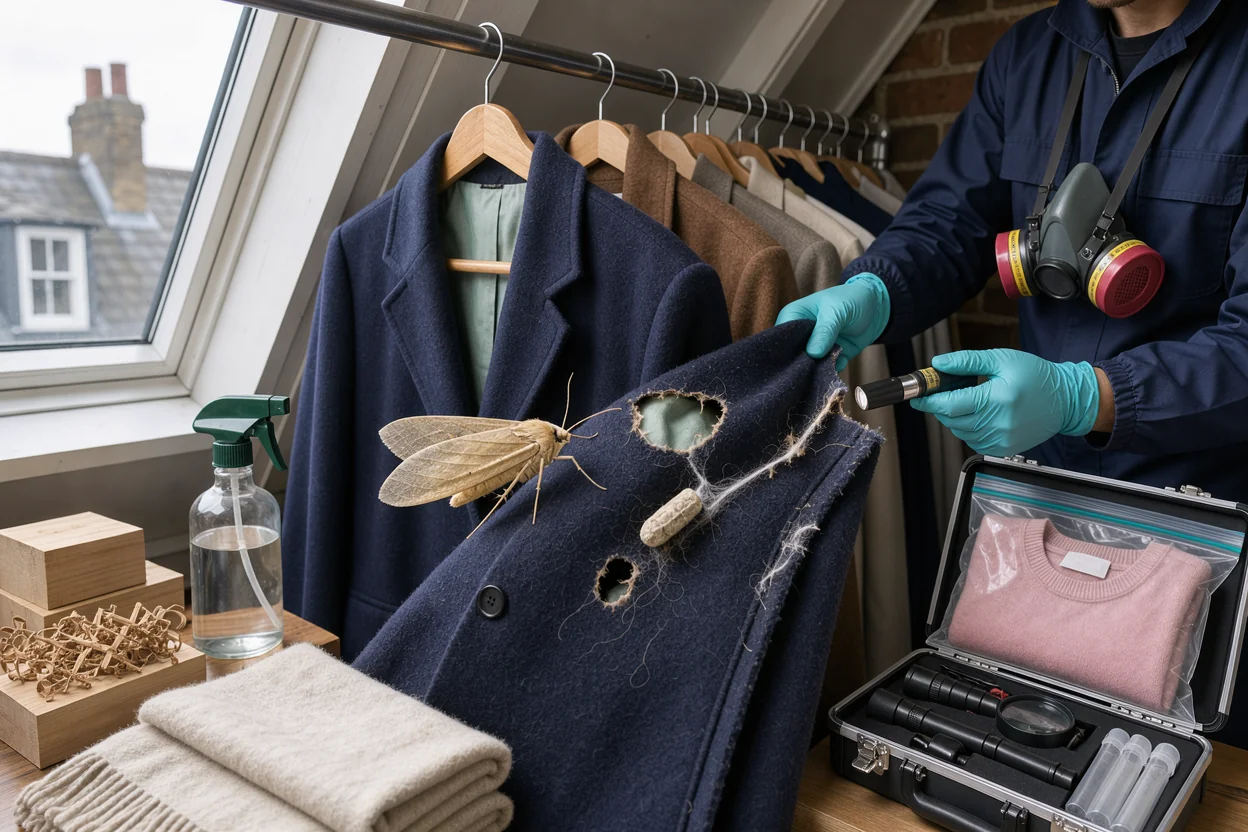
Finding small holes in a wool jumper or a silk blouse is usually the first sign that clothes moths have moved in. The good news is that learning how to get rid of clothes moths naturally is entirely possible without reaching for sprays or foggers, provided the infestation is still contained to a wardrobe or a few drawers. This guide walks through the full sequence a technician would follow: confirming the pest, emptying and deep-cleaning the storage area, treating every garment with heat or cold, wiping surfaces with vinegar, and setting up natural deterrents so the moths do not return. Follow the steps in order and most early infestations clear within two to three weeks.
Confirm it really is clothes moths before you start
The adult moth is not the one eating your clothes. Clothes moth larvae feed on keratin, the protein found in natural fibres such as wool, cashmere, silk, leather and felt, and the larvae do almost all of the damage. Adult moths live only to mate and lay eggs, so swatting the small buff-coloured moths fluttering near the wardrobe does nothing to stop the chewing.
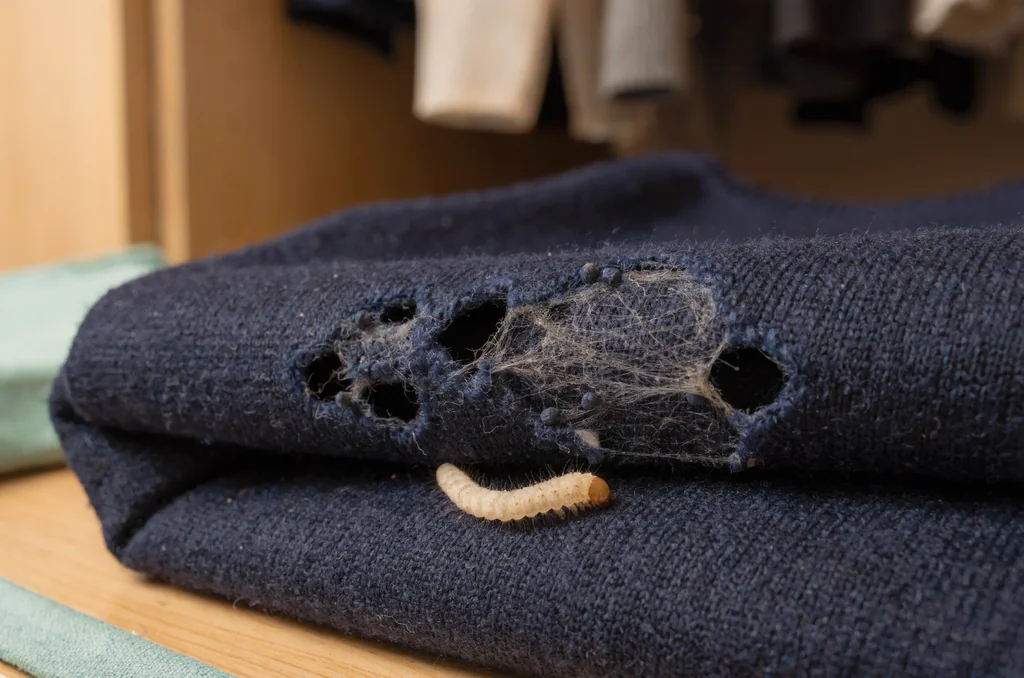
Before you commit a weekend to the full clear-out, check for the evidence that separates clothes moths from other fabric pests:
- Irregular holes in wool, cashmere, silk or fur items, often in folds, under collars or along seams where the fabric sits undisturbed.
- Cream-coloured larvae, roughly 1cm long, or empty silk cases left behind as they grow.
- Fine webbing or silken tubes on stored garments, plus gritty pellets of frass (larval droppings) that match the fabric colour.
- Small golden-buff moths, around 6 to 8mm long, that scuttle away from light rather than flying toward it.
One common mix-up is with carpet beetle larvae, which also eat natural fibres but look like tiny hairy grubs and leave shed bristly skins. If what you are finding matches that description, a carpet beetle larvae guide will serve you better, because the treatment routes differ.
Also check where the infestation sits. Moths favour dark, warm, undisturbed spots, so the back of a rarely opened wardrobe, a chest of out-of-season knitwear, or the carpet edges under a bed are far more likely than a rail of clothes you wear weekly. If you are unsure whether what you have found is active or old damage, reviewing the early clothes moth signs before you start will stop you treating a problem that has already moved elsewhere.
Empty the wardrobe and vacuum every crevice
The first real action, and the one you can start within the next 30 minutes, is emptying the affected storage completely. Every hanger, every folded item, every box on the top shelf comes out. Clothes moth eggs are glued to fibres and tucked into corners, and a partial clear-out leaves the infestation alive.
Once the wardrobe or drawers are empty:
- Vacuum the interior thoroughly with a crevice tool. Work along shelf edges, drawer runners, joints, screw holes and the floor track of sliding doors, because eggs and larvae hide in exactly these gaps.
- Vacuum the floor around and beneath the furniture, including carpet edges and skirting boards. Larvae wander away from the feeding site to pupate, so the infestation is almost always wider than the visible damage.
- Empty the vacuum canister or remove the bag immediately, seal it in a bin bag, and put it straight in an outside bin. A vacuum full of live eggs left in a cupboard is a nursery, not a solution.
- Vacuum-seal or bag any garments you suspect but have not yet treated, so nothing escapes into clean rooms while you work.
Guidance from the British Pest Control Association places this physical removal stage at the centre of any moth treatment, chemical or otherwise. Skipping it is the single most common reason natural methods appear to fail: the deterrents go in, but the eggs stay behind and hatch a fortnight later.
Treat every garment with heat or cold
With the storage area clean, the next job is killing eggs and larvae inside the clothing itself. You have three natural options, and which one you use depends on the fabric.
Washing at 50°C or higher
A hot wash is the most reliable option for anything the care label allows. Washing at 50 to 60°C kills eggs, larvae and adults in one cycle. Pest control experts quoted by the Express on moth removal recommend washing infested clothes at a minimum of 50 degrees alongside thorough vacuuming of storage areas, which matches the two-stage approach in this guide. Dry the items on a hot tumble cycle where possible for a second hit of heat.
Freezing for delicates
Cashmere, silk, vintage pieces and anything labelled cold-wash-only go to the freezer instead. The method is simple but the details matter:
- Seal each garment in a plastic bag, pressing out as much air as you can.
- Freeze at -18°C for at least 72 hours. UK pest evidence guidance confirms that 72 hours at -18°C kills all life stages, including eggs.
- Let the garment return to room temperature inside the bag before opening, so condensation forms on the bag rather than the fabric.
For heavily infested or sentimental items, repeat the cycle once: freeze, thaw for 24 hours, freeze again. The thaw tricks any surviving eggs into hatching, and the second freeze kills the larvae before they can feed.
Steaming and dry cleaning
A garment steamer passed slowly over both sides of the fabric kills eggs and larvae on contact and suits structured coats and suits that cannot be washed. Dry cleaning also kills all moth life stages, so it counts as a legitimate natural-adjacent route for tailored pieces, though it adds cost per garment.
Do not forget the non-wardrobe items. Wool rugs, felt crafts, feather accessories, sheepskin and even taxidermy all host clothes moth larvae, and leaving one infested rug untreated reseeds the whole room.
Wipe surfaces with vinegar and sunlight where you can
Once the wardrobe is empty and the clothes are in treatment, clean the surfaces themselves. Wipe every shelf, rail, drawer and wall joint with a cloth dampened in a 50:50 solution of white vinegar and water. Vinegar is mildly acidic, shifts the residue eggs are glued with, and leaves a smell moths avoid. Let everything dry fully before anything goes back in.
While the furniture stands empty, give it sunlight if the layout allows. Dragging a chest of drawers into direct daylight for a few hours is genuinely useful: larvae avoid light, and any stragglers will abandon a sunlit, freshly wiped surface. Natural removal methods like these work best stacked together rather than used one at a time, a point echoed in the comprehensive natural moth guide from Woman & Home.
One honest caution: vinegar cleans and discourages, but it does not penetrate cracks where pupae sit. Treat it as the final pass after vacuuming, not a substitute for it.
Set up cedar, lavender and airtight storage
Now the wardrobe earns its second job: keeping moths out. Natural deterrents do not kill anything, so they only make sense after the cleaning and garment treatment above. Within that role, though, they work well.
Cedar. Cedar wood releases an oil that repels adult female moths looking for somewhere to lay eggs. Cedar blocks, rings over hanger hooks, or a cedar-lined drawer all help, but the oil fades within months. Sand the surfaces lightly each season to refresh the scent, and replace blocks yearly. As the team behind natural moth repellents at The Butler's Closet notes, cedar is a protective measure for clean clothes, never a cure for an active problem.
Lavender and herbs. Dried lavender sachets, or mixes of lavender with rosemary, thyme and cloves, mask the human scents that attract egg-laying females. Consumer advice from Which? on clothes moths points out that deterrents such as cedarwood or lavender help prevent moths returning but do nothing against larvae already present, so hang sachets only after the clear-out is complete. Refresh them every few months; a dry, scentless sachet is decoration.
Airtight storage. This is the strongest natural defence of all. Out-of-season knitwear and sentimental pieces go into vacuum-sealed bags or lidded plastic boxes with tight seals. Moths cannot eat what they cannot reach. Knitters on UK forums swear by ziplock bags plus a freezer week for any new skein of wool, and the logic is sound.
Pheromone traps. These sticky traps release a synthetic version of the female moth's scent, luring males onto the adhesive and breaking the breeding cycle. They are pesticide-free, safe around children and pets, and double as a monitoring tool: if the trap keeps catching moths after your treatment, something nearby is still infested. Hang one on the clothes rail and check it weekly for two months.
Keep the wardrobe unwelcoming for the next season
Clothes moth season in UK homes peaks in April and May, when warming temperatures speed up the moth lifecycle, but centrally heated homes let moths breed year-round. That means prevention is a habit rather than a one-off.
- Vacuum wardrobes, drawers and the carpet beneath them monthly, not just when you spot a moth.
- Rotate and shake out stored clothes every few weeks. Larvae hate disturbance, and items worn or moved regularly are rarely attacked.
- Wash or dry clean garments before long-term storage. Sweat, skin cells and food traces make fabric far more attractive to egg-laying females.
- Keep humidity down where you can. Moths prefer humid rooms, so a dehumidifier or good ventilation in a damp spare bedroom removes part of the attraction.
- Quarantine second-hand finds. Vintage wool, charity-shop cashmere and inherited rugs are classic entry routes. Bag and freeze them for 72 hours before they meet your wardrobe, and read up on clothes moth sources if you keep finding moths despite a clean house.
A simple interactive idea that works well here is a seasonal wardrobe checklist: a printable tick-list for April and October covering wash, freeze, vacuum, sachet refresh and trap check. Ticking through it twice a year is far easier than repeating a full clear-out.
The point where natural methods stop working
Natural removal succeeds when the infestation is young and contained. It struggles when the moths have spread beyond one storage area, and being honest about that threshold saves you months of frustration.
Call for professional help when any of these apply:
- Pheromone traps keep catching fresh moths six to eight weeks after a thorough clear-out.
- Damage appears in several rooms, or in fixed textiles like carpets, underlay, upholstered furniture or curtains you cannot freeze or wash.
- The property is a period flat with floor voids, fitted wardrobes or thick wool carpeting, where eggs sit beyond the reach of a household vacuum.
- You are a landlord or manage a commercial space such as a hotel, where infestation spreads between units and documented treatment matters.
At that stage, technicians use residual insecticides approved under the UK Biocidal Products Regulation, or professional heat treatment that raises the affected rooms above 50°C for several hours to kill every life stage at once. Industry reporting from Merlin Environmental on moth callouts notes that heat treatment is the preferred professional option for established infestations, precisely because it reaches the voids and fixed textiles that home methods cannot. If your clear-out has not held the line, a targeted professional clothes moth treatment is the practical next step rather than a second round of lavender.
Clothes moth questions readers ask most
Do natural methods actually kill clothes moths, or just repel them? Both, depending on the method. Heat (washing at 50-60°C, steaming) and cold (72 hours at -18°C) genuinely kill eggs, larvae and adults. Cedar, lavender and vinegar only repel or clean. A complete natural treatment needs at least one killing method and one deterrent.
How long does it take to get rid of clothes moths naturally? Expect two to three weeks for the active work: a day for the clear-out and vacuuming, 72 hours per freezing batch, then several weeks of trap monitoring to confirm no new moths are emerging. Eggs already hidden can hatch up to a month later, so keep traps out for at least eight weeks before declaring victory.
Will lavender sachets on their own fix an infestation? No. Sachets discourage egg-laying females from settling, but they do nothing to eggs and larvae already feeding in your knitwear. Hang them after treatment, not instead of it.
Are natural methods safe around children and pets? Yes, which is the main reason families choose them. Freezing, hot washing, vacuuming, vinegar, cedar and pheromone traps carry no chemical residue. That is a meaningful advantage over insecticide sprays in bedrooms and nurseries, and it is why natural removal is worth attempting first whenever the infestation is small.
Why do the moths keep coming back every spring? Usually because one reservoir stayed untreated: a rug under a bed, a bag of old wool in the loft, a second wardrobe. Warmer spring temperatures speed up the moth lifecycle, so a hidden pocket of eggs becomes a visible swarm fast. Find and treat the last reservoir, and the annual return stops.