
For UK households asking what kills dust mites instantly, heat can kill mites it reaches, but there is no dependable instant treatment for an entire mattress or room. Allergy UK recommends washing suitable bedding at 60°C or above. The practical aim is to reduce living mites and the allergens they leave behind, rather than expect immediate relief after one treatment. Its house dust mite guidance explains why cleaning remains necessary after mites die.
Online advice published or updated in 2026 makes that distinction particularly relevant. Some pages describe treatments as instant while recommending hours of exposure. The laboratory papers cited for heat and washing are older studies, and they do not establish a new comparison of every household method.
The 2026 advice exposes a problem with instant claims
Dust mite advice can sound contradictory because publishers use “instant” to describe different outcomes: killing an exposed mite, treating a washable item or reducing a bedroom’s allergen load.
A Dr. Killigan’s article updated on 13 February 2026 says there is no truly instant and safe solution. Its updated dust mite advice instead centres on repeated washing, cleaning and moisture control. That is household guidance, rather than a report of new comparative laboratory testing.
The Ecology Works takes a different editorial approach. Its household treatment guide describes freezing as an instant method, then specifies 24 hours in a freezer. It also describes a treatment whose population effects begin over days.
Those timings matter. A method that requires overnight exposure cannot provide a result within seconds. A treatment applied to one cushion also cannot establish what happened elsewhere in the room.
For readers, the useful questions are more precise than whether a method works:
- What temperature or concentration was used?
- How long did the mites experience that condition?
- Was the test performed on exposed mites or inside household fabric?
- Did it measure mite survival, allergen removal or changes in symptoms?
These are separate measurements. A positive result for one does not establish the others.
The practical interpretation is that speed claims need a stated endpoint. Before following an instant-treatment recommendation, look for its exposure time and the exact item it is intended to treat.
Hot washing has laboratory support, with clear limits
Hot washing has stronger support than a vague promise that a cleaning product will clear every mite from bedding immediately. Its advantage is that a suitable textile can undergo a complete washing process.
What the washing study actually measured
In August 1989, A. Andersen and J. Roesen published research in Allergy using simulated washing programmes on cultures of Dermatophagoides pteronyssinus, a house dust mite species.
Their laboratory washing study reported that a minimum washing temperature of 58°C was needed to kill all mites under the tested conditions. Washing also reduced the protein pool, but remaining allergens retained activity in the researchers’ assay.
The finding supports two distinct points: temperature affected survival, and reducing allergen material did not mean every remaining allergen had become inactive.
It does not provide an instant-kill time for every washing machine, fabric or load. Nor does it show that treating sheets removes mites from the mattress underneath them.
Translate the finding into a safe laundry decision
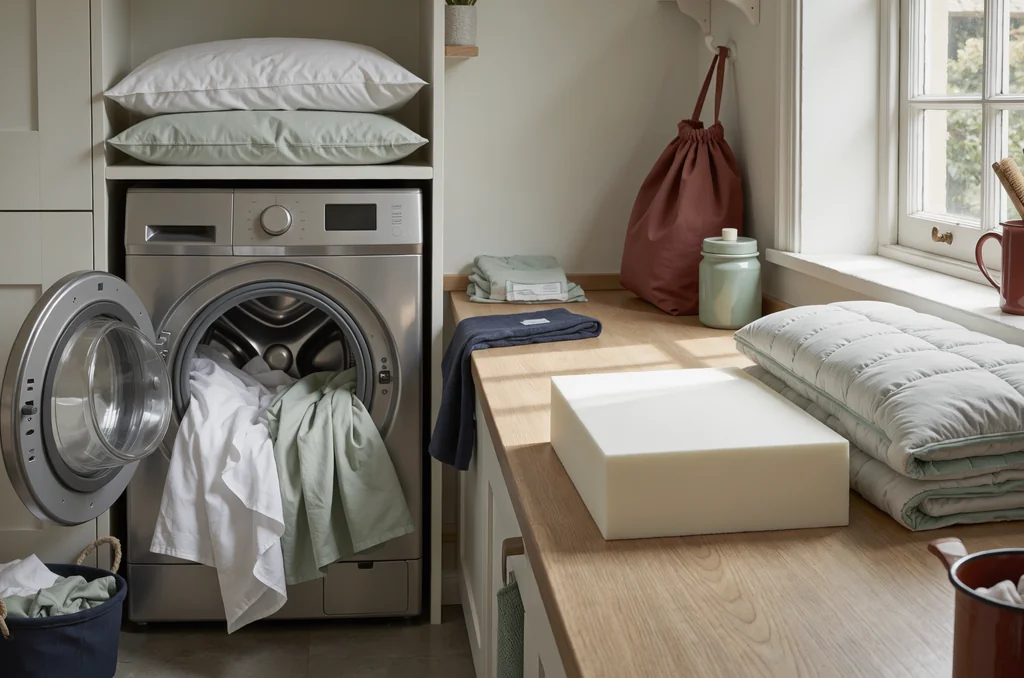
For suitable bedding, the practical UK recommendation is a 60°C wash. Check the care label first, then use the machine programme intended for that temperature and follow its loading instructions.
Start with sheets, pillowcases and duvet covers. Treat pillows, duvets and mattress protectors as separate items because their care instructions may differ. A sheet’s permitted temperature tells you nothing about a foam pillow.
If an item only permits a cooler wash, continue washing it according to its label. Describe that as cleaning, rather than assume it has achieved the same mite-killing result as a hot programme.
Plan the drying stage before starting a large load. Keep clean bedding separate from items awaiting washing, and return it to the bed only when thoroughly dry.
For a household with limited laundry capacity, prioritise the bedding currently in use. Put the next wash date on the calendar rather than attempt an unmanageable whole-house reset.
Steam treatment depends on reach and drying
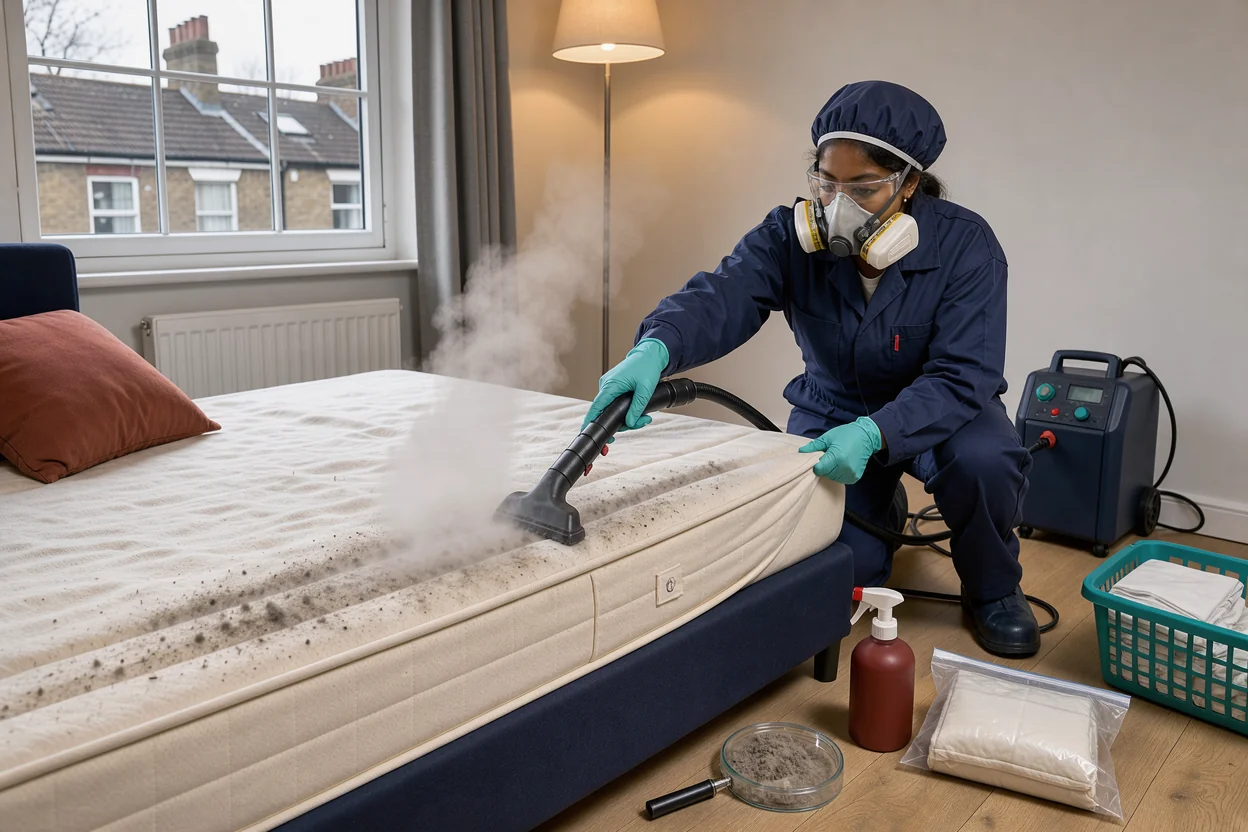
Steam can kill mites where sufficient heat reaches them, but a hot appliance nozzle does not establish the temperature throughout a mattress or cushion.
Carpet advice does not cover every mattress
Allergy UK recommends high-temperature steam cleaning for carpets that cannot be removed. Its carpet cleaning recommendations also include regular vacuuming with suitable filtration.
That recommendation needs to be applied to the correct surface. A carpet, an upholstered chair and a foam mattress have different care requirements. Check the manufacturer’s instructions before choosing steam.
A brief pass over a mattress gives no reliable evidence that its filling received the required heat exposure. Surface treatment should therefore be described by its actual reach, without extending the result to the entire item.
If someone proposes a steam treatment, ask which materials it suits and how they will establish an adequate drying period.
Decide whether the item can dry before bedtime
Drying is part of the treatment decision. Before wet cleaning, consider the room’s ventilation, the item’s thickness and whether it must be used again that evening.
For example, treating a mattress shortly before bedtime leaves little room for delays. A spare sleeping arrangement makes the decision easier, but the care label still governs whether steam is suitable.
Avoid repeated passes simply because the first treatment produced no visible change. Dust mites are too small for an ordinary visual inspection to verify treatment success.
For an item without clear steam-cleaning instructions, obtain suitable cleaning advice before adding heat and moisture. Keep it out of use until it has dried fully.
Freezing is an overnight option for small items
Freezing is a possible route for some small fabric items that cannot tolerate a hot wash. It is a timed treatment, and the cleaning job continues afterwards.
For washable soft toys that cannot be washed at 60°C, Allergy UK advises placing them in a plastic bag in the freezer for at least 12 hours, then washing at the recommended temperature. Its soft toy cleaning advice makes the sequence explicit: freezing followed by washing.
Keep that recommendation within its stated scope. It does not establish that briefly chilling a bulky duvet will treat every part of its filling.
Check the toy’s instructions before beginning, particularly if it contains electronics, batteries or materials with special care requirements. Choose another cleaning route where the manufacturer advises against freezing or washing.
For an appropriate washable item, organise the job as a complete sequence:
- Check the care instructions and place the item in a suitable bag.
- Allow the full recommended freezer period.
- Wash it at its permitted temperature.
- Dry it completely before returning it to use.
The final wash matters because freezing does not physically rinse away deposited material.
A household freezer also has practical limits. Treat manageable items rather than compress a large textile into an available corner and assume it received an equivalent treatment.
Record when the item went into the freezer. An overnight method needs a start time, not a judgement based on how cold its surface feels.
Spray claims need a named product and a suitable surface
A spray’s suitability depends on its instructions and evidence for the intended use. “Kills mites” is too broad to establish that it belongs on a pillow or mattress.
Fabric suitability needs to be explicit
Redi National’s article dated 29 June 2026 discusses fabric products expressly labelled for bedding or upholstery. Its bedding treatment advice also cautions against improvised household remedies.
That is US guidance. It cannot establish that a particular product is suitable or authorised for the same use in Britain.
For a UK household, read the actual product label. Check the target pest, permitted surface, application directions, drying requirements and any restrictions relevant to the people using the room.
Permission to treat a carpet should not be extended to pillows. Instructions for a hard bed frame should not be transferred to sheets.
Ask what the claimed result means
A useful treatment claim names the product and describes its tested outcome. Look for an exposure time and a clear distinction between killing mites and reducing allergen material.
Ask whether the evidence concerns exposed mites in a test container or mites within fabric. If a claim concerns allergens, ask what was measured and whether the result applies to the intended surface.
Avoid making a stronger mixture or combining products to chase a faster result. Follow the label’s directions.
When considering dust mite treatment, first identify the item that needs attention and the outcome sought. A washable cover, an unsuitable mattress and an unexplained skin complaint require different decisions.
If the instructions do not clearly permit the proposed use, keep the product off that surface.
Dead mites leave a second cleaning job
Killing mites leaves deposited material to manage. This explains why a treatment can affect mite survival without producing immediate improvement for someone sensitive to the allergens.
Happy Maids makes that distinction in its mite and allergen explanation. It describes deposited allergens as material that remains after the living animal dies.
The practical implication is to include removal or containment in the cleaning plan. Washing a suitable removable cover is a different task from treating the item beneath it.
For a mattress, separate the decisions: how its removable parts can be cleaned, what its care instructions permit and whether a suitable allergen barrier is appropriate.
Vacuuming also needs a defined purpose. Collecting surface dust is useful housekeeping, but the contents of a vacuum container cannot establish that every mite inside upholstery has been removed.
The same caution applies to inspection equipment. Information about dust mite detection tools can help explain what a device measures, but a treatment should be judged against that measurement’s limits.
A dust photograph, a sample of living mites and an allergen measurement answer different questions. Ask which one is relevant before paying for a test.
After cleaning, keep a record of the item treated, method used and date. That gives any later assessment a clear starting point.
The bedroom checks households can make this week
A manageable bedroom routine turns the evidence into specific jobs without promising a permanently mite-free home.
Identify the laundry and building constraints
Begin with the bed currently in use. Read each care label, identify what can take a hot wash and set aside items needing another route.
Then inspect the room’s practical constraints. In a period property, persistent window condensation, a leak or a poorly working extractor should prompt a separate building check. Cleaning upholstery does not repair those faults.
Allergy UK’s guidance includes ventilation and humidity control. For a household assessment, record readings at comparable times rather than rely on how the room feels during one visit.
Landlords can make the work more reviewable by keeping dates and photographs for reported damp, ventilation faults and repairs. Avoid using an occupant’s allergy symptoms alone as proof of a particular building defect.
An item selector could help organise the routine: enter the care temperature, item size and drying options to identify a suitable washing, freezing or specialist-cleaning route.
Give each job a finish point
Keep the first week achievable:
- Wash suitable bedding and allow it to dry completely.
- Follow the care instructions for pillows, duvets and removable covers.
- Choose a manageable time for the room’s normal cleaning.
- Record ventilation faults or damp that needs investigation.
- Schedule the next bedding wash before putting the laundry away.
For shared accommodation, assign responsibility for communal upholstery and report maintenance issues in writing. A clear division of jobs prevents everyone assuming someone else cleaned the item.
Keep symptom observations separate from cleaning records. Note whether discomfort occurs on waking, during cleaning or elsewhere, without treating that pattern as a diagnosis.
If breathing, nasal or skin symptoms remain troublesome, discuss them with a healthcare professional rather than repeatedly increasing the intensity of cleaning.
Questions about bites, mattresses and persistent symptoms
Some dust mite concerns change the appropriate response. Establishing what the problem is can prevent unnecessary treatment.
Do dust mites cause bite marks?
House dust mites do not bite. Their allergens can be associated with irritation, but skin marks alone do not identify their cause.
Guidance about dust mites in bedding can help readers understand the concern. It should not turn symptoms into proof of an infestation.
If you find a visible insect, photograph it clearly for identification. Seek medical advice for unexplained or persistent skin symptoms.
Should the mattress be replaced immediately?
Replacement should not be the automatic first response to suspected mites. Start with the mattress’s condition, its cleaning instructions and the washable bedding around it.
A new mattress does not resolve an untreated moisture problem or establish the cause of symptoms.
If replacement becomes necessary, choose an item with care requirements the household can maintain. Deal with any identified damp or leak before putting it into use.
Why might symptoms continue after cleaning?
Continued symptoms cannot establish whether mites survived a treatment. Deposited allergens may remain, and the symptoms may have another cause.
Avoid repeating steam or spray applications solely because someone still feels uncomfortable. Review what was actually treated and whether the intended cleaning sequence was completed.
Bring the symptom pattern and cleaning record to a healthcare appointment if the problem persists.
What evidence would justify changing the routine?
A useful update should state the treatment conditions, exposure time and measured outcome. Evidence from occupied homes would answer different questions from a laboratory survival test.
The cited Allergy UK factsheet gives no timetable for a forthcoming revision. Watch for dated guidance that explains whether a new method reduces allergens or improves symptoms, alongside its effect on mites.
For today, check the bedding care labels and schedule the next suitable wash.