
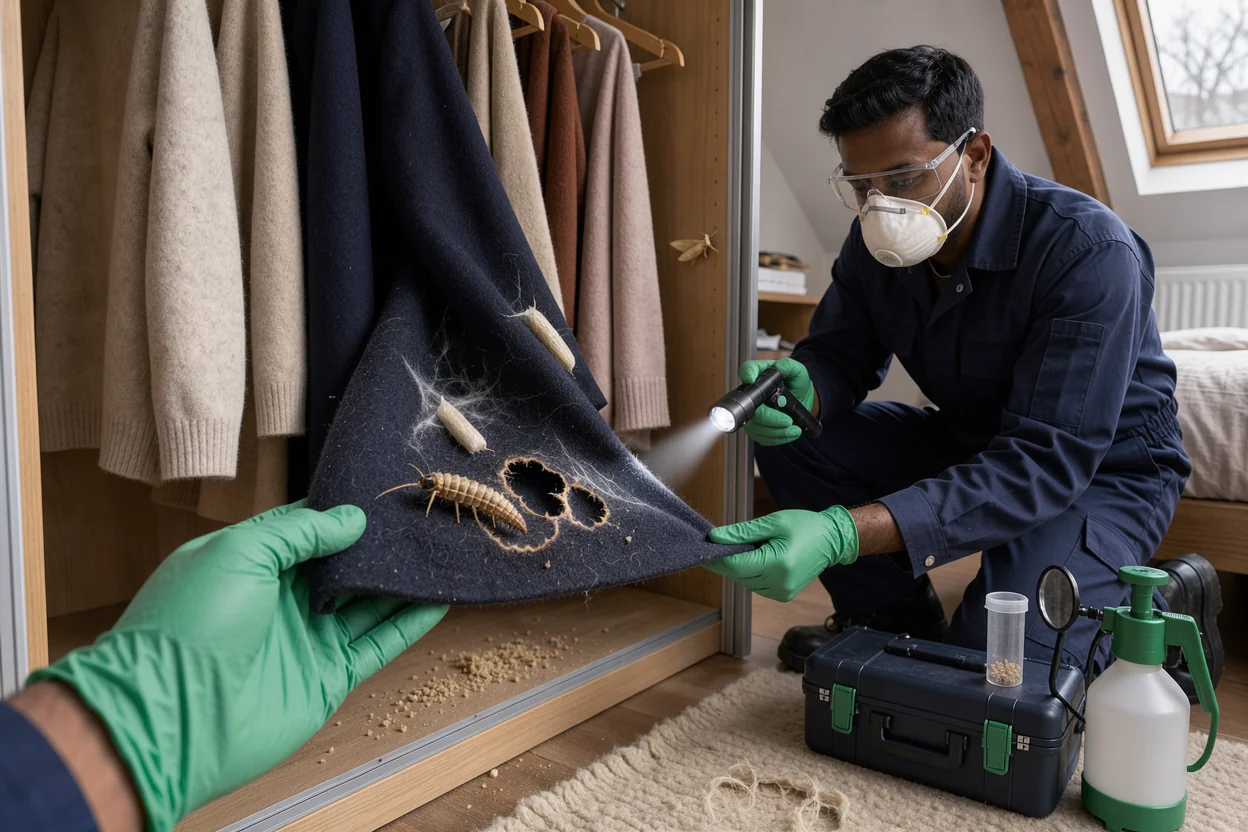
If you searched "what do clothes moths look like UK" after finding a hole in a favourite cardigan, the short answer is: smaller and plainer than you expect. An adult is a pale golden-buff moth roughly 6 to 8 mm long, with narrow, silky wings folded flat over its back. The part that eats wool is its larva, a creamy-white grub up to about a centimetre long with a brown head, curled inside a fold of fabric.
That gap between what you see and what does the damage shapes this list. The signs are ranked by how much each one proves once you are holding it. How early it shows up matters less. The sign most people notice first, a moth drifting past a lamp, is some of the weakest evidence going, while a live larva settles the question in seconds. In London's period flats, with warm radiators, fitted wool carpets and boxes tucked into loft space, these signs can go unnoticed for months. Each entry below says what you are likely to see, where it misleads people, and what to do next. Work down in order and stop when you have a confident answer.
1. Cream-coloured larvae with brown heads in the folds
Larvae come first because they are the pest and the proof in one. Look where fabric is pressed against fabric and kept in the dark: inside sleeve cuffs, under collars, along the seams of a wool coat, and in the creases of a jumper that has sat folded since spring. A larva is soft, glossy and cream-white with a darker head, and it stays still until disturbed.
Expect to find only a few. Larvae spend their time buried in the fibres, and they can feed for anything from a couple of months to a year or more, depending on warmth and food. A centrally heated flat tilts that towards the quick end. Shake the garment over a white sheet or pale tea towel, because anything cream-coloured that wriggles stands out against the cotton at once.
The usual slip is mistaking a carpet beetle larva for a moth one. If your find is stubby, striped and covered in bristles, it is a beetle grub, and the advice on carpet beetle larvae fits better. One confirmed moth larva is enough to act on. Seal the garment in a bag and check every other wool item stored within arm's reach of it today.
2. Silk webbing and tunnels along seams
Webbing is the second sign because few other things explain it. Larvae of the webbing clothes moth spin fine silk as they feed, leaving silvery patches or short tunnels on the fabric, often clogged with fibre fluff and tiny gritty droppings in the colour of whatever they have eaten. Brush a patch with a fingertip and it feels like a wisp of cobweb mixed with sand.
Look under folded knitwear, in the crease of a scarf, and behind a lapel. Under heavy furniture, webbing in the pile of a wool carpet looks like a patch of flattened, dusty fluff, and the same goes for the edge of a rug where it meets the skirting board. The grit is a better clue than the silk. A spider's cobweb hangs loose across a corner, whereas moth silk lies on the fabric itself with fibres stuck in it.
The limit is that a short dusty thread is easy to write off as lint, and old webbing can stay behind long after the larvae have gone. Photograph the patch, brush it away, and check the same spot in a week. Fresh silk or new grains mean feeding is still going on, and webbing with grit in it counts as confirmed.
3. Rice-shaped silk cases dotted with fibres
Third place goes to cases, which point to a particular culprit, the case-bearing clothes moth, and which pass easily for fluff. Its larva builds a silk tube up to about a centimetre long and decorates it with scraps of the fabric it is eating, so the case matches the garment's colour. The larva drags the case along and pokes its head out to feed.
On wool, felt, fur trims or the underside of a rug, a case looks like a slightly lumpy grain of rice. Cases also turn up along carpet edges and under heavy furniture, where they look like specks of the carpet itself. Occupied cases shift a few millimetres between checks. Empty ones are thinner and paler and can stay stuck for months. This sign matters most to anyone with a fur collar, a felt hat or a wool rug, since those are the textures this species favours.
Many people flick a case away as fluff and carry on. Rest a suspect one on a pale plate and watch it for a minute or two. A twitch means a larva is inside, and a moving case deserves the same urgency as the larva in item one.
4. Ragged holes and thinned patches in wool
Holes sit fourth because they prove damage without naming the culprit. Moth holes are irregular and vary in size, and the fabric around them often looks grazed: bare, thin patches where larvae have shaved the surface of knitwear without breaking through. The edges look frayed rather than cut. Holes tend to cluster near folds and seams, where larvae shelter. Cashmere, merino, silk, fur and felt go first. Clean cotton and synthetics are usually left alone, although sweat, food marks and wool blends change that.
Plenty else makes holes. Carpet beetle larvae damage wool in much the same way, and a snagged zip or a worn elbow can mimic moth damage. A hole with no webbing, grit, cases or larvae nearby may simply be wear. Turn the garment inside out too, because larvae favour hidden surfaces and a jumper can look fine from the front while the inner face is grazed.
Date-stamp photos of the damage. New holes in other garments from the same wardrobe a few weeks later tell you the cause is still active, while a hole that never changes is history.
5. Small buff moths that scuttle rather than swoop
Adults land mid-list because they are the most reported sign and the least reliable. A clothes moth is small, roughly 6 to 8 mm, evenly pale gold or straw-coloured with a silky sheen and narrow wings fringed with fine hairs. The common species has a tuft of reddish hairs on top of its head. The case-bearing species is slightly browner, with faint dark flecks on the forewings. Neither has bold patterns.
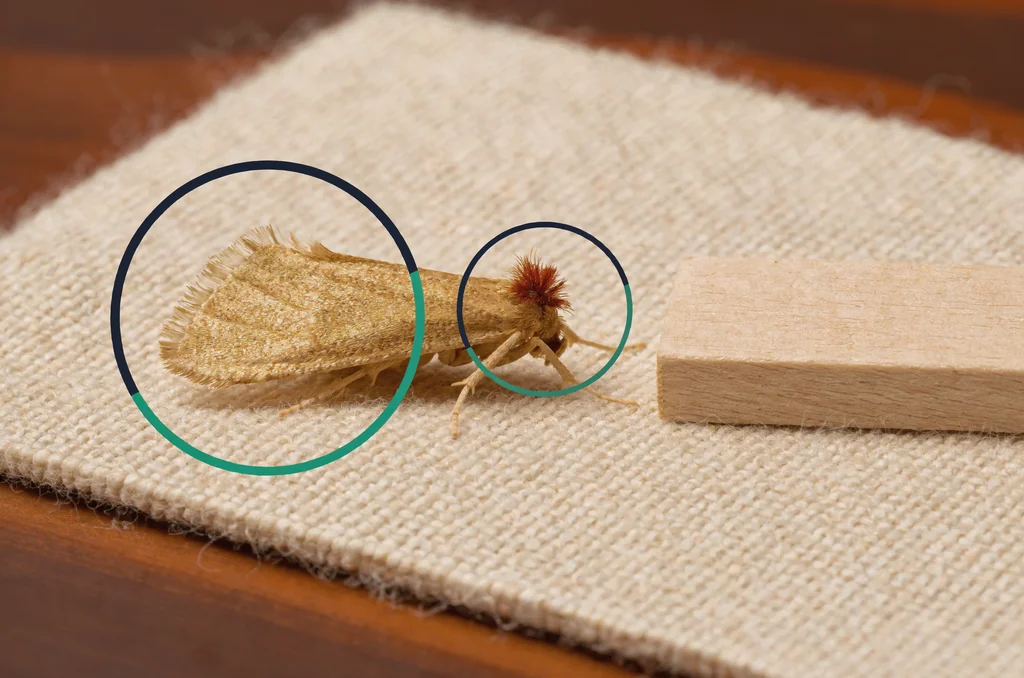
Behaviour is the better clue. Clothes moths avoid light, run across fabric in short bursts, flutter weakly when disturbed and settle somewhere dark. A large moth circling your ceiling light on a summer evening is almost certainly something else, usually a bigger, harmless garden visitor. The kitchen moths with two-tone wings that turn up around dried food are a different group again.
One moth proves little, since it could have wandered in from next door. Repeated sightings in one room, especially near a wardrobe, are another matter. A sticky pheromone trap placed in the wardrobe, which draws male moths onto the card, confirms the species cheaply, though it will not clear a problem. Catch one under a glass, compare it with the description above, then go looking for the larva from item one. If you want to know how it got in, where clothes moths come from covers the usual routes.
6. A stale, musty smell from the wardrobe
Smell is sixth because it is vague and easy to blame on something else. A well-established infestation can leave a stale, musty note in a wardrobe or drawer as droppings, silk and shed larval skins build up. Damp does exactly the same, and it is often the likelier cause in homes with cold external walls, poor airflow behind fitted wardrobes or winter condensation. A musty wardrobe sends you looking for damp as readily as for moths.
Treat a smell as a prompt to inspect. If the odour fades after airing and nothing turns up, damp was the probable cause. If it comes back and there is grit on the shelf, you have your answer. Subtler cues like that grit, and the faint silk beneath folded knitwear, are covered in more detail in overlooked clothes moth signs.
Empty the wardrobe onto a clean sheet, open a window for an hour and check the shelf for gritty droppings before you decide anything.
7. Damage that clusters in dark, undisturbed corners
Location comes last, yet it explains everything above it. Clothes moths pick places where nothing moves and no light reaches: the back of a wardrobe, the bottom drawer, boxes under the bed, a suitcase of winter coats, a rolled-up rug, the felts inside a piano. They also work through the fluff, hair and pet fur that gather along skirting boards and in the gaps between floorboards, which period properties have plenty of. Clothes you wear weekly are rarely hit, because movement, brushing and light disturb the larvae.
The pattern is the clue. Holes in the jumper at the back of the shelf and none in the one you wore on Monday point to a hidden source. Knitwear that was worn and then stored unwashed carries the biggest risk, since skin oils, sweat and food marks draw moths in. Say a wool coat goes into a loft box in March after a winter of wear and is never cleaned. By October it has sat undisturbed for seven months, which is long enough for a few larvae to do real harm.
Check the dark places first: the lowest drawer, the back of the wardrobe and anything stored in a box. Damage there, with a clean front row of clothes, is the classic pattern.
Questions people ask after finding a moth in a wardrobe
Does finding clothes moths mean my home is dirty?
No. Clothes moths reach tidy homes on second-hand clothing and vintage rugs, on pet hair and fluff, and from roof spaces where old bird nests sit. What lets them settle is unwashed natural fibre stored in the dark.
Do clothes moths eat cotton and polyester?
Rarely. Larvae want keratin, the protein in wool, silk, fur, feathers and felt. Clean cotton, linen and synthetics are usually left alone, but stained fabric can be damaged, and larvae will chew through a blend to reach the wool in it.
How fast do clothes moths ruin clothes?
Usually over weeks to months, depending on warmth and how many larvae are feeding. Because the activity is hidden, most people only find it after the damage has built up. That delay is why the early signs above are worth learning.
Will mothballs or lavender fix it?
No. Scent may put egg-laying moths off, but it does not kill larvae already in the fabric. Heat and cold do: wash at the hottest temperature the care label allows, dry clean, or freeze bagged items at -18°C for at least a week. Mothballs are strong-smelling chemicals and need to stay out of reach of children, pets and food areas.
Do I have to bin the affected clothes?
Seldom. Washing, dry cleaning or freezing deals with the larvae and eggs in the fabric. Bin only what is beyond repair, and bag it before carrying it through the house so nothing drops out on the way.
When a wardrobe problem needs more than a hot wash
Where a thorough clean is enough
If the signs are confined to one wardrobe and a handful of garments, you can usually deal with it yourself. Wash or freeze what can take it, empty and vacuum the wardrobe, wipe down the shelves, and keep a pheromone trap in place for a few weeks to see whether anything turns up. The methods in natural clothes moth remedies suit this stage well, and they keep harsh chemicals away from children and food.
Signs the problem has outgrown one wardrobe
Established infestations behave differently. Book an inspection when you find live larvae or cases in more than one room, webbing or grazing on a wool carpet or rug, or fresh damage returning within a month or so of a thorough clean. Fitted carpets, shared roof voids and floorboard gaps in London period flats and terraces give moths a food supply nobody can put through a washing machine. A pest controller's job is to find that hidden source and treat the surfaces and voids you cannot launder, which is the point where professional clothes moth treatment becomes worth paying for. It also makes sense for stored furs, antique textiles and anything you could not replace.
A two-minute tally helps you decide. As a rule of thumb, score one point for each of the seven signs you can confirm, plus one for every extra room involved. A low score in a single wardrobe suits a home clean. A score that keeps rising, or any confirmed sign in a second room, is the moment to book.
If you do one thing today, shake your most valuable wool item over a white sheet and look for larvae. People overreact most to the lone moth by the window, which says very little by itself. It deserves a quick wardrobe inspection tonight and a sticky trap this week, and nothing more drastic.